If you want the short version: pick Neon for serverless, spiky, or branch-heavy workloads; pick AWS RDS for PostgreSQL (or Aurora) when you need a boring, always-on production database with deep AWS integration; pick Supabase when you want a Postgres plus auth, storage, and APIs in one box. Everything else on this list earns its place for a narrower reason — cheapest, time-series, or single-vendor simplicity.
Managed Postgres in 2026 isn't one market anymore. It split into two: the old-guard "rent a tuned instance" model (RDS, Cloud SQL, Azure, DigitalOcean, Crunchy) and the newer serverless model that separates storage from compute and bills you for what you actually burn (Neon, Aurora Serverless v2, increasingly PlanetScale). Knowing which camp you're in matters more than any single feature.
How we picked
We weighted five things: real published pricing (free tier, idle cost, scale behavior), production-readiness (HA, backups, point-in-time recovery), the developer workflow around it (branching, preview databases, migrations), regional and egress economics, and the catch — the line item that surprises people on the second invoice. TechRiseUps runs its own Postgres in production (Supabase plus self-hosted on WaseerHost), so we read these pricing pages the way an operator does, not a brochure. All prices below are pulled from official vendor pages as of June 2026 and will drift; check the source before you commit a budget.
 Neon pricing, June 2026
The ranked list
1. Neon — best serverless Postgres, best for branching
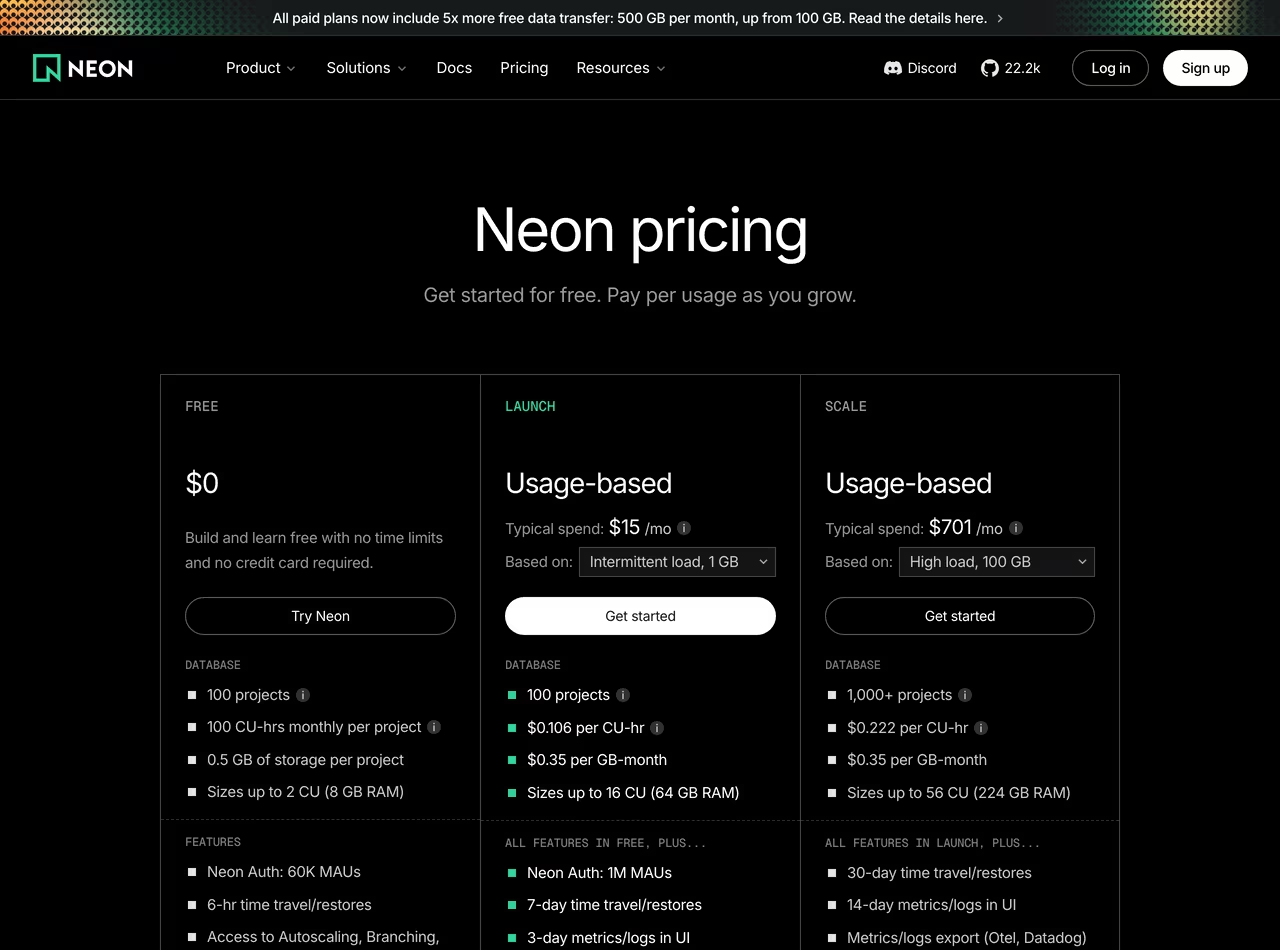
Neon separates storage from compute, which is why two of its headline tricks actually work instead of being marketing: scale-to-zero (your compute idles down after 5 minutes and you stop paying for it) and instant database branching (a branch is a copy-on-write fork, not a dump-and-restore). The free plan gives you 0.5 GB storage and 100 CU-hours per project with up to 10 branches and no credit card. The pay-as-you-go Launch plan bills compute at $0.106 per CU-hour and storage at $0.35 per GB-month, with no minimum; the Scale plan moves compute to $0.222 per CU-hour and lets you configure scale-to-zero down to one minute. (Neon pricing)
The catch: usage-based billing punishes always-on, steady-load apps. If your database never goes idle, scale-to-zero buys you nothing and a fixed-price competitor is often cheaper. Neon shines on spiky, bursty, and dev/preview traffic — not a 24/7 transactional core that's pinned at 80% CPU.
2. AWS RDS for PostgreSQL / Aurora — best always-on production database
This is the default for a reason. RDS gives you managed PostgreSQL on provisioned instances (Graviton-based db.t4g and db.r-series deliver the best price-performance), automated backups, Multi-AZ failover, and point-in-time recovery, all wired into IAM, VPC, CloudWatch, and the rest of AWS. Aurora is the higher-performance, higher-cost sibling; Aurora Serverless v2 auto-scales in 0.5-ACU steps and bills per ACU-hour (roughly $0.12 per ACU-hour, region-dependent). (Amazon RDS pricing, Amazon Aurora pricing)
The catch: complexity and egress. Pricing is region- and instance-dependent, I/O-Optimized vs Standard storage changes the math, and cross-AZ plus internet egress is where bills quietly balloon. If your data leaves AWS, read our breakdown of cloud egress fees and how to stop paying the exit tax before you architect anything chatty.
3. Supabase — best Postgres-plus-backend
Supabase is real Postgres with auth, row-level security, storage, edge functions, realtime, and auto-generated APIs bolted on. The free plan gives you 500 MB database, 50,000 monthly active users, and 5 GB egress across up to 2 projects — but free projects pause after a week of inactivity, so it's not for anything that has to stay warm. Pro is $25/month and includes $10 in compute credits (enough for one Micro instance), 8 GB database, 100K MAUs, and 7-day backups; Team is $599/month for SOC2/compliance and longer retention. pgvector is included on every plan, which matters if you're doing embeddings. (Supabase pricing)
The catch: the $25 sticker isn't the real bill. Most production apps land at $35–75/month once compute upgrades and egress are counted, and the free-tier pause makes it a poor fit for low-traffic production unless you upgrade.
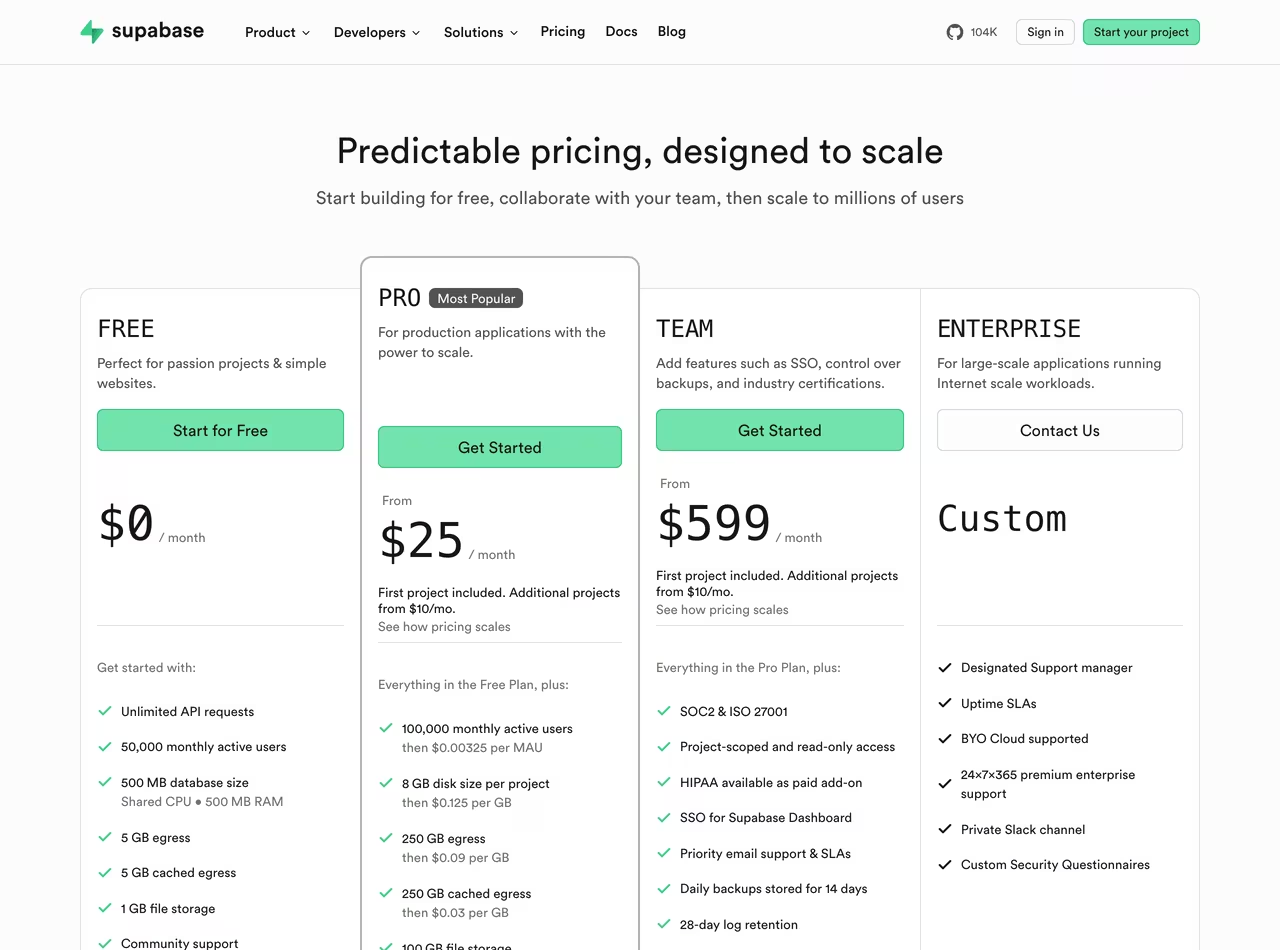 Supabase pricing, June 2026
4. PlanetScale for Postgres — best for serious scale on a budget
PlanetScale's Postgres offering went generally available and brought its operational pedigree with it. Single-node production starts at $5/month, highly available clusters from $15/month (the PS-5 HA tier), and PlanetScale Metal — locally-attached NVMe instead of network storage, for predictable low-latency IO — starts at $50/month. Billing is prorated to the millisecond. (PlanetScale Postgres pricing)
The catch: no free tier, and egress is metered (production branches include 100 GB/month, then $0.06–0.238 per GB on AWS depending on region). It's aimed at teams who'll grow into Metal, not hobbyists kicking tires.
5. Crunchy Bridge — best no-surprises managed Postgres
Crunchy Data are long-time Postgres specialists, and Crunchy Bridge is the least gimmicky option here. Hobby plans start at $9/month, Standard (production) from $70/month, and Memory-optimized from $240/month, on AWS, Azure, or GCP. Storage is a flat $0.10 per GB, backups and connection pooling (PgBouncer) are included, and there's no charge for ingress or egress — a genuinely rare feature. HA doubles the cluster price on any production plan. (Crunchy Bridge pricing)
The catch: no scale-to-zero, no branching, and the Hobby tier runs on lower-grade hardware without pooling, so it's not for production. You're paying for plain, well-run Postgres — which for a lot of teams is exactly the point.
6. Google Cloud SQL / AlloyDB — best for GCP-native and analytical Postgres
If you're already on Google Cloud, Cloud SQL is the straightforward managed Postgres (SSD storage around $0.17–0.22 per GB-month, HA roughly $0.34). AlloyDB is Google's performance-tuned, PostgreSQL-compatible engine for demanding transactional and analytical workloads: compute is priced per vCPU (around $0.066 per vCPU-hour standard) and per GiB of memory, with storage near $0.34 per GB. (AlloyDB pricing)
The catch: AlloyDB carries roughly a 39% markup over Cloud SQL Enterprise Plus and storage costs about double. It's worth it for heavy analytical or HTAP workloads, overkill for a standard CRUD app.
7. DigitalOcean Managed PostgreSQL — best simple, predictable pricing
Flat, legible, no surprises. Single-node clusters start at $15/month (1 GiB RAM); HA starts at $30/month for the primary plus a matching standby. General-purpose 8 GiB lands around $120–130/month, 16 GiB around $240–260. Extra storage is $0.21 per GiB-month, and pricing is consistent across regions. (DigitalOcean PostgreSQL pricing) Good if you want one monthly number you can predict to the dollar.
The catch: no scale-to-zero, no branching, and ceiling-limited compared to hyperscaler tiers. Fine for small-to-mid apps, not where you'd run a massive fleet.
8. Tiger Cloud (Timescale) — best for time-series and metrics
Built by the TimescaleDB team, Tiger Cloud is managed Postgres tuned for time-series and event data: columnar compression up to 95%, hypertables, and built-in search, with consumption-based hourly compute and storage billing and a usable free plan. (Tiger Cloud pricing) If you're storing IoT readings, metrics, or financial ticks, this is purpose-built. For a general-purpose app, the time-series specialization is weight you don't need.
A quick word on Azure: Azure Database for PostgreSQL Flexible Server starts at about $12.41/month for a B1ms burstable instance (1 vCore, 2 GiB), billed hourly. It's the obvious pick if you're already standardized on Azure; for everyone else it rarely wins on price or features. (Azure PostgreSQL pricing)
Which to choose, by use case
- Serverless / spiky traffic: Neon. Scale-to-zero and per-CU billing mean idle costs nothing — exactly right for variable load.
- Always-on production core: AWS RDS (or Aurora for scale), or Crunchy Bridge if you want the same reliability with zero egress charges and simpler pricing.
- Enterprise / compliance: Aurora, AlloyDB, or Supabase Team — HA, certifications, and support contracts that procurement will accept.
- Cheapest viable production: PlanetScale single-node at $5/month or Crunchy Hobby at $9/month for non-critical work; DigitalOcean at $15 when you want HA-ready predictability.
- Branching / preview environments: Neon, full stop. Copy-on-write branches per pull request are the feature no one else matches cheaply.
- Time-series: Tiger Cloud.
One cost lever sits underneath all of these and most pricing pages bury it: where your bytes physically live and move. Compute is getting cheaper while the hardware under it isn't — see why your VPS bill is rising in 2026 and the RAM shortage behind it — and the cheapest sticker price loses to a noisy egress line every time.
FAQ
What is the best managed PostgreSQL?
There's no single winner — it depends on your traffic shape. For most teams in 2026 the answer is Neon (serverless and spiky), AWS RDS/Aurora (always-on production), or Supabase (Postgres plus a backend). Pick by how your load behaves, not by a feature checklist.
Is Supabase or Neon better?
They solve different problems. Supabase is Postgres plus auth, storage, realtime, and auto-generated APIs — pick it when you want a full backend in one place. Neon is pure serverless Postgres with scale-to-zero and branching — pick it when you want a lean, elastic database and you'll bring your own backend. For preview environments per pull request, Neon wins; for an all-in-one app backend, Supabase wins.
Is RDS worth it?
Yes, if you're on AWS and need a dependable always-on database with HA, point-in-time recovery, and tight IAM/VPC integration. It's the safe, well-documented default. It's not worth it if your workload is spiky and frequently idle — a serverless option like Neon or Aurora Serverless v2 will likely cost less — or if heavy egress would make a zero-egress provider cheaper overall.
What's the cheapest managed Postgres?
For real production, PlanetScale's single-node Postgres at $5/month and Crunchy Bridge's Hobby tier at $9/month are the lowest sticker prices, with Azure's B1ms burstable around $12.41/month close behind. For genuinely idle or bursty workloads, Neon's free tier or pay-as-you-go can be cheaper still because you're not paying for idle compute. Watch egress — a cheap instance with expensive data transfer isn't actually cheap.
Do free Postgres tiers work for production?
Mostly no. Neon's free tier is the most production-adjacent but caps storage at 0.5 GB, and Supabase pauses free projects after a week of inactivity. Free tiers are for prototypes, side projects, and CI databases. The moment you have real users, budget for at least an entry paid plan.
Our recommendation
Default to Neon if your traffic is variable or you live in pull-request preview environments, AWS RDS or Aurora if you need an always-on production core inside AWS, and Crunchy Bridge if you want plain, reliable Postgres with no egress surprises. Supabase is the standout when you want the database and the backend to be the same product. Run the numbers against your actual load profile — these prices change, and the one that wins on paper isn't always the one that wins on your invoice.
Affiliate disclosure: TechRiseUps may earn a commission from some links on this page at no extra cost to you. It doesn't change our rankings — we run our own Postgres and rate these on their published pricing and features.
Sources: Neon pricing · Supabase pricing · PlanetScale Postgres pricing · Crunchy Bridge pricing · Amazon RDS pricing · Amazon Aurora pricing · Google AlloyDB pricing · DigitalOcean managed database pricing · Tiger Cloud pricing · Azure PostgreSQL pricing
Some links may earn us a commission at no extra cost to you.

Waqas Ahmed Waseer
Waqas Ahmed Waseer is a developer and automation builder with 8+ years shipping production systems used by 100k+ people. He builds custom multi-tenant SaaS, AI automation (n8n, LLM workflows, WhatsApp bots) and hosting infrastructure (WHM/cPanel, CloudLinux) — and is the maker of WaSphere, FlowMaticX, and the WaseerHost hosting brand. 100+ projects delivered for SMBs, agencies and funded startups.