If you're a Postgres shop that wants real per-branch isolation, scale-to-zero on dev databases, and a bill that starts at literally zero dollars, pick Neon. If you run MySQL at serious scale, live on Vitess, or you simply want a database that never cold-starts and never sleeps, pick PlanetScale. That's the whole decision in two sentences, and almost everything below is just me showing my work so you can argue with me.
I've spent the better part of a decade babysitting production databases, and the thing nobody tells you is that the "serverless database" category quietly split into two religions. One side optimizes for cost elasticity — your database should disappear when nobody's looking and cost nothing. The other side optimizes for predictability — your database should be running, warm, and identical every single millisecond, and you pay for that peace of mind. Neon is the first church. PlanetScale is the second. Neither is wrong. They're answering different questions.
Here's the fast version before we get into receipts.
PlanetScale vs Neon at a glance
| PlanetScale | Neon | |
|---|---|---|
| Engine | MySQL (Vitess) + Postgres (GA Sept 2025) | Serverless Postgres only |
| Cheapest paid entry | $5/mo single-node Postgres (PS-5) | Pure usage-based, starts near $0 |
| Free tier | None (killed April 2024) | Yes — $0/mo, 100 CU-hours, 0.5 GB/project |
| Branching | Yes (schema-first; data via restore on PG) | Yes (instant copy-on-write, full data) |
| Scale-to-zero | No — always-on, no cold starts | Yes — suspends after 5 min idle |
| Storage price | Cluster + EBS storage billed separately | $0.35/GB-month |
| Owned by | Independent | Databricks (acquired May 2025, ~$1B) |
| Best for | MySQL/Vitess shops, high-QPS, latency-sensitive | Postgres greenfield, dev/preview economics, AI agents |
Now the receipts.
PlanetScale in 2026: the always-on bet
PlanetScale's reputation was built on Vitess, the MySQL sharding layer YouTube wrote to keep its database from melting. That heritage still matters — if you need to shard MySQL across thousands of nodes, there is no calmer place on the internet to do it. But the big 2026 story is that PlanetScale is no longer MySQL-only. PlanetScale for Postgres went generally available on September 22, 2025 (PlanetScale), so the old "MySQL or go home" framing is dead.
The pricing is cluster-based, and it's honestly refreshing after years of vague "compute units." On AWS us-east-1, a single-node (non-HA) Postgres cluster starts at $5/mo, while the high-availability three-node version starts at $15/mo and climbs from there (PlanetScale pricing). Vitess (MySQL) plans start higher — the non-Metal three-node config begins around $39/mo. And then there's PlanetScale Metal, the NVMe-backed tier where storage is local to the box instead of network-attached EBS; Metal Postgres starts at $50/mo. You pay a flat monthly fee per cluster, prorated, and storage on the EBS plans is billed on top.
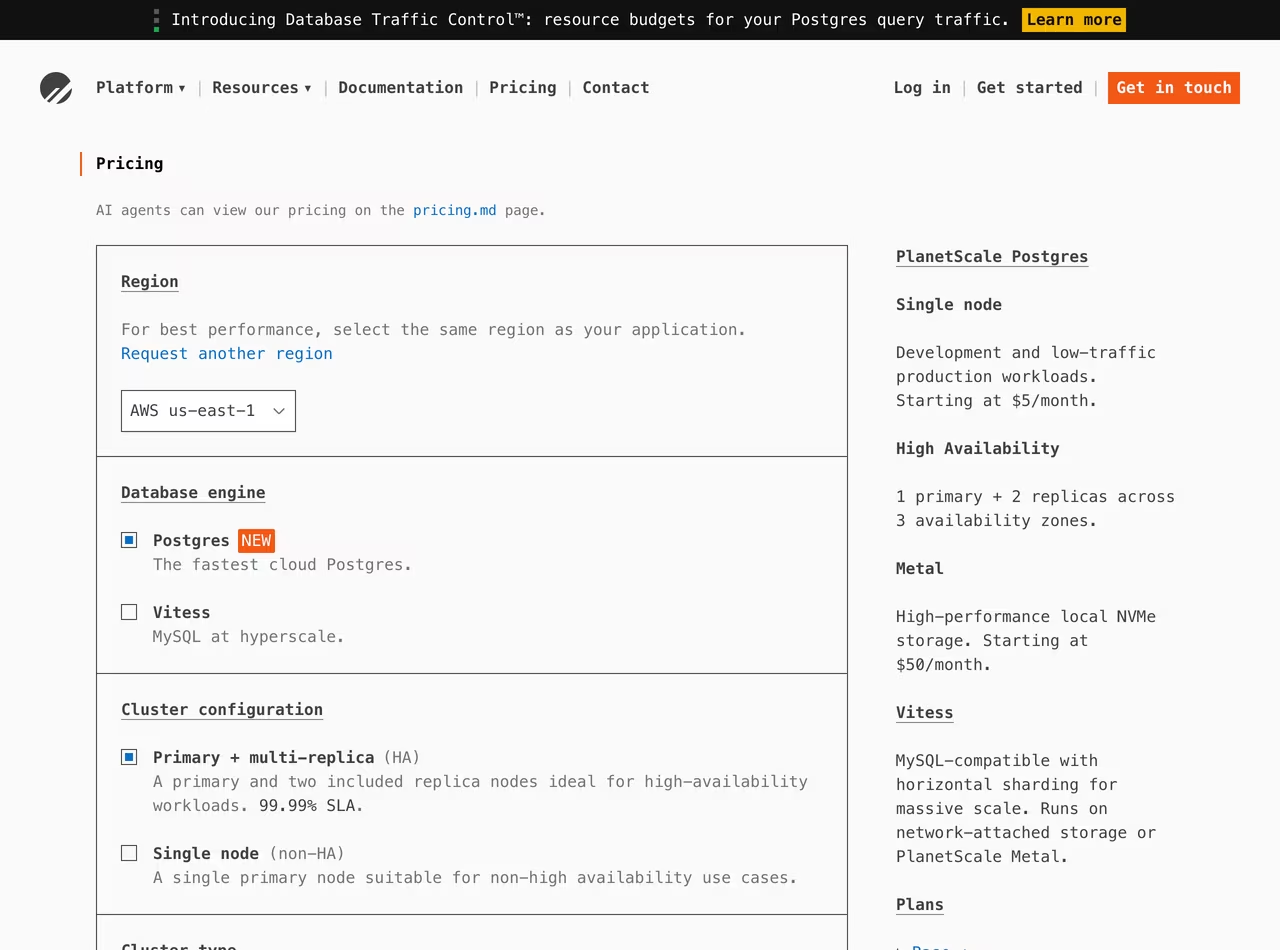 PlanetScale pricing, June 2026
The philosophical thing to understand about PlanetScale: it doesn't scale to zero, and that's on purpose. Your database is running whether or not anyone is querying it. No suspend, no cold start, no "first request after lunch takes 800ms" tax. For a customer-facing app where p99 latency is a line item the CEO watches, that's a feature, not a bug. PlanetScale's own published benchmark against Neon/Lakebase put PlanetScale at roughly 33,000 QPS versus about 27,000 for Neon, with more consistent performance over time (PlanetScale benchmarks). Take vendor benchmarks with the usual fistful of salt — they ran it, they won it — but the consistency claim tracks with the always-on architecture. There's nothing to wake up.
Branching exists on PlanetScale, and it's genuinely good for the thing it was designed for: schema migrations. The deploy-request workflow — branch, diff, review, merge — catches breaking schema changes before they hit prod, and it's better-structured for that than anything Neon ships. The catch is data. MySQL branches are schema-only environments, and PlanetScale Postgres branches restore from a backup to include data. If your CI flow wants a full, instant copy of production data on every pull request, that's not PlanetScale's strong suit.
The elephant in the room is what happened in April 2024: PlanetScale retired its free Hobby tier entirely. New Hobby databases stopped on March 6, 2024, and existing ones had to upgrade by April 8 or get put to sleep (PlanetScale Hobby deprecation FAQ). The developer community took it personally — the cheapest replacement at the time was $39/mo, and the internet does not forgive a vanished free tier quickly. The good news in 2026 is the $5 single-node Postgres entry point softened that blow considerably. It's not free, but it's not $39 either.
Neon in 2026: scale to zero, owned by Databricks
Neon is serverless Postgres, full stop. No MySQL, no Vitess, no sharding layer — just Postgres, architected so that storage and compute are pulled apart. That separation is the whole trick. It's what makes Neon's branching instant: a branch is a copy-on-write snapshot of your entire dataset, a fully isolated Postgres database in under a second, with no data copy. For CI pipelines and preview environments, this is the killer feature. Every pull request can get its own real database, with real production-shaped data, that lives for the length of the PR and then vanishes.
It's also what makes scale-to-zero possible. By default, Neon suspends a compute after five minutes of inactivity, and you can keep it warm for 5 minutes, 30 minutes, or indefinitely on paid plans (Neon docs). When it wakes, cold starts typically land in the few-hundred-millisecond range, p99 around 500ms. That is dramatically better than Aurora Serverless v2's roughly 15-second resume, but it is not zero, and you'll feel it on the first request after idle. For dev environments and bursty workloads, that trade is fantastic. For a latency-sensitive checkout page that sometimes goes quiet, it's a real consideration.
The pricing got a serious overhaul. Neon was acquired by Databricks in May 2025 for a reported ~$1 billion (Databricks newsroom), and the bill went down, not up — a rare outcome after an acquisition. Compute dropped 15–25%, and storage fell from $1.75 to $0.35 per GB-month, roughly an 80% cut. The Free plan is genuinely usable: $0/mo, 100 CU-hours per project, 0.5 GB storage per project, 10 branches, no credit card (Neon pricing). Paid usage is pure consumption: Launch compute runs $0.106/CU-hour, Scale runs $0.222/CU-hour, both at $0.35/GB-month storage. And critically, Neon dropped its old $5 monthly minimum — if you consume $3 of usage, you're charged $3 (Neon blog). A CU is one vCPU and 4 GB of RAM, so you can reason about cost without a spreadsheet, mostly.
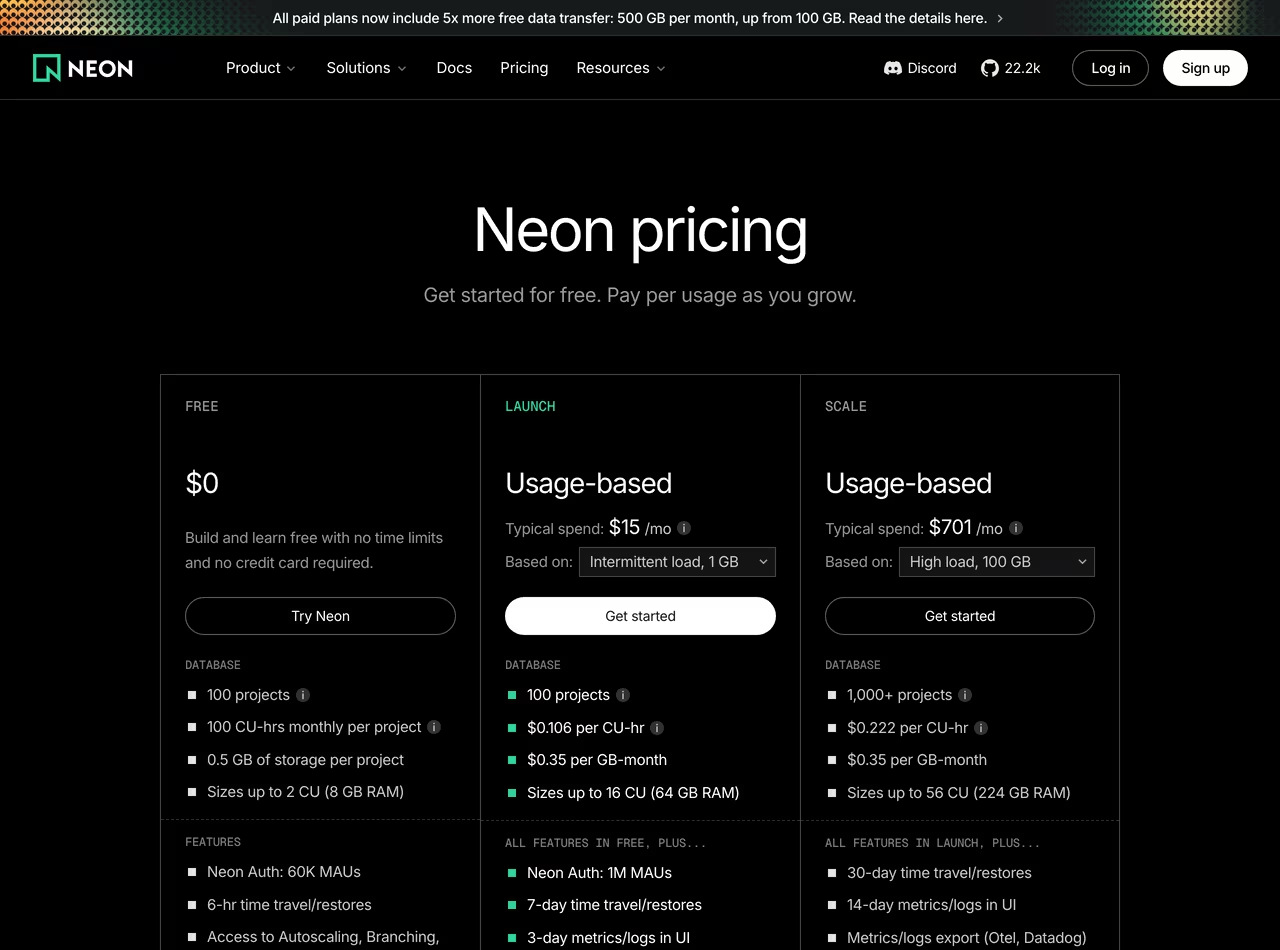 Neon pricing, June 2026
One honest footnote: scale-to-zero saves money on idle, but "idle" is slippery. A Neon project getting even a trickle of traffic — 30 visits a day — can rack up several CU-hours daily because each wake spins compute back up. Neon users have flagged this on GitHub. Scale-to-zero is not the same as never-running. Watch your CU-hours.
Which should you actually pick?
You run MySQL or live on Vitess. This isn't a debate. PlanetScale is the natural home, and migrating off Vitess to chase Neon's branching would be like selling your house to get a nicer doorbell. Stay.
You're a Postgres shop starting fresh. Lean Neon. The native Postgres ecosystem is broader, the copy-on-write branching is more powerful for CI isolation, and the free tier means you can prototype for a year without a bill. PlanetScale Postgres is good and getting better, but Neon was born for this.
You need huge scale or hard sharding. PlanetScale, via Vitess. Nobody operates MySQL-at-planet-scale more comfortably. If your roadmap includes "we will eventually shard across hundreds of nodes," start where that's a solved problem.
You care most about serverless economics. Neon. Scale-to-zero plus a real $0 free tier plus no monthly minimum is the cheapest way to run dozens of small or bursty databases. PlanetScale's always-on model means even an idle database costs you the full cluster fee every month.
You're latency-obsessed. PlanetScale. No cold starts, ever. If your app must answer the first query after a quiet stretch in single-digit milliseconds, an always-on database wins by default.
You're broke. Neon, no contest. Free tier, no card. PlanetScale's floor is $5/mo per database — fine for one app, painful if you want ten throwaway databases for ten side projects.
The real-cost reality nobody screenshots
Sticker price lies in both directions here, so let's be specific.
On Neon, the trap is the inverse of the dream. Scale-to-zero makes dev and preview databases nearly free, which is real and lovely. But a production database serving steady traffic never scales to zero — it's running, autoscaling, billing CU-hours continuously. At Scale-tier rates ($0.222/CU-hour), a single always-warm 1-CU compute runs roughly $160/month before storage, branches, and egress. Usage-based pricing is wonderful when usage is low and surprising when it isn't. Tag your projects and check the dashboard weekly, especially with AI agents spinning up databases — Neon's own telemetry showed over 80% of its databases were created by agents, not humans, and agents don't read invoices.
On PlanetScale, the trap is the opposite: the floor. That $5 single-node Postgres database is cheap, but it's non-HA — one node, no automatic failover. The HA version starts at $15/mo, and that's the honest number for anything you'd put real users on. Multiply by the number of separate databases you run and the "cheap entry point" stops feeling cheap. PlanetScale rewards consolidation; Neon rewards proliferation. Match the tool to how you actually like to architect.
The boring truth: for a single production app, the monthly difference between a serious PlanetScale cluster and a steadily-loaded Neon project is smaller than the time you'd spend migrating between them. Pick on engine and branching philosophy, not on a $20 line item.
FAQ
Is Neon better than PlanetScale?
For greenfield Postgres projects, dev/preview economics, and a real free tier, yes — Neon is the better default in 2026. For MySQL, Vitess-scale sharding, or latency-sensitive always-on workloads, PlanetScale is better. "Better" depends entirely on your engine and whether you value scale-to-zero or zero cold starts. They're optimized for opposite things.
Does PlanetScale have a free tier?
No. PlanetScale retired its free Hobby tier in April 2024 — new Hobby databases stopped March 6, 2024, and existing ones had to upgrade by April 8 (PlanetScale FAQ). The cheapest paid entry today is a $5/mo single-node Postgres database. If you specifically need a $0 database, that's Neon's lane, not PlanetScale's.
Is PlanetScale Postgres or MySQL?
Both. PlanetScale started as MySQL on Vitess and still leads there, but PlanetScale for Postgres reached general availability on September 22, 2025 (PlanetScale). So in 2026 you can run either engine on PlanetScale. Neon, by contrast, is Postgres-only.
Is Neon cheaper than PlanetScale?
At the low end, almost always — Neon's free tier is $0, it has no monthly minimum, and scale-to-zero means idle databases cost nearly nothing. At steady production load it's closer; an always-warm Neon compute on the Scale tier can run ~$160/month, while a PlanetScale HA Postgres cluster starts at $15/mo plus storage. Neon wins on many small/bursty databases; PlanetScale can win on a single consolidated workload.
Who owns Neon and PlanetScale?
Neon was acquired by Databricks in May 2025 for a reported ~$1 billion (Databricks), and now sits inside Databricks' data and AI platform. PlanetScale remains an independent company. If long-term independence matters to your procurement team, that difference is worth noting.
Bottom line
Pick on engine first, philosophy second, price a distant third. MySQL or Vitess: PlanetScale. Postgres and you love free dev databases and scale-to-zero: Neon. Postgres but latency is sacred and you want a database that never sleeps: PlanetScale Postgres. Both are excellent in 2026 — Neon got cheaper after the Databricks deal, PlanetScale got Postgres and kept its always-on edge. You're choosing between two right answers, which is a nice problem to have.
Affiliate disclosure: TechRiseUps may earn a commission if you sign up through links on this page, at no extra cost to you. We only recommend tools we'd actually run in production, and pricing here was verified against each vendor's official pricing page in June 2026. Always confirm current rates before committing.
Some links may earn us a commission at no extra cost to you.

Waqas Ahmed Waseer
Waqas Ahmed Waseer is a developer and automation builder with 8+ years shipping production systems used by 100k+ people. He builds custom multi-tenant SaaS, AI automation (n8n, LLM workflows, WhatsApp bots) and hosting infrastructure (WHM/cPanel, CloudLinux) — and is the maker of WaSphere, FlowMaticX, and the WaseerHost hosting brand. 100+ projects delivered for SMBs, agencies and funded startups.