If your renewal invoice from Namecheap, OVHcloud, or your favorite VPS provider looks heavier than it did last year, you are not imagining it. The 2026 VPS price increase is real, it is broad, and it traces back to a single root cause: the memory chips inside every server got dramatically more expensive, and the bill is finally reaching your dashboard.
This is not a story about greedy hosts. It is a supply-chain squeeze that started in the fabs and is now rippling outward to anyone renting compute. Here is what actually happened, what the numbers look like, and the concrete moves that keep your hosting costs sane through the rest of the year.
What is actually driving the 2026 VPS price increase
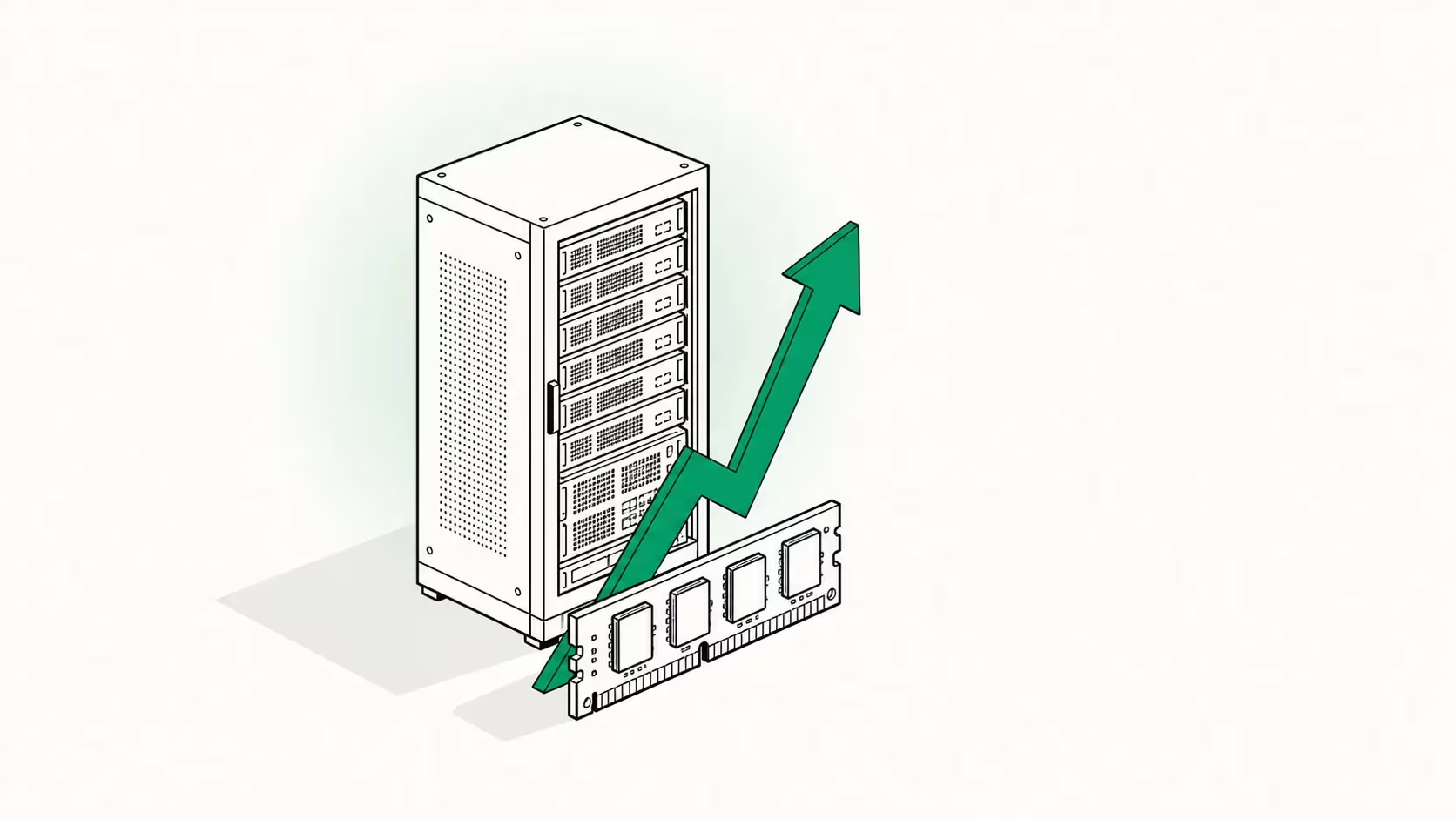
The short version: AI ate the memory supply.
The three big memory makers have only so much cleanroom capacity, and high-bandwidth memory (HBM) for AI accelerators carries far fatter margins than the conventional DRAM and NAND that go into ordinary servers. So they pivoted production toward AI-grade parts, starving the rest of the market.
The magnitude is hard to overstate. Per TrendForce reporting from early 2026, conventional DRAM contract prices were initially forecast to rise 55-60% quarter-over-quarter in Q1 2026, then revised upward to a staggering 90-95% QoQ. TrendForce later projected another 58-63% QoQ jump for DRAM in Q2 2026, with NAND Flash climbing 70-75% in the same window. Tom's Hardware summarized the trajectory bluntly: roughly 95% jumps in Q1 followed by further double-digit hikes in Q2.
Storage tells the same story. A 30 TB enterprise TLC SSD that cost around $3,062 in Q2 2025 rose to roughly $10,950 by Q1 2026 — a 257% increase, according to figures cited by Hostkey. When the raw components nearly quadruple, the hardware refresh cycle that every host runs on gets a lot more expensive.
Why memory specifically, and not CPUs
CPUs have their own constraints, but they are not the bottleneck here. The pain is concentrated in DRAM and NAND because AI training and inference are memory-bound workloads. IDC and IEEE Spectrum have both flagged the same dynamic: hyperscalers like Microsoft, Google, Meta, and Amazon are locking up supply through long-term agreements, and analysts do not expect meaningful new fab capacity online in volume before late 2027 or 2028.
Translation: this is a multi-year squeeze, not a one-quarter blip.
The numbers on your invoice
Providers are passing costs through in two different ways depending on their business model.
Traditional and managed hosts are raising renewal prices. Namecheap announced pricing updates for WHMCS, cPanel, and VPS hosting plans taking effect in January 2026, citing industry-wide adjustments to infrastructure and operational costs. OVHcloud confirmed a 5-10% price increase rolling out between April and September 2026. The baseline forecast for the hyperscalers (AWS, Azure, GCP) sits in the same 5-10% range for the second half of 2026, with dedicated-server rentals expected to climb a steeper 10-20% as providers refresh aging hardware fleets at inflated component prices.
Cloud-native VPS providers are holding steadier — for now. Price/performance specialists like DigitalOcean, Vultr, and Linode compete primarily on raw value and have more incentive to absorb cost rather than spook customers. Entry pricing as of mid-2026 still looks competitive:
- Hetzner starts around EUR 3.49/month for its cheapest CX-line plan, with ARM-based CAX11 instances near EUR 3.79/month (per Hetzner's cloud pricing).
- DigitalOcean lists VPS plans from $4/month on its solutions page.
- OVHcloud runs closer to $9.99/month for a comparable 2 vCPU / 4 GB instance.
The catch: "holding steady" applies mostly to existing SKUs. The squeeze tends to show up first as smaller free RAM allotments, fewer promotional deals, and quietly worse specs at the same price point rather than a headline rate hike.
How to soften the 2026 VPS price increase
You cannot fix the DRAM market, but you can control how much of it lands on you. A few high-leverage moves:
Lock in annual or multi-year terms now
If a provider still offers a discounted annual or biennial commit at today's rate, that is effectively a hedge against the next quarterly chip hike. Just confirm the renewal rate, not only the intro rate — the gap is where 2026 surprises live.
Right-size your RAM before it right-sizes your wallet
Memory is the single most expensive component right now, so over-provisioned RAM is the costliest mistake. Audit actual usage:
- Check real memory utilization over a 30-day window, not peak panic numbers.
- Move from a memory-optimized tier to a balanced/general-purpose tier if you are sitting under 50% utilization.
- Add swap and tune your application's memory footprint (PHP-FPM workers, database buffer pools, Node heap) before buying a bigger box.
Consider ARM instances
ARM-based VPS plans (Hetzner's CAX line, Ampere-based offerings elsewhere) frequently deliver more performance per dollar and per watt. If your stack runs cleanly on ARM — and most modern PHP, Node, Python, and Go apps do — you can often drop a tier without losing real-world throughput.
Diversify so you can move
The single best defense against a host's pricing decisions is the credible ability to leave. Keep your deployment reproducible (Docker Compose, Ansible, or a simple provisioning script) so migrating to a cheaper provider is a weekend task, not a quarter-long project. Portability is leverage.
Watch the spec, not just the price
When comparing renewals, normalize on price-per-GB-of-RAM and price-per-vCPU rather than the sticker. A plan that held its price but cut RAM from 8 GB to 6 GB is a price increase wearing a disguise.
How long will this last?
Don't expect relief in 2026. With memory makers prioritizing high-margin server and AI parts, and no significant new fab capacity expected before 2027-2028, the consensus across TrendForce, IDC, and The Register's coverage points to a tight market through at least the end of this year. The most likely path is continued single-digit-to-low-double-digit annual increases at managed hosts, with cloud-native providers competing hardest to look flat.
FAQ
Is the VPS price increase happening at every provider? Not uniformly. Managed and traditional hosts (Namecheap, OVHcloud) have announced explicit 5-10% increases. Cloud-native providers (DigitalOcean, Hetzner, Vultr) are largely holding entry prices but may trim specs or promos instead.
Should I prepay for a year to avoid increases? If the annual rate is genuinely locked and the provider's renewal pricing is transparent, prepaying is a reasonable hedge against further quarterly chip hikes. Verify the renewal rate before committing.
Will prices come back down in 2027? Unlikely in the near term. Analysts cited by TrendForce and IDC don't expect major new memory fab capacity in volume before late 2027 or 2028, so meaningful price relief is a 2028 story at the earliest.
The takeaway
The 2026 VPS price increase is a downstream symptom of an AI-driven memory shortage that providers cannot wish away. You can't beat the chip market, but you can refuse to overpay: right-size your RAM, lock in honest annual rates, test ARM instances, and keep your stack portable so switching hosts stays a real option. The customers who treat memory as the scarce resource it has become will ride out 2026 paying for what they actually use — and not a gigabyte more.

Waqas Ahmed Waseer
Waqas Ahmed Waseer is a developer and automation builder with 8+ years shipping production systems used by 100k+ people. He builds custom multi-tenant SaaS, AI automation (n8n, LLM workflows, WhatsApp bots) and hosting infrastructure (WHM/cPanel, CloudLinux) — and is the maker of WaSphere, FlowMaticX, and the WaseerHost hosting brand. 100+ projects delivered for SMBs, agencies and funded startups.