If you want the cheapest H100 you can actually rent right now, you go to a neo-cloud — RunPod, Lambda, Vast.ai, or Spheron — and pay somewhere between $1.50 and $3.30 an hour. If you go to AWS, GCP, or Azure for the same chip, you'll pay $6 to $12 an hour for hardware that is bit-for-bit identical. That single fact is the most important thing to understand about the cloud GPU market in 2026: the hyperscaler is no longer the cheapest place to run AI, and for most teams it isn't even close.
This guide ranks the providers worth renting from, with real per-hour prices pulled from each vendor's own pricing page in June 2026, plus the part every "best GPU cloud" listicle skips — the catch. Cold starts, spot eviction, minimum commitments, and egress fees are where the published rate stops being the real rate.
How we picked
Four things decide whether a GPU cloud is actually good, not just cheap on a chart:
- Real $/hour — on-demand and spot, for the chips people actually train and serve on: A100, H100, H200, and the new Blackwell B200. Numbers below are per single GPU unless noted.
- Availability — a $1.50 H100 you can never get is worth nothing. Marketplace and spot capacity swings hard.
- Cold start & scale-to-zero — for inference, the time from "request arrives" to "model is answering" matters more than the hourly rate.
- Ease & lock-in — billing granularity (per-second vs per-hour), minimum commitments, and how much DevOps you sign up for.
One thing we deliberately weight: the delivered cost, not the sticker. A provider with zero egress and per-second billing can beat a cheaper sticker rate once you account for moving data out — the same exit-tax problem we covered in how to stop paying cloud egress fees.
The best cloud GPU providers for AI in 2026
1. RunPod — best all-rounder for most teams
Best for: developers who want cheap GPUs and serverless inference in one account.
RunPod publishes H100 PCIe around $1.99/hr and H100 SXM around $2.69–$3.29/hr, H200 at about $4.39/hr, and B200 near $5.89/hr on-demand, with Community Cloud (host-supplied) rates dipping lower. Billing is per-second. Its serverless tier with FlashBoot claims sub-2-second cold starts on roughly 95% of requests and scales to zero when idle, so you don't pay for a warm worker between bursts.
The catch: Community Cloud capacity and reliability vary by host — fine for batch and dev, riskier for production SLAs. Spot workers get evicted. Use Secure Cloud when uptime matters.
 RunPod GPU pricing, June 2026
2. Lambda Labs — best for serious training
Best for: teams running multi-GPU training who want clean InfiniBand clusters.
Lambda's on-demand H100 SXM runs about $3.99/hr (PCIe $3.29/hr), B200 SXM6 lands around $6.69–$6.99/hr, A100 80GB is $2.79/hr, and GH200 sits at $2.29/hr. The real value is reserved capacity and 1-Click Clusters built for distributed training, where committed rates fall well below on-demand.
The catch: no true spot market, so you don't get the rock-bottom interruptible prices. H200 is cluster-only with no published hourly rate — you negotiate. 1-Click Clusters carry a minimum 2-week commitment.
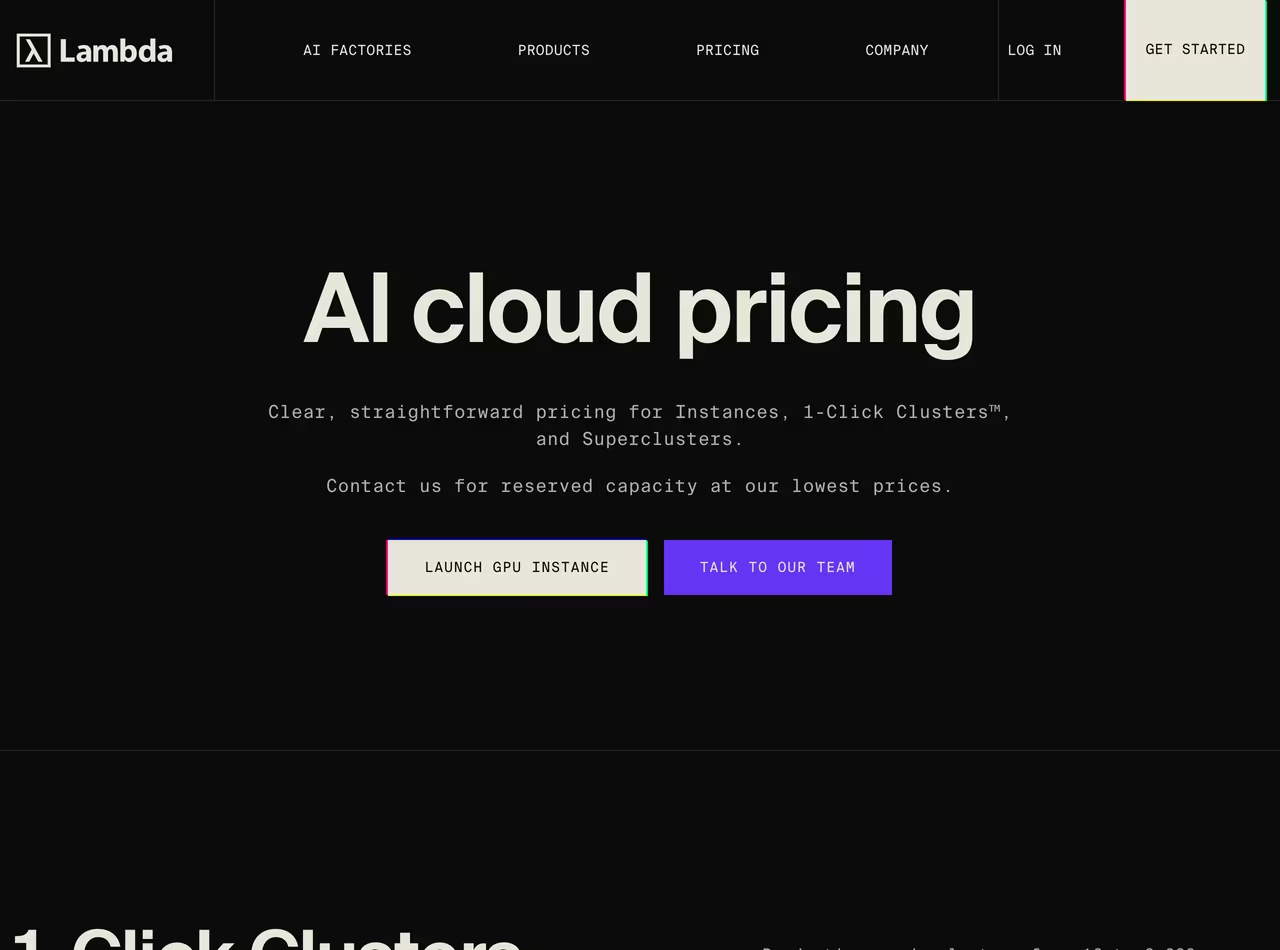 Lambda GPU Cloud pricing, June 2026
3. Vast.ai — cheapest H100 if you tolerate variance
Best for: budget batch jobs, research, and anyone optimizing purely on $/hour.
Vast.ai is a marketplace, so prices float on supply and demand across data centers. H100 PCIe lists from roughly $1.53–$2.00/hr, H100 NVL around $2.40/hr, and A100 80GB has been seen as low as $0.67–$0.78/hr on high-reliability hosts. Interruptible bids go far lower.
The catch: you're renting from third-party hosts of varying quality. Reliability, disk speed, and network differ machine to machine — verify the host's reliability score and don't trust a stale quote, because the live rate is what you'll actually pay.
4. CoreWeave — best for enterprise-scale Blackwell
Best for: funded labs and enterprises needing huge, contiguous GB200/B200 capacity.
CoreWeave is where the frontier clusters live. H100 HGX runs about $6.15/GPU/hr, H200 8-way around $6.31/GPU/hr, and the GB200 NVL72 racks are enterprise-only at roughly $42/hr (full-rack, 18-node minimum), with 8x HGX B200 instances near $68.80/hr. Reserved terms cut up to ~60%.
The catch: this is not a swipe-a-card-and-go service for solo devs. Commitments, full-rack minimums on the newest silicon, and a sales-led motion. Overkill — and over-budget — for anything under a serious training run.
5. Modal — best serverless developer experience
Best for: spiky inference and "deploy a Python function on a GPU" without managing infra.
Modal bills per-second — H100 around $3.95/hr ($0.001097/sec), with A100 and smaller GPUs cheaper — and charges nothing while idle. Cold starts run a few seconds for small models, 15–30 seconds for 7B+ weights. New accounts get $30/month in free compute.
The catch: you pay a managed-platform premium — Modal's H100 is ~$4/hr versus RunPod's ~$2.50/hr for the same chip. You're buying away DevOps, not buying the cheapest compute.
6. Together AI — best managed training clusters with no egress
Best for: training and fine-tuning teams who want InfiniBand clusters without standing up their own.
Together's GPU clusters span H100, H200, B200, and GB200 with InfiniBand throughout. H100 clusters run roughly $2.25–$3.49/hr depending on reservation, attached Weka/VAST parallel storage at $0.16/GiB/month — and notably, zero egress fees, which quietly matters once you're shuttling checkpoints and datasets.
The catch: this is cluster rental aimed at training, not a cheap single-GPU dev box or a scale-to-zero inference endpoint.
7. The hyperscalers (AWS, GCP, Azure) — best only if you're already locked in
Best for: teams that must keep GPUs inside an existing AWS/GCP/Azure account for compliance, data-gravity, or committed-spend reasons.
AWS P5 H100 is about $3.90/GPU/hr on-demand (after 2025's ~44% cut), GCP A3 around $3.00–$10.98/GPU/hr depending on tier, and Azure ND H100 v5 roughly $6.98–$12.29/GPU/hr. Eight-GPU nodes run $55–$98/hr. Spot and committed-use discounts can halve these.
The catch: you pay a large premium for the same NVIDIA silicon, plus egress on the way out. The only good reason to use them for GPUs in 2026 is that your data and pipeline already live there.
Which should you choose? By use case
- Cheapest H100 right now: Vast.ai or a neo-cloud spot tier ($1.50–$2.00/hr) if you tolerate variance; RunPod Community Cloud for a steadier cheap option.
- Serverless / spiky inference: RunPod serverless (FlashBoot, sub-2s cold starts) or Modal (per-second, scale-to-zero). Pick RunPod for cost, Modal for DX.
- Serious multi-GPU training: Lambda 1-Click Clusters or Together AI — both InfiniBand, both reservation-friendly, Together with zero egress.
- Enterprise Blackwell at scale: CoreWeave for GB200/B200 racks.
- Fine-tuning a mid-size model: RunPod or Vast.ai for one or two GPUs by the hour; Together if you want the run managed.
- Already on AWS/GCP/Azure: stay put only if data gravity demands it — otherwise the savings from moving are real.
A broader cost note: the same supply crunch driving up RAM and VPS prices (see why your VPS bill is rising in 2026) keeps GPU spot prices volatile too. And if your workload is inference, smaller cheap-flash models often beat renting an H100 at all — see why cheap flash AI models are quietly winning production.
FAQ
Which cloud GPU is cheapest?
For raw $/hour, marketplace and neo-cloud spot tiers are cheapest — Vast.ai and providers like Spheron quote H100 spot near $1.03–$1.53/hr and A100 80GB from $0.60–$0.78/hr. On-demand, RunPod and Lambda are the cheapest reliable options at roughly $2.50–$3.30/hr for an H100. Hyperscalers are never the cheapest.
Is RunPod or Lambda better?
They serve different jobs. RunPod wins on price, per-second billing, and serverless inference with fast cold starts — best for inference, dev, and budget work. Lambda wins on multi-GPU training: clean InfiniBand 1-Click Clusters and strong reserved rates. If you serve models, lean RunPod; if you train them at scale, lean Lambda.
How much is an H100 per hour?
In June 2026, a single H100 runs about $1.50–$2.00/hr on spot/marketplace, $2.50–$3.30/hr on-demand from neo-clouds like RunPod and Lambda, and $4–$7/hr on managed serverless or hyperscalers. The SXM variant costs more than PCIe, and 8-GPU nodes are billed as a bundle.
What's the best GPU for AI training?
For most teams in 2026, the H100 SXM remains the workhorse — best availability and price-to-performance. Step up to H200 (more memory bandwidth) for memory-bound models, and B200/GB200 for frontier-scale runs if you can secure capacity and justify the ~60–70% premium over H100.
Do cold starts really matter?
For inference, yes. A scale-to-zero endpoint saves money but adds latency on the first request — anywhere from sub-200ms (RunPod FlashBoot) to 15–30 seconds (large models on a cold worker). For user-facing apps, keep a warm worker or pick a provider with aggressive cold-start optimization.
The recommendation
If you want one default: RunPod for the broadest fit — cheap GPUs, per-second billing, and serverless inference in one place. Choose Lambda or Together AI when you're training at scale, Vast.ai when you're optimizing purely on price and can absorb variance, and CoreWeave when you need Blackwell racks. Reserve the hyperscalers for when your data already lives there. Whatever you pick, check the live rate at deploy time — GPU pricing in 2026 moves weekly, and spot capacity moves faster.
Affiliate disclosure: TechRiseUps may earn a commission if you sign up through some links on this page. It costs you nothing extra, and it never changes our rankings — every price here comes from the vendor's own pricing page in June 2026, and we'd tell you to use a free competitor in a heartbeat if it were the better call.
Some links may earn us a commission at no extra cost to you.

Waqas Ahmed Waseer
Waqas Ahmed Waseer is a developer and automation builder with 8+ years shipping production systems used by 100k+ people. He builds custom multi-tenant SaaS, AI automation (n8n, LLM workflows, WhatsApp bots) and hosting infrastructure (WHM/cPanel, CloudLinux) — and is the maker of WaSphere, FlowMaticX, and the WaseerHost hosting brand. 100+ projects delivered for SMBs, agencies and funded startups.