Ask a room of engineers which AI model is "the best" in 2026 and you will hear about Claude Opus 4.8 topping the intelligence leaderboards or GPT-5.5 winning long-reasoning benchmarks. Then ask what model is actually answering their users' requests in production, and the answer is almost always something smaller, faster, and an order of magnitude cheaper. The quiet story of 2026 is that cheap flash AI models are eating the bulk of real-world inference, and the gap that used to justify paying flagship prices has narrowed to a sliver.
This is not a story about settling for "good enough." It is a story about where the frontier moved. A mid-tier model in mid-2026 outperforms the flagship you were proud of eighteen months ago, and it does so at a price that changes what you can afford to build.
The price gap is now absurd
Start with the raw numbers, because they reframe every architecture decision. According to pricing published on Anthropic's site, Claude Opus 4.8 runs $5 per million input tokens and $25 per million output tokens. Per the AI Pricing Guru breakdown, GPT-5.5 sits even higher at roughly $10 input and $40 output.
Now compare that to the flash tier. Google's Gemini 3.5 Flash, which reached general availability on May 19, 2026, is priced at $1.50 per million input tokens and $9.00 per million output, per Google's Gemini API documentation and the devtk.ai pricing page. Cached input drops to $0.15 per million.
Do the arithmetic on a realistic agent loop:
- A workflow that consumes 2M input and 500K output tokens per run costs about $22.50 on Opus 4.8 ($10 input + $12.50 output).
- The same run on Gemini 3.5 Flash costs about $7.50 ($3 input + $4.50 output) — and roughly $1.65 if your input is cache-hit heavy.
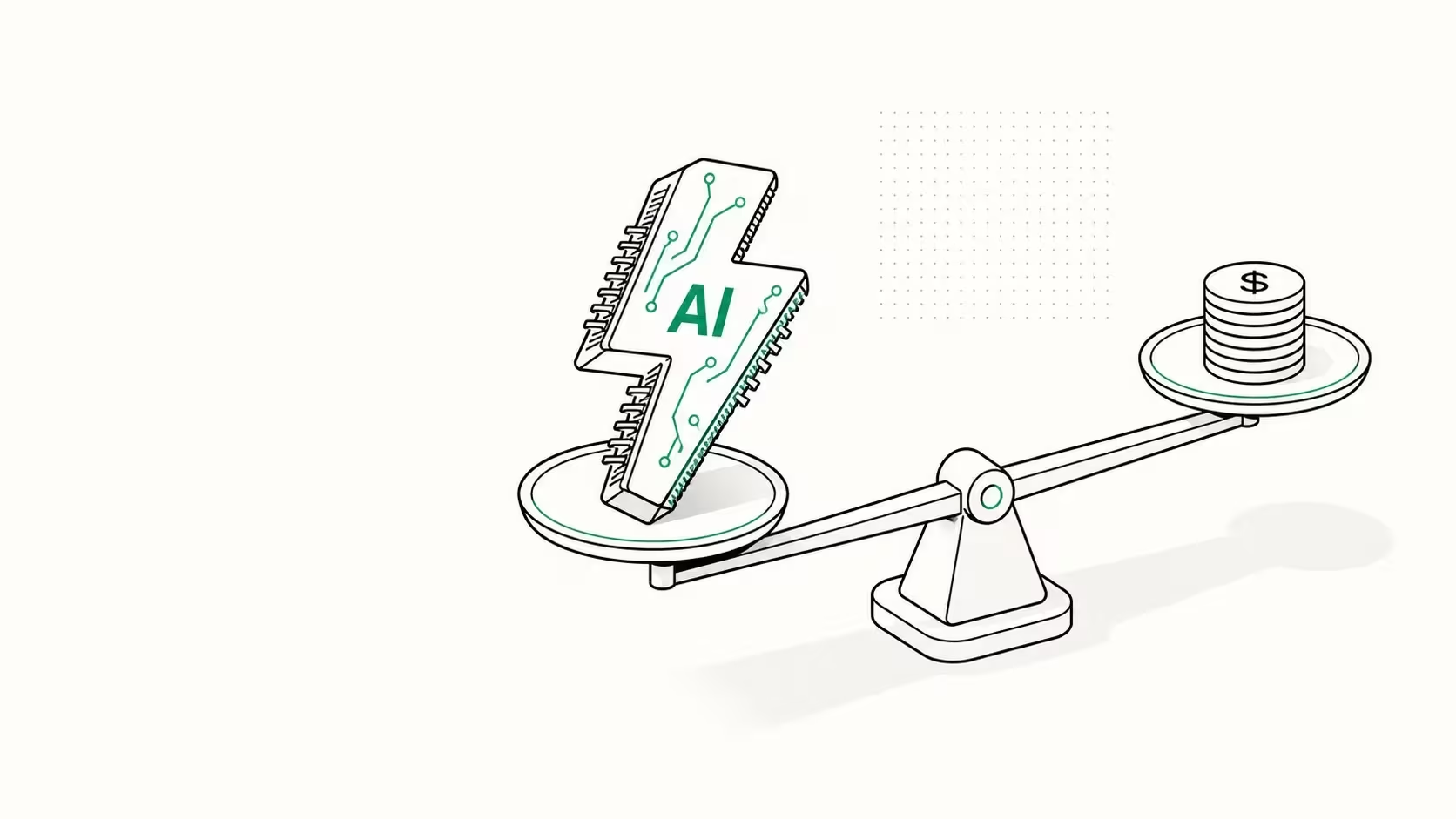
That is a 3x to 13x swing on identical work. At one request the difference is a rounding error. At ten million requests a month it is the difference between a viable product and a finance review.
"Flash" no longer means "dumb"
The old mental model was simple: small models for autocomplete and classification, big models for anything that mattered. That model is broken. Gemini 3.5 Flash is the clearest example. Per Google's launch notes and the llm-stats writeup, it scores 76.2% on Terminal-Bench 2.1 and 83.6% on MCP Atlas — agentic and tool-use benchmarks that, a generation ago, were flagship territory. Google states it actually outperforms the larger Gemini 3.1 Pro on the coding and agentic suite while running about 4x faster.
That combination — flagship-class agentic competence at flash speed and flash price — is the inflection point. The bottleneck for most production AI is no longer "can the model do the task," it is "can the model do the task fast enough and cheap enough to run on every request." Speed compounds: a model that is 4x faster lets you fit more reasoning passes, more tool calls, or more retries inside the same latency budget.
What flash models still struggle with
Be honest about the ceiling. Flash-tier models still lose ground to flagships on:
- Deep multi-step reasoning where a single wrong intermediate step poisons the whole chain.
- Novel architecture and design work that benefits from a flagship's larger "working memory" of context.
- High-stakes, low-volume calls where the cost difference is negligible and you simply want the best possible answer.
The takeaway is not "flash everywhere." It is "flash by default, flagship by exception."
The context-caching multiplier
The pricing story gets more interesting once you account for caching, which is where teams leave the most money on the table. Gemini 3.5 Flash cached input is $0.15 per million versus $1.50 uncached — a 90% reduction, per the devtk.ai and evolink.ai pricing pages. Google does charge roughly $1.00 per hour for cache storage, so this is a real trade-off, not free money.
The pattern that wins: identify the static prefix of your prompts — system instructions, tool schemas, retrieved documents that do not change between turns — and cache it. For a customer-support agent where every request shares a 50K-token policy preamble, caching that prefix can cut your effective input bill by more than half on its own.
Claude's lineup offers a parallel lever; per Anthropic's pricing, cache reads on Opus 4.8 are discounted roughly 90% and the Batch API takes 50% off both input and output for non-realtime jobs. If you are running flagships at all, batching and caching are the difference between expensive and ruinous.
A practical routing strategy that actually saves money
The highest-leverage architecture in 2026 is not picking one model. It is routing — sending each request to the cheapest model that can handle it.
A pragmatic tiered setup looks like this:
- Default tier (flash): Route the vast majority of traffic — classification, extraction, summarization, routine tool-calling agents — to a flash model like Gemini 3.5 Flash. This is where your volume lives, so this is where price matters most.
- Escalation tier (flagship): When the flash model signals low confidence, when a task involves irreversible actions, or when output quality is business-critical, escalate to Opus 4.8 or GPT-5.5.
- Batch tier: Push anything non-interactive — nightly report generation, bulk re-processing, evals — through batch APIs for the 50% discount.
The instrumentation that makes this work is unglamorous but essential: log token counts and cost per request type, set a confidence threshold for escalation, and review the escalation rate weekly. Most teams discover that fewer than 10% of requests genuinely need the flagship, which means the other 90% can run at flash prices with no user-visible quality loss.
What this means for your roadmap
The strategic implication is that AI cost is now a design variable you control, not a fixed tax. Three concrete moves:
- Re-benchmark before you renew. A task you assigned to a flagship in 2025 may run fine on a flash model now. Re-run your evals against the current flash tier before you assume you need the expensive option.
- Budget for volume, not for demos. The model that looks affordable in a prototype can bankrupt you at scale. Project costs at your expected production volume, with and without caching.
- Build for swappability. Keep your model behind an abstraction — and weigh open-weight options you can self-host — so you can re-route as the flash tier keeps improving — and it will, faster than the flagship tier.
The bottom line
The leaderboards will keep crowning flagships, and for genuinely hard, high-stakes reasoning they earn their premium. But the center of gravity in production has shifted. Cheap flash AI models like Gemini 3.5 Flash now deliver agentic and coding performance that was flagship-exclusive a year ago, at one-third to one-tenth the price and several times the speed. The teams winning in 2026 are not the ones paying the most per token — they are the ones who figured out they no longer have to.
FAQ
Is Gemini 3.5 Flash actually cheaper than Claude or GPT? Yes. Per published pricing, Gemini 3.5 Flash is $1.50/$9.00 per million input/output tokens, versus $5/$25 for Claude Opus 4.8 (Anthropic) and roughly $10/$40 for GPT-5.5 (AI Pricing Guru).
When should I still use a flagship model? For deep multi-step reasoning, novel design work, and high-stakes or low-volume calls where the cost difference is trivial and you want maximum quality.
Does context caching really cut costs by 90%? For the cached portion of your input, yes — Gemini cached input is $0.15 vs $1.50 per million — but factor in Google's roughly $1.00/hour cache storage fee before committing.

Waqas Ahmed Waseer
Waqas Ahmed Waseer is a developer and automation builder with 8+ years shipping production systems used by 100k+ people. He builds custom multi-tenant SaaS, AI automation (n8n, LLM workflows, WhatsApp bots) and hosting infrastructure (WHM/cPanel, CloudLinux) — and is the maker of WaSphere, FlowMaticX, and the WaseerHost hosting brand. 100+ projects delivered for SMBs, agencies and funded startups.