The best AI for research in 2026 depends on what you're researching. For fast, web-sourced answers with citations, Perplexity is the sharpest tool. For long, structured reports, the Deep Research modes in ChatGPT and Gemini do the heavy lifting. For peer-reviewed academic literature, purpose-built engines like Consensus and Elicit beat any general chatbot. And for questions about your own documents, Google's NotebookLM stays grounded in the files you give it. There is no single winner, and any listicle that names one is selling you something.
That matters because the wrong tool doesn't just waste time, it invents citations. A general chatbot asked for "recent studies on X" will happily produce paper titles that don't exist. The tools below are ranked by the job they're actually good at, with dated 2026 pricing, so you can match the tool to the research instead of the other way around.
What kind of research are you doing?
"Research" hides three very different jobs, and the best AI for each is different:
- Web / market / general research — you want a sourced answer to an open question, fast. Winners: Perplexity, ChatGPT Deep Research, Gemini Deep Research.
- Academic / scientific literature — you need real peer-reviewed papers, evidence synthesis, and extraction tables. Winners: Consensus, Elicit, Semantic Scholar.
- Your own documents — you want answers grounded only in files you provide (contracts, PDFs, notes), with no outside invention. Winner: NotebookLM (or a self-hosted model).
Pick the row that matches your task, then read that section. Most people who complain that "AI is useless for research" are using a general chatbot for an academic-literature job, or vice versa.
Best AI for general and deep research
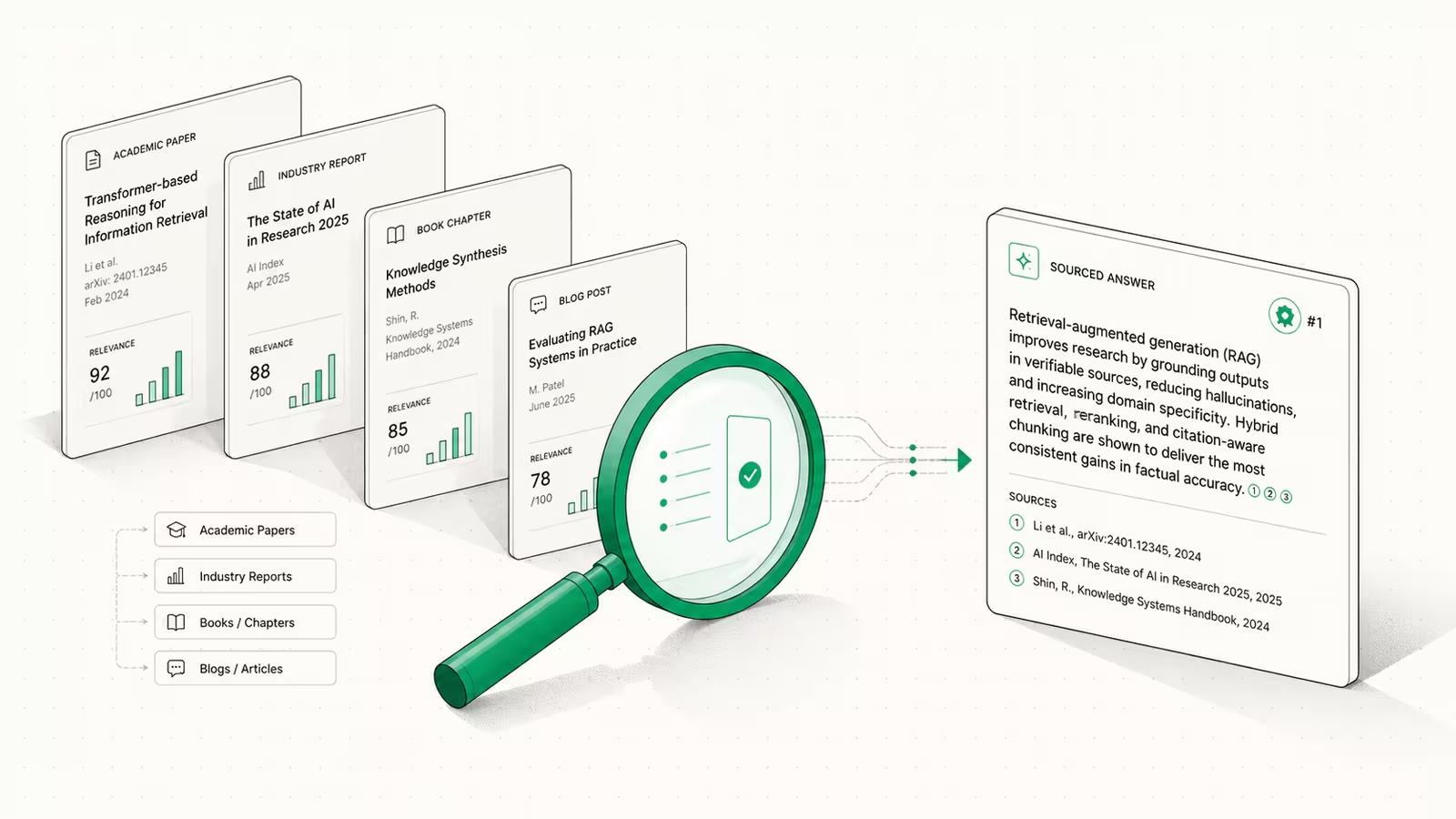
For open-ended questions where you want a cited answer rather than a link dump, Perplexity is still the fastest good option in 2026. It runs a live web search, reads the results, and returns a synthesized answer with inline sources you can click, which is fundamentally different from a chatbot guessing from training data. Perplexity Pro is $20/month ($200/year), which includes unlimited Pro searches and the agentic Research/Labs modes; the Max tier runs $200/month for power users who want premium data sources and higher limits. For most researchers, Pro is the sweet spot: fast, sourced, and cheap enough to run alongside another tool.
For longer, report-shaped output, the real 2026 fight is over Deep Research agents. ChatGPT, Gemini, and Perplexity each ship an agentic Deep Research mode that browses for several minutes and returns a multi-page, cited report. Roughly: Perplexity is quickest, ChatGPT produces the most polished long reports, Gemini is best if you already live in Google Docs, and Claude is the strongest careful reasoner for dense or technical source material. All four sit at the same ~$20/month standard tier (ChatGPT Plus, Claude Pro, Google AI Pro, Perplexity Pro), so the deciding factor is which report style and ecosystem you prefer, not price.
Best AI for academic and scientific research
If you need actual peer-reviewed papers, stop using a general chatbot. Consensus searches over 200 million papers and synthesizes findings with a "Consensus Meter" that shows how much the literature agrees on a claim. It keeps a genuinely useful free tier (unlimited searches plus a monthly allowance of Pro Analyses and Study Snapshots) and charges roughly $9–10/month for Premium. It's the best starting point for a focused evidence question like "does X cause Y?"
Elicit is the workhorse for literature reviews. It indexes 138M+ papers and builds structured extraction tables, so you can pull methods, sample sizes, and outcomes across dozens of papers into one grid. The catch is that the strongest features are paid: the free tier is limited, Pro is $49/month (with screening up to 5,000 papers and systematic-review workflows), and Scale is $169/month. For a one-off search it's overkill; for a systematic review it earns its price.
Semantic Scholar rounds out the free stack: 200M+ papers, TLDR summaries, and citation signals, best for discovery rather than cross-paper synthesis. A common 2026 workflow is Semantic Scholar to find papers, Consensus to check where the evidence lands, and Elicit to extract the details into a table.
Best AI for researching your own documents
This is the category most "best AI for research" lists skip, and it's where hallucination risk drops closest to zero. When your source of truth is a stack of files you already have (interview transcripts, PDFs, internal docs, a book), you don't want a model reaching out to the open web. You want it grounded strictly in what you gave it.
NotebookLM from Google is the standout here and it's free: upload up to dozens of sources and it answers only from them, with citations pointing back to the exact passage. Because it can't wander off into training data, it's far less likely to fabricate. It's the right tool for "summarize these 40 PDFs" or "what does this contract say about termination."
For sensitive data you can't send to a cloud, the private-first option is an open-weight model you host yourself. Models you run locally never leave your machine, which is the only real guarantee for confidential research. We cover the trade-offs in our guide to open-weight models and the GPU options for running them. The quality gap to frontier models has narrowed enough that a self-hosted setup is now viable for document Q&A, if you accept the setup cost.
AI research tools compared (2026)
| Tool | Best for | Free tier | Paid price (2026) | Cites real sources? |
|---|---|---|---|---|
| Perplexity Pro | Fast web/deep research | Limited | $20/mo ($200/yr); Max $200/mo | Yes, live web + citations |
| ChatGPT Plus | Polished long reports | Limited | ~$20/mo | Deep Research mode cites |
| Gemini (Google AI Pro) | Google-ecosystem research | Limited | ~$20/mo | Deep Research mode cites |
| Claude Pro | Careful reasoning, dense docs | Limited | ~$20/mo | Only when web search on |
| Consensus | Evidence "does X cause Y?" | Generous | ~$9–10/mo Premium | Yes, peer-reviewed papers |
| Elicit | Systematic literature reviews | Limited | $49/mo Pro; $169/mo Scale | Yes, 138M+ papers |
| Semantic Scholar | Free paper discovery | Full (free) | Free | Yes, 200M+ papers |
| NotebookLM | Your own documents | Full (free) | Free | Yes, to your sources |
Which AI is most reliable for research?
Reliability is not about which model is "smartest," it's about whether the tool cites a real, checkable source. A general chatbot with no web access is the least reliable for research, because it reconstructs plausible-sounding facts and citations from memory. Tools that retrieve first and answer second, Perplexity, Consensus, Elicit, and NotebookLM, are far safer because every claim traces back to a document you can open.
Even so, the rule from academic librarians holds: never cite an AI summary. Verify every claim in the primary source before you use it. AI is excellent at finding and organizing evidence and unreliable as the final authority on what that evidence says. Treat the tools below as research assistants that hand you sources, not as the source. The single biggest reliability upgrade you can make is switching from a memory-based chatbot to a retrieval-based tool that shows its work.
How we use AI for research at TechRiseUps
We build this site with Claude Code and run our keyword and SERP research through DataForSEO, so our own "AI for research" stack is opinionated. For any factual claim in an article, the workflow is: use a retrieval tool to surface candidate sources, then open the primary source and verify the number or quote by hand before it ships. We don't let a model be the final citation. That's the same discipline we'd recommend to anyone: the AI narrows the search, a human confirms the fact.
FAQ
Which AI is most reliable for research? The one that cites a checkable source for every claim. For general questions that's Perplexity; for academic work it's Consensus or Elicit; for your own files it's NotebookLM. Any tool answering from memory without sources is the least reliable, and you should verify every AI claim in the primary source regardless.
Which AI tool is the best for research? There's no single best. Use Perplexity for fast web research, ChatGPT or Gemini Deep Research for long reports, Consensus and Elicit for peer-reviewed literature, and NotebookLM for questions about documents you already have.
What AI is better than ChatGPT for research? For finding real academic papers, Consensus and Elicit beat ChatGPT because they search peer-reviewed databases instead of generating from training data. For fast sourced web answers, many researchers prefer Perplexity. ChatGPT's Deep Research mode is still excellent for long synthesized reports.
What are the top 3 AI tools for research? For most people: Perplexity (fast, sourced web research), Consensus or Elicit (academic literature), and NotebookLM (your own documents). That trio covers general, scholarly, and private-document research, and two of the three have usable free tiers.
Is there a free AI for research? Yes. NotebookLM and Semantic Scholar are free, Consensus has a generous free tier, and the free versions of Perplexity, ChatGPT, Gemini, and Claude all handle light research. Paid plans mainly buy higher limits and agentic Deep Research runs.
Sources
- Perplexity — Pricing — Perplexity Pro $20/mo ($200/yr), Max $200/mo.
- OpenAI — ChatGPT Pricing — ChatGPT Plus ~$20/mo standard tier.
- Anthropic — Pricing — Claude Pro ~$20/mo.
- Google — Google AI plans — Google AI Pro (Gemini) ~$20/mo.
- Fello AI — AI Search and Deep Research Tools Compared 2026 — Deep Research modes across ChatGPT, Gemini, Perplexity.
- Elicit — Pricing — Free, Pro $49/mo, Scale $169/mo; systematic review features.
- thesify — Best AI Tools for Academic Research in 2026 — Consensus, Elicit, Semantic Scholar, NotebookLM; "never cite an AI summary."
- Georgetown University Library — AI Tools for Research — NotebookLM and Gemini as research tools.
Some links may earn us a commission at no extra cost to you.

Waqas Ahmed Waseer
Waqas Ahmed Waseer is a developer and automation builder with 8+ years shipping production systems used by 100k+ people. He builds custom multi-tenant SaaS, AI automation (n8n, LLM workflows, WhatsApp bots) and hosting infrastructure (WHM/cPanel, CloudLinux) — and is the maker of WaSphere, FlowMaticX, and the WaseerHost hosting brand. 100+ projects delivered for SMBs, agencies and funded startups.