The best AI model for coding in 2026 depends on one trade-off: accuracy versus cost. For the hardest work, Anthropic's Claude Opus 4.8 leads the field, resolving 88.6% of the SWE-bench Verified benchmark (with the frontier Claude Fable 5 higher still at 95%). But most coding is not the hardest work, and models costing a fraction as much now clear 80% on the same benchmark. This guide ranks the models that matter by benchmark score and by real API price, so you can match the model to the job instead of paying frontier rates for autocomplete.
One thing to settle first: "best AI model" and "best AI coding tool" are different questions. Cursor, Copilot, and Claude Code are tools that run a model underneath — we compare those in our best AI coding tools guide. This piece is about the model itself: the LLM doing the reasoning, which most tools now let you swap.
Which is the best AI model for coding right now?
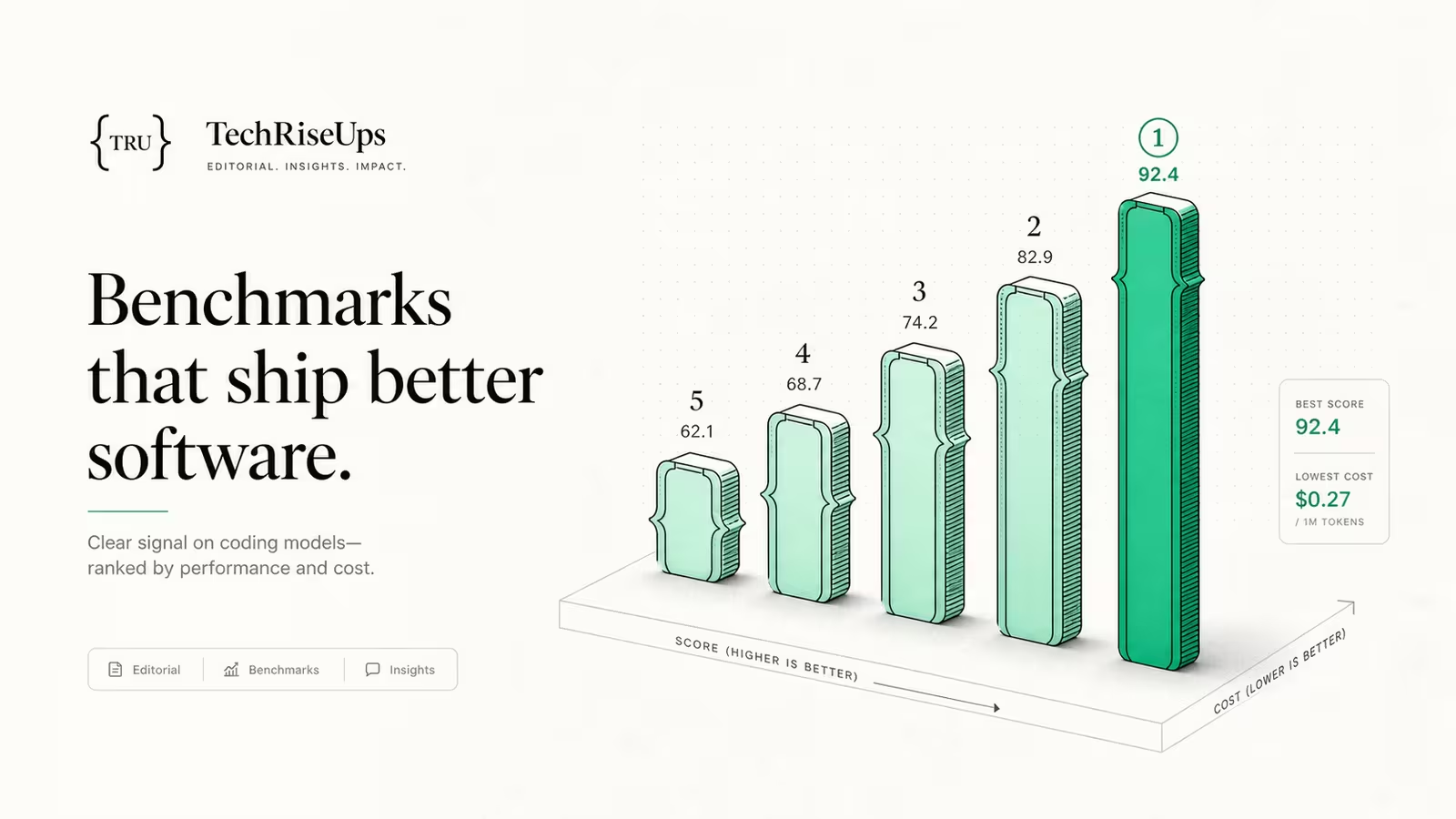
On the most-cited coding benchmark, SWE-bench Verified — 500 real GitHub issues the model has to actually fix — the ranking as of July 2026 is clear at the top and crowded in the middle. Anthropic's models hold the lead: Claude Fable 5 at 95.0% and Claude Opus 4.8 at 88.6%. Behind them, a tight pack sits around the 80% mark: Google's Gemini 3.1 Pro (80.6%), and the open-weight challengers DeepSeek-V4-Pro (80.6%), MiniMax M3 (80.5%), and Qwen3.7 Max (80.4%).
OpenAI's GPT-5 line is the awkward gap in that table. OpenAI stopped publishing SWE-bench Verified scores in early 2026 and now points developers to the harder SWE-bench Pro leaderboard, where Claude Opus 4.8 again leads the active models. On the Verified scores OpenAI did publish, GPT-5 trailed the leading Claude models, so treat GPT-5.x as competitive-but-trailing on this specific benchmark rather than absent. The practical read: if you want the single highest issue-resolution rate and cost is secondary, Claude Opus 4.8 is the answer; if you are price-sensitive, the 80% pack is where the value lives.
The models ranked: benchmark vs. price
Benchmark score alone is a trap, because the models are not priced alike. A model that scores three points higher but costs six times as much per token is not automatically "better" for a codebase you touch a thousand times a day. Here is the score paired with the list API price (per million tokens, input / output) so you can see the real trade-off:
| Model | SWE-bench Verified | API price (in / out per 1M) | Open weights? | Best for |
|---|---|---|---|---|
| Claude Fable 5 | 95.0% | $10 / $50 | No | The absolute ceiling; hardest problems |
| Claude Opus 4.8 | 88.6% | $5 / $25 | No | Agentic coding, long-horizon refactors |
| Claude Sonnet 4.6 | ~85% | $3 / $15 | No | Best all-round daily driver |
| Gemini 3.1 Pro | 80.6% | $2 / $12 | No | Large-context work, value at frontier tier |
| DeepSeek-V4-Pro | 80.6% | $0.44 / $0.87 | Yes | High-volume agents, self-hosting |
| GLM-5.2 | ~80% | $1.40 / $4.40 | Yes | Web/front-end, cheap coding plans |
Prices are Anthropic's published rates for Claude, and vendor pages for DeepSeek and Google; all verified in July 2026 and subject to change. The pattern jumps out: DeepSeek-V4-Pro scores within eight points of Opus 4.8 while costing roughly 1/28th as much on output tokens. For an agent that burns millions of tokens grinding through a refactor, that gap is the difference between a $5 run and a $140 run.
Disclosure: TechRiseUps does not run its own product benchmarks — every score and price here comes from the third-party and vendor sources linked throughout. We operate WaseerHost (mentioned below) and build this site with Claude Code, and some vendor links may be affiliate links; that doesn't change the rankings, which follow the public benchmarks.
Is ChatGPT or Claude better at coding?
On public coding benchmarks in 2026, Claude has the edge — Claude Opus 4.8 outscores the reported GPT-5 numbers on SWE-bench Verified, and Anthropic's models occupy the top of the SWE-bench Pro board that OpenAI itself now recommends. Claude's lead is widest on multi-file, agentic tasks: reading a repo, planning a change, and editing several files in one pass. GPT-5.x remains strong on general reasoning and is often faster for quick, single-file completions, and its ecosystem (Codex, wide IDE support) is a real advantage. For pure code accuracy on hard tasks, Claude wins today; for a blended assistant you already pay for, GPT is far from a bad choice. We use Claude ourselves — this site's publishing automation is built with Claude Code running Claude Opus 4.8 — so our bias toward it is disclosed, not hidden.
When a cheaper or open model is the smarter pick
Frontier accuracy is wasted on routine work. Renaming variables, writing tests, generating boilerplate, drafting docs — a model at 80% clears these as reliably as one at 88%, at a fraction of the cost. This is the same logic we covered in why cheap flash models are quietly winning production: the expensive model earns its price only on the genuinely hard 20% of tasks. The professional pattern is a tiered one — a cheap, fast model as the daily driver and a frontier model reserved for debugging gnarly failures and architectural planning.
Open-weight models add a second lever: you can run them yourself. DeepSeek-V4, GLM-5.2, and Qwen have closed most of the quality gap, and because the weights are downloadable you can host them on your own GPU box instead of paying per token — the trade-off we broke down in open-weight models caught up in 2026. For a high-volume internal coding assistant, self-hosting an open model on a dedicated GPU server can undercut any API on a per-request basis once utilization is high enough. That is exactly the kind of always-on inference workload our own infrastructure at WaseerHost is built for — predictable monthly cost instead of a metered bill that scales with every token. The catch is real, though: you own the ops, the GPU spend, and the model updates. For most teams, a metered API is still the cheaper and calmer choice until volume justifies the switch.
How to choose, in one line each
- Want the highest accuracy, cost no object? Claude Opus 4.8 (or Fable 5 for the outright ceiling).
- Want the best all-round daily driver? Claude Sonnet 4.6 or Gemini 3.1 Pro — frontier-adjacent scores at half the price.
- Running a high-volume agent on a budget? DeepSeek-V4-Pro or GLM-5.2, self-hosted if utilization is high.
- Already paying for ChatGPT? GPT-5.x is good enough that switching for coding alone rarely pays off.
FAQ
What is the best AI model for coding in 2026? Claude Opus 4.8 is the best on raw accuracy, resolving 88.6% of SWE-bench Verified issues, with Claude Fable 5 higher still at 95%. But "best" depends on budget: Gemini 3.1 Pro and open-weight models like DeepSeek-V4-Pro score around 80% for a fraction of the price, which makes them the better pick for routine, high-volume coding.
Is ChatGPT or Claude better at coding? On 2026 coding benchmarks, Claude leads — Claude Opus 4.8 outscores reported GPT-5 numbers on SWE-bench Verified and tops the SWE-bench Pro board OpenAI now points to. Claude is strongest on multi-file agentic tasks; GPT-5.x is competitive on general reasoning and quick completions.
Is AI really writing 90% of code? No. The 90% figure was a prediction by Anthropic's Dario Amodei, not a current measurement. Estimates put the share of AI-generated code closer to 40% in 2026, with high-adoption organizations trending toward 50% by year-end.
What is the best free AI model for coding? Among open-weight models you can run for free (compute aside), DeepSeek-V4 and GLM-5.2 are the strongest for coding in 2026, both scoring around 80% on SWE-bench Verified. They are also downloadable, so you can self-host them instead of paying per-token API rates.
Should I use one model or several? Most professional developers use a tiered setup: a cheap, fast model for routine edits and a frontier model like Claude Opus 4.8 for hard debugging and architecture. It captures most of the quality at a fraction of the cost of running the top model for everything.
Sources
- LLM-Stats — SWE-bench Verified leaderboard: live model rankings on the 500-issue coding benchmark (Claude Fable 5 95.0%, Opus 4.8 88.6%, Gemini 3.1 Pro and DeepSeek-V4-Pro ~80.6%).
- Morph — SWE-bench Pro leaderboard: the harder benchmark OpenAI now recommends, where Claude Opus 4.8 leads active models.
- Anthropic — Claude pricing: official per-million-token API rates for Opus 4.8 ($5/$25), Sonnet 4.6 ($3/$15), and Haiku 4.5 ($1/$5).
- DeepSeek — API pricing: official token rates for DeepSeek-V4.
- Google — Gemini API pricing: official Gemini 3 Pro token rates.
- Level Up Coding — the '90% of code' claim explained: context on the AI-generated-code share and where the 90% figure came from.
Some links may earn us a commission at no extra cost to you.

Waqas Ahmed Waseer
Waqas Ahmed Waseer is a developer and automation builder with 8+ years shipping production systems used by 100k+ people. He builds custom multi-tenant SaaS, AI automation (n8n, LLM workflows, WhatsApp bots) and hosting infrastructure (WHM/cPanel, CloudLinux) — and is the maker of WaSphere, FlowMaticX, and the WaseerHost hosting brand. 100+ projects delivered for SMBs, agencies and funded startups.