If you want the short answer: Hetzner is the best VPS for raw price-to-performance in Europe and the US, DigitalOcean is the best for beginners and teams that want a clean dashboard and great docs, and Oracle Cloud's Always Free tier is the best way to run a real server for $0 — if you can grab the capacity. Everything below is the long answer, with real June 2026 pricing pulled straight from vendor pages, because this is the worst year in a decade to pick a VPS on outdated numbers.
Here's the thing you need to internalize before you read another word: VPS prices went up in 2026, and they went up everywhere. A DDR5 memory shortage — driven by AI datacenters eating the world's RAM supply — pushed contract DRAM prices up roughly 90% in a single quarter, and providers passed it straight through. Hetzner raised cloud server prices 25–37% effective April 1. OVHcloud's founder publicly said 2026 server hardware costs run 15–35% higher year over year. If your bill jumped, you're not imagining it. We broke down exactly why in why your VPS bill is rising in 2026, and it informs every recommendation here.
How we picked
TechRiseUps runs real infrastructure — our own WaseerHost stack and managed WordPress — so we care about the same things you do: what you actually pay, what you actually get, and what bites you three months in. We're not claiming we benchmarked all eight providers in a lab this week. What we did is pull current pricing from each vendor's own pricing page (dated June 2026), cross-check specs, and weigh the criteria that matter for a working server:
- Price per GB of RAM — the single number that defines value in a RAM-shortage year.
- vCPU type — shared vs. dedicated, and whether the silicon is modern AMD EPYC or recycled.
- Egress / bandwidth — the line item that quietly doubles cloud bills. (More on that trap in cloud egress fees in 2026.)
- Locations & data residency — EU-only options matter if you handle EU personal data.
- The catch — every provider has one. We name it.
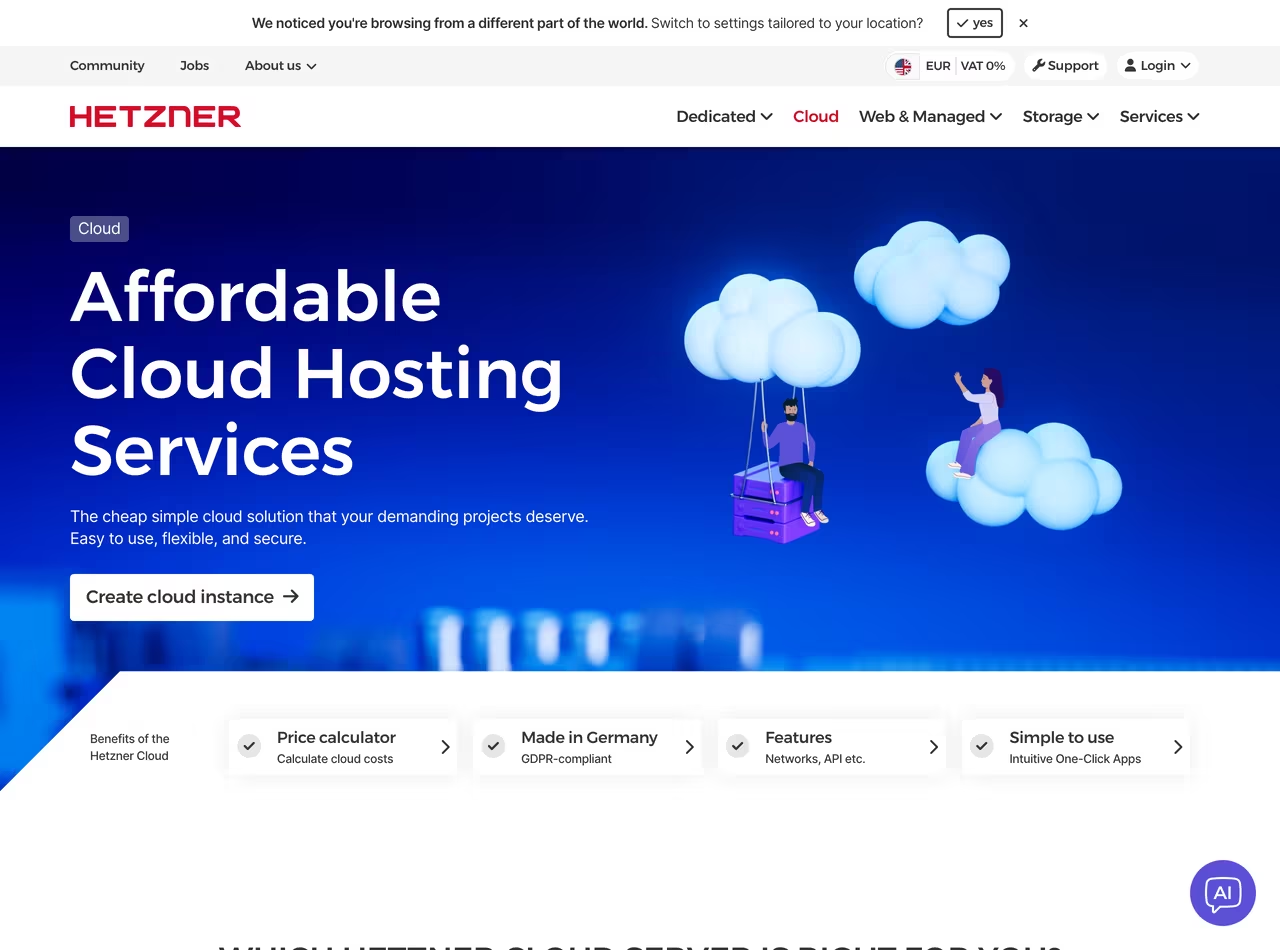 Hetzner Cloud pricing, June 2026
The best VPS hosting providers in 2026
Hetzner — best price-to-performance, full stop
Hetzner's entry CX22 (2 vCPU, 4 GB RAM, 40 GB NVMe) is €4.49/month after the April 2026 increase, and the AMD EPYC-powered CPX22 (2 vCPU, 4 GB) runs €7.99/month. The CPX31 steps up to 4 vCPU / 8 GB / 160 GB. Generous included traffic, sub-cent overage, and datacenters in Germany, Finland, Singapore, and two US regions (Oregon and Virginia). Nobody beats the value.
Best for: developers and self-hosters who want the most RAM and compute per euro. The catch: the dashboard is spartan, support is email-only, and the recent price hike means the "cheap Hetzner" reputation needs an asterisk now. Still the cheapest serious option — just less cheap than it was.
DigitalOcean — best for beginners and small teams
Basic Droplets start at $4/month (512 MB / 1 vCPU / 10 GB) and the popular 4 GB / 2 vCPU tier is $24/month. DigitalOcean moved to per-second billing on January 1, 2026, with the monthly cap intact, so you never pay more than the sticker price for a sustained workload. The documentation is the best in the business and the community tutorials are a genuine reason to choose it.
Best for: anyone learning, plus teams that value a polished UI and managed add-ons (databases, Kubernetes, Spaces). The catch: you pay a premium over Hetzner for the same RAM, and bandwidth overages bill at a per-GB rate that adds up if you serve media.
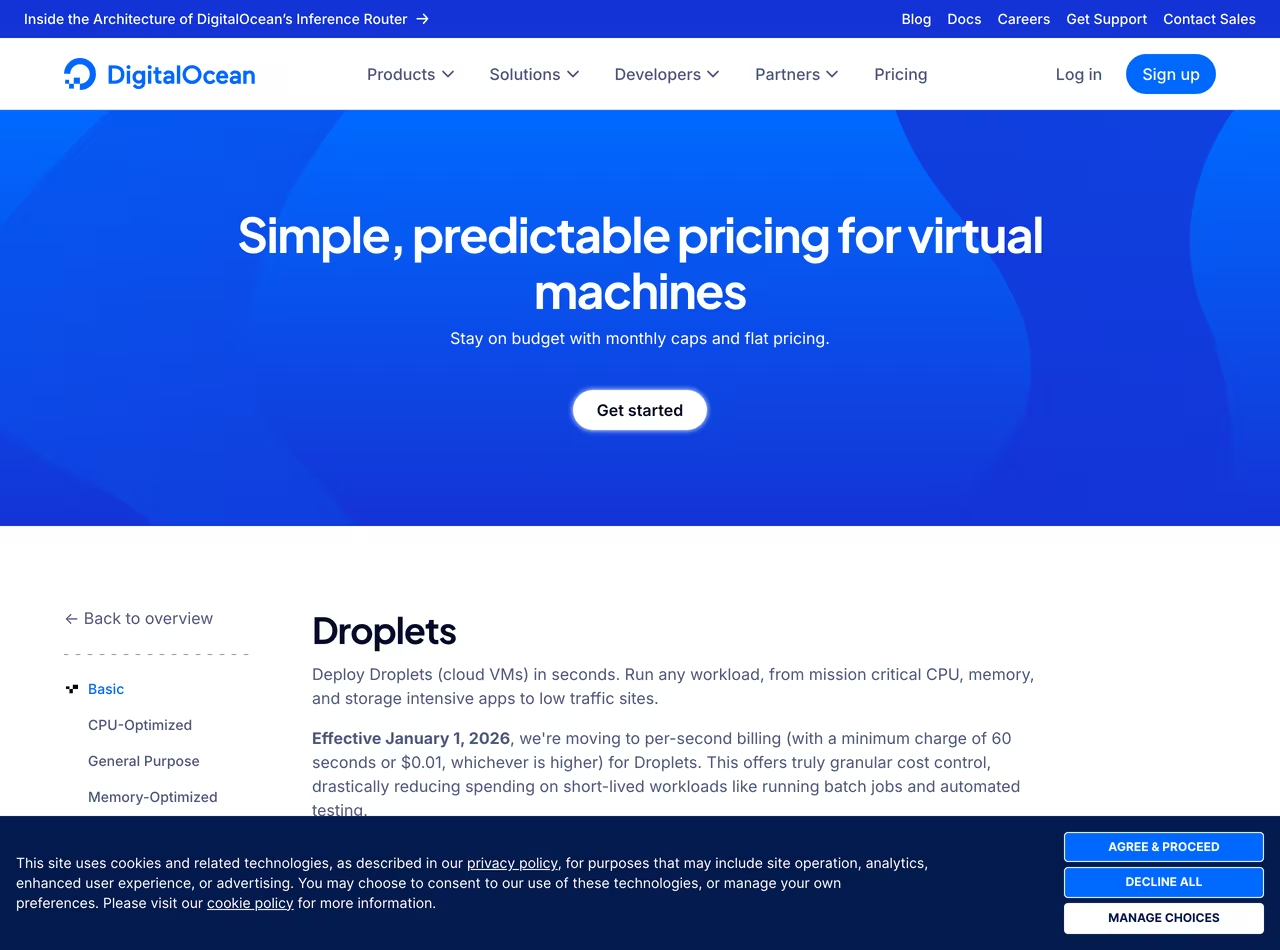 DigitalOcean Droplet pricing, June 2026
Vultr — best for global reach and bare metal options
Cloud Compute starts around $2.50–$6/month, with High Frequency instances on 3 GHz+ Xeon and NVMe from $6/month (the 2 GB tier is $12). Vultr's edge is geography: dozens of locations worldwide, plus bare metal if you outgrow virtualization.
Best for: apps that need a node close to users in many regions, or game/voice servers needing high single-thread speed. The catch: automated backups cost an extra 20% of the instance price — a $20 box becomes $24 the moment you turn on backups.
Contabo — best for maximum RAM on a budget
Contabo plays a different game: stuff the box. Cloud VPS 10 gives you 4 vCPU, 8 GB RAM, 75 GB NVMe for €4.40/month, and the Cloud VPS 30 (8 vCPU, 24 GB RAM) is €11.20. On paper, the cheapest RAM here.
Best for: memory-hungry workloads where you want lots of GB and don't need top-tier latency. The catch: oversubscription and slower disks/network are the well-known trade. Performance is variable, and locations are fewer. Great value, mediocre consistency.
Akamai (Linode) — best balance of simplicity and dedicated CPU
The Nanode is $5/month (1 vCPU, 1 GB, 25 GB) and shared plans scale cleanly: Linode 4 GB is $24/month. Dedicated CPU plans start at $36/month for guaranteed, non-shared cores — useful when consistent performance matters more than price.
Best for: teams that want DigitalOcean-style simplicity with an easy path to dedicated CPUs and Akamai's network behind it. The catch: pricing tracks DigitalOcean closely, so it's not the cheapest; you're buying predictability and network quality.
OVHcloud — best for EU data residency and compliance
OVHcloud VPS starts around $6.46/month, with VPS-2 from $9.99. The real draw is European ownership, EU datacenters, and strong sovereignty/compliance positioning — relevant if GDPR data residency is non-negotiable for you.
Best for: EU businesses that need data to legally and physically stay in Europe under an EU operator. The catch: the control panel and provisioning UX lag the cleaner competitors, and Windows/managed add-ons push the effective price well above the base rate.
Oracle Cloud — best free tier, period
Oracle's Always Free tier is genuinely the most generous on the market: up to 4 Arm Ampere A1 OCPUs, 24 GB RAM, 200 GB storage, and 10 TB/month egress — free forever, not a 12-month trial. You can run a real production-grade small server for $0.
Best for: side projects, learning, and anyone who wants a capable always-free box. The catch: ARM capacity is frequently "out of capacity" in popular regions, account verification needs a card, and the broader OCI console is enterprise-complex. Grabbing the free instance can take patience.
AWS Lightsail — best for staying inside the AWS ecosystem
Lightsail bundles start at $3.50/month (IPv6-only nano) and $5/month with a public IPv4, scaling up to memory-optimized boxes. New Memory-Optimized bundles launched February 2026. It's AWS's "simple VPS" front door with predictable bundle pricing.
Best for: developers already on AWS who want a fixed-price box that can later reach into S3, RDS, and friends. The catch: you pay for the AWS brand and ecosystem; per-GB RAM value trails Hetzner and Contabo badly, and the "simple" pricing gets less simple once you attach other AWS services.
An angle nobody else covers: lock in price now, because RAM isn't getting cheaper
Most "best VPS" lists treat price as a static number. In 2026 that's a mistake. Analysts expect DRAM to stay tight into 2027–2028, with prices potentially 2.5–3x their 2025 level by year-end. The practical implication: if a provider offers a longer-term commitment at today's rate, that's effectively a hedge against the next hike — and the providers most exposed to RAM cost (the ultra-cheap, RAM-stuffed plans like Contabo) are the ones most likely to raise prices again. Buying the cheapest-per-GB box today can mean the steepest renewal tomorrow. Factor renewal risk into the decision, not just the launch price.
Which to choose, by use case
- Cheapest real VPS: Hetzner CX22 (€4.49) or Contabo Cloud VPS 10 if you want raw RAM. AWS Lightsail's $3.50 IPv6-only nano is technically cheaper but tiny.
- Best performance per euro: Hetzner CPX line (AMD EPYC) — nothing else is close on value.
- Best for beginners: DigitalOcean, for the docs and dashboard. Akamai/Linode a close second.
- EU data residency: OVHcloud (EU operator) or Hetzner's German/Finnish regions.
- Free: Oracle Cloud Always Free — 24 GB RAM ARM for $0, if you can claim it.
- Global edge presence: Vultr.
FAQ
Which VPS is best?
For most people, Hetzner — it offers the most RAM and CPU per euro, with solid NVMe storage and locations in the EU and US. If you're new or want a polished experience, DigitalOcean is the better first VPS. If your budget is $0, Oracle Cloud's Always Free tier is unmatched.
Is Hetzner better than DigitalOcean?
For value, yes — Hetzner gives you noticeably more RAM and compute for your money (CX22 at €4.49 vs. comparable DO Droplets at higher prices). DigitalOcean wins on developer experience: better dashboard, best-in-class documentation, managed databases and Kubernetes, and per-second billing. Choose Hetzner to save money, DigitalOcean to save time.
What's the cheapest VPS hosting?
By absolute price, AWS Lightsail's $3.50/month IPv6-only nano and Vultr's ~$2.50/month entry instances are the lowest sticker prices, but they're very small. For cheapest usable RAM, Contabo (4 vCPU / 8 GB / €4.40) and Hetzner (€4.49) lead. For free, Oracle Cloud Always Free beats every paid option.
Is a VPS worth it in 2026?
Yes — even with the price increases, a VPS still costs a few dollars to low double-digits per month for full root control, dedicated resources, and far better performance than shared hosting. The RAM shortage raised prices industry-wide, but a VPS remains the cheapest way to run real workloads with real control. Just buy on current pricing and watch renewal terms.
Will VPS prices keep rising?
Likely through 2026 and into 2027, because the underlying DDR5 shortage is expected to persist until new memory production capacity comes online around 2027–2028. Locking a longer-term rate now can hedge against the next increase.
Our recommendation
Pick Hetzner if you want the best value and can live with a basic dashboard. Pick DigitalOcean if you're new or want polish and great docs. Grab Oracle Cloud Always Free if you want a capable server for $0. Whatever you choose, decide on June 2026 pricing — not last year's — and read the renewal terms before you commit.
Affiliate disclosure: TechRiseUps may earn a commission if you sign up through some links on this page, at no extra cost to you. It never changes our rankings — pricing and verdicts are based on each vendor's official, dated pricing pages and primary reporting on the 2026 memory market.
Sources
- Hetzner — official Cloud pricing and the April 2026 price adjustment notice (CX/CPX plans, €/month, traffic, locations).
- DigitalOcean — official Droplet pricing page (Basic plans, $/month, per-second billing change Jan 2026).
- Vultr — official pricing page (Cloud Compute, High Frequency, backup add-on cost).
- Contabo — official pricing page (Cloud VPS 10–50 specs and €/month).
- Akamai/Linode — official compute pricing (shared and dedicated CPU plans).
- Oracle Cloud — Always Free tier documentation (Ampere A1, 24 GB RAM, 200 GB, 10 TB egress).
- Network World / Tom's Hardware / TrendForce — primary reporting on the 2026 DDR5 shortage and DRAM contract-price increases.
Some links may earn us a commission at no extra cost to you.

Waqas Ahmed Waseer
Waqas Ahmed Waseer is a developer and automation builder with 8+ years shipping production systems used by 100k+ people. He builds custom multi-tenant SaaS, AI automation (n8n, LLM workflows, WhatsApp bots) and hosting infrastructure (WHM/cPanel, CloudLinux) — and is the maker of WaSphere, FlowMaticX, and the WaseerHost hosting brand. 100+ projects delivered for SMBs, agencies and funded startups.