If you're building a relational app and you care about owning your data, pick Supabase. If you're shipping a mobile app that needs rock-solid offline sync and you already live inside Google Cloud, pick Firebase. That's the short answer, and for most of you it's the whole answer — but the gap between these two narrowed in a way nobody predicted a year ago, so the details matter more in 2026 than they used to.
We build TechRiseUps on Supabase and Postgres. So you're getting this from people who actually run one of these in production, not a feature-grid recap. We'll be fair to Firebase anyway, because the 2026 version of Firebase is a genuinely different product than the one most "vs" articles are still describing.
Supabase vs Firebase at a glance
| Supabase | Firebase | |
|---|---|---|
| Database | PostgreSQL (relational, SQL) | Firestore (NoSQL documents) + SQL Connect (Postgres, newer) |
| Pricing model | Flat tiers + usage caps (Free, $25 Pro, $599 Team) | Spark (free) + Blaze pay-per-operation |
| Auth | Postgres-backed, Row Level Security | Firebase Auth, declarative Security Rules |
| Realtime | Postgres LISTEN/NOTIFY + WebSockets | Native realtime sync, offline-first |
| Scaling | Vertical compute + read replicas | Auto-scales reads/writes, near-zero ops |
| Lock-in | Low — open source, self-hostable, pg_dump out | High — proprietary format, Google Cloud only |
| Best for | Relational apps, AI/vector, cost predictability | Mobile, realtime, Google-ecosystem teams |
 Supabase pricing, July 2026
Supabase: Postgres with the boring parts done for you
Supabase isn't a database. It's a managed layer wrapped around a real PostgreSQL instance — auth, storage, realtime, edge functions, and a vector store (pgvector) bolted onto a database you'd recognize from any backend job in the last 20 years. That's the entire pitch, and it's a good one. When you outgrow the convenience layer, you still have plain Postgres underneath. You can pg_dump it and walk.
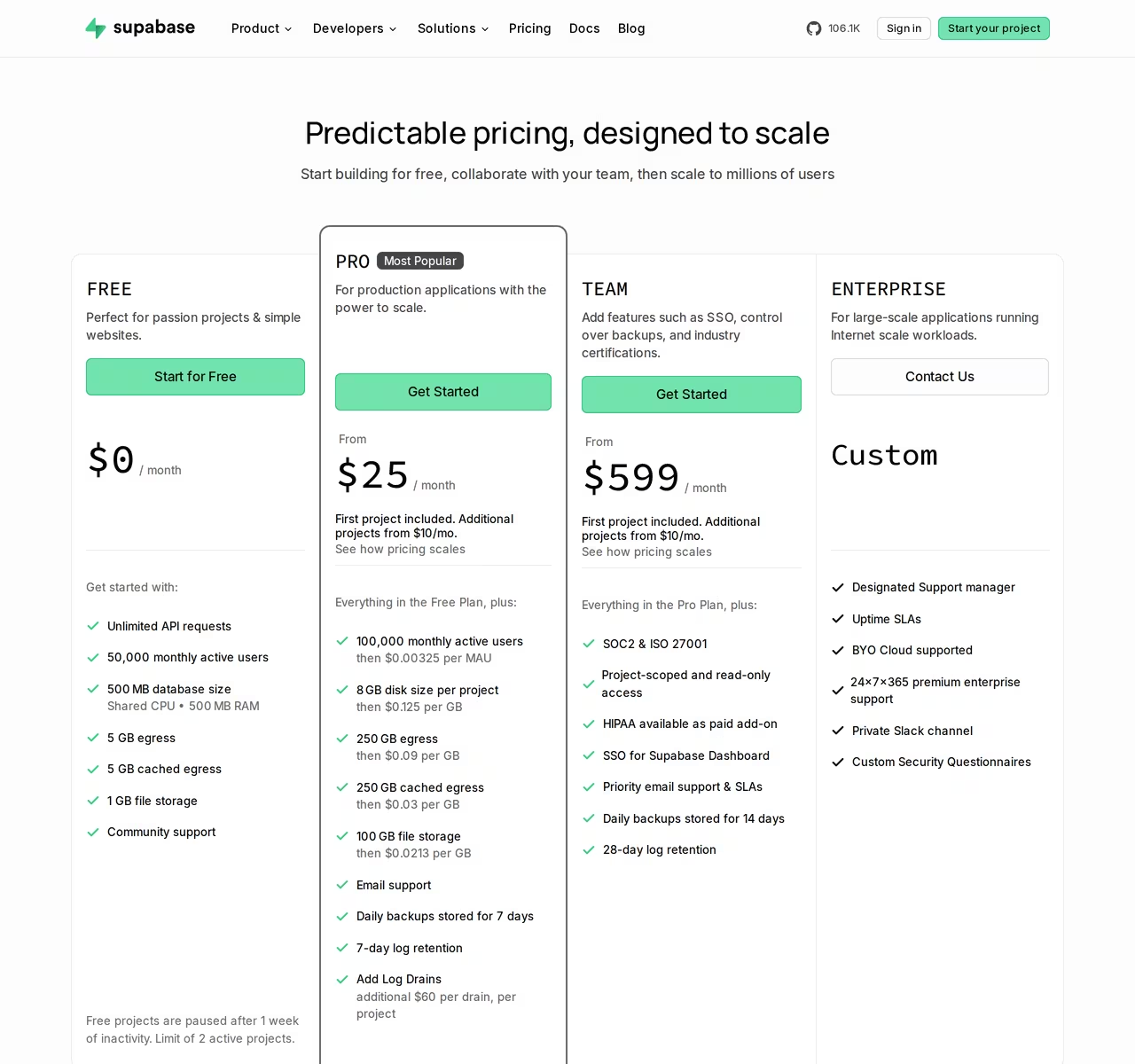
Pricing is refreshingly legible. The Free plan gives you 500 MB of database storage, 50,000 monthly active users, 1 GB file storage, 5 GB egress, and 200 concurrent realtime connections — at $0. Free projects pause after a week of inactivity, and you're capped at two active projects, so it's for prototypes, not production.
Pro is $25/month and bumps you to 8 GB database, 100,000 MAUs, 100 GB file storage, 250 GB egress, and 500 realtime connections, plus $10/month in compute credits that cover one Micro instance. The thing I appreciate most: the spend cap is on by default. You have to actively choose to let your bill grow past the included quota. Overages, when you opt in, are cheap and predictable — $0.125/GB for database, $0.09/GB egress, $0.00325 per extra MAU (Supabase pricing).
Team is $599/month and exists mostly for compliance — SOC 2, ISO 27001, 14-day backup retention, priority support. Enterprise is custom, with HIPAA and bring-your-own-cloud. The jump from $25 to $599 is steep, and that's a fair criticism: there's nothing in between, so a small team that needs SOC 2 but not the rest of the Team tier pays a tax.
On the developer experience: it is good but not magic. Row Level Security is the killer feature and also the foot-gun. RLS policies are SQL, they live next to your data, and one set of rules governs the database, storage, and APIs at once. When you get them right, access control is airtight. When you get them wrong, you ship a public table and find out on Hacker News. Budget real time to learn it.
The other thing worth knowing: Supabase is fully open source under Apache 2.0, and every component — the Postgres image, the auth server, the realtime engine, the storage API — is on GitHub. You can run the whole stack locally with Docker or self-host it on your own infrastructure. We don't self-host TechRiseUps, but the option changes the calculus. It means the worst-case exit isn't a migration project; it's a config change. Few teams ever pull that lever, but knowing you can keeps the vendor honest, and it's the cleanest answer to lock-in anxiety in this whole category (opensourcealternatives.to).
Firebase: the realtime mobile backend that just grew a Postgres
Firebase is Google's app platform, and for a decade its identity was Firestore — a NoSQL document store with native realtime sync and genuinely excellent offline support. If you've ever built a chat app or a collaborative mobile feature and had it "just work" when the user goes through a tunnel, that's Firestore's conflict resolution and local cache doing the heavy lifting. Supabase still doesn't match it here, and I won't pretend otherwise.
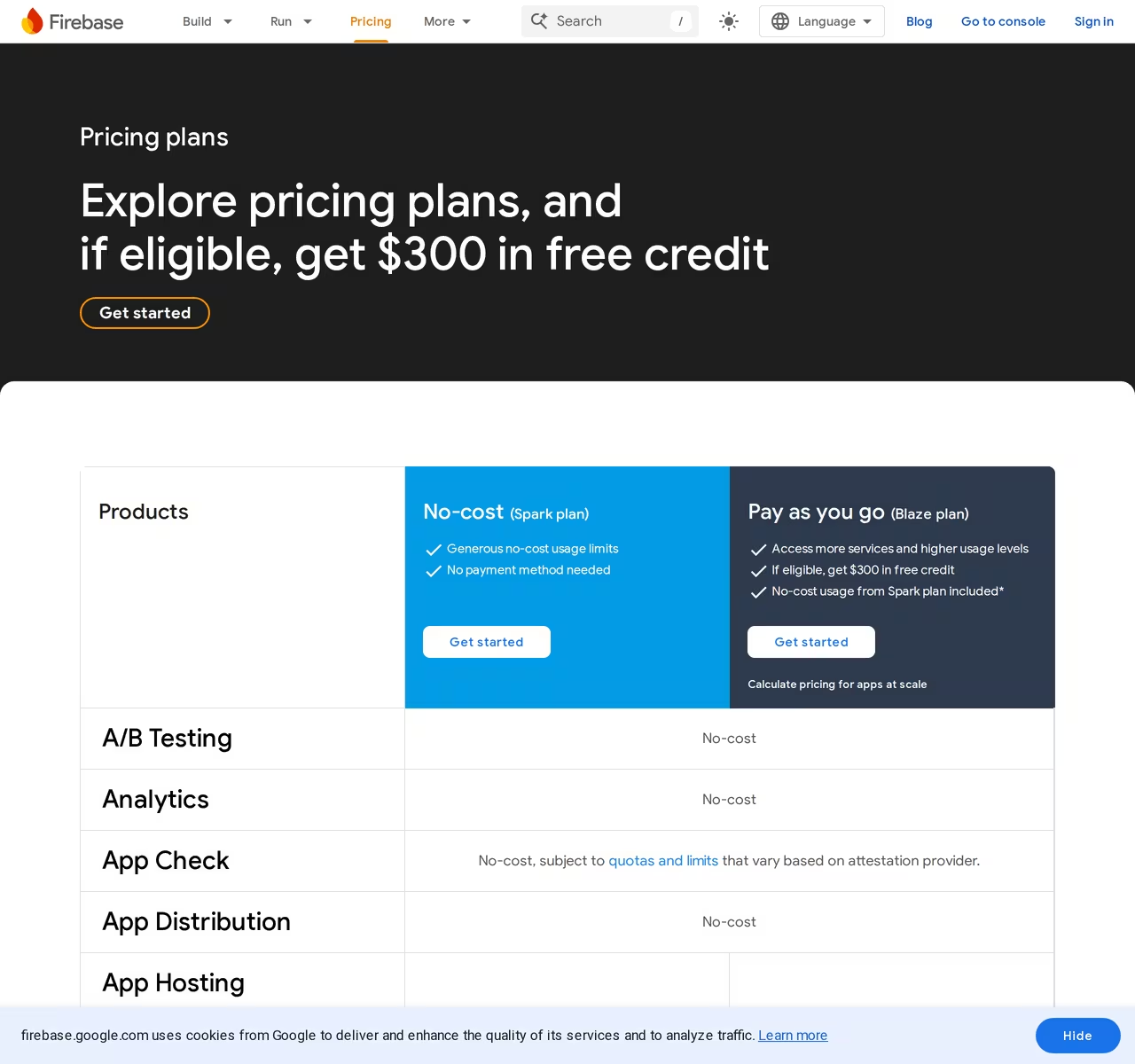
Firebase has exactly two plans, and that simplicity is real. Spark is free: 1 GiB Firestore storage, 50,000 document reads/day, 20,000 writes/day, 20,000 deletes/day, 5 GB Cloud Storage, 10 GB hosting, and 50,000 free MAUs on Auth. Blaze is pay-as-you-go — same free quotas, then you're billed for every operation over the line.
The numbers that matter on Blaze: Firestore runs roughly $0.06 per 100,000 reads, $0.18 per 100,000 writes, $0.02 per 100,000 deletes, and $0.18/GB stored. Cloud Functions are free up to 2M invocations/month, then $0.40/million. Cloud Storage is about $0.026/GB. These are small numbers, which is exactly how the bill sneaks up on you — more on that below.
The 2026 story you probably haven't caught up on: Firebase Data Connect became Firebase SQL Connect in April, and it's a managed PostgreSQL (Cloud SQL) layer with realtime subscriptions, offline caching, and now native SQL queries — window functions, PostGIS, the works (Firebase blog, April 2026). SQL Connect operations are priced at $0.90 per million as of May 1, and the Spark plan throws in a 90-day free Postgres instance with no card. Read that again: Firebase will now sell you managed Postgres. The product is converging on Supabase's home turf, which is the single most important thing happening in this comparison and the part most "vs" pages haven't absorbed yet.
 Firebase pricing, July 2026
Which one should you actually pick
You're building a relational app (SaaS, dashboards, anything with users → orgs → projects → records). Supabase, easily. Postgres handles joins, transactions, and foreign keys natively. Firestore makes you denormalize or fire multiple queries to model the same thing, and you feel that pain forever. This is the most common case and Supabase wins it cleanly.
You're shipping a realtime or mobile-first app. Firebase, still. Firestore's offline sync and conflict handling are battle-tested across millions of apps. Supabase realtime works — it's Postgres LISTEN/NOTIFY over WebSockets — but it doesn't do offline-first or automatic conflict resolution. If your app's whole personality is "live and works on the subway," Firebase saves you months.
You need predictable cost. Supabase. A flat $25 with a default spend cap means you know your bill. Firebase's per-operation model is its own section below, and the word is "surprise."
You're deep in Google's ecosystem — BigQuery, Vertex AI, GCP IAM, the whole estate. Firebase, obviously. The integration is seamless and SQL Connect now means you can get Postgres without leaving the building.
You're building AI features. Supabase, lightly. pgvector ships on every tier including Free, so embeddings and semantic search cost nothing extra. Firebase has Vertex AI integration, which is more powerful but also more cost and more lock-in.
The pricing reality nobody screenshots for you
Here's the honest tradeoff, and it cuts both ways.
Firebase Blaze looks cheap until you go viral. The model charges per document read, and modern apps read constantly — every page load, every list, every realtime listener fires reads. A feed-style app with 50,000 daily active users each triggering 1,000 reads runs roughly 50 million reads a day. At $0.06 per 100,000, that's about $30/day on reads alone, before writes, storage, or functions. Comparison pages quote even scarier monthly figures, and while your real mileage depends heavily on caching and query design, the structural risk is real: your bill scales with engagement, not with value. People discover this after a launch, not before. The Firebase docs are upfront about the per-operation rates; it's the multiplication that bites.
Supabase inverts the risk. You pay for the database size and compute, not the number of reads. Ten million reads on a Pro instance cost the same as ten thousand, as long as the box keeps up. The ceiling is "my instance is too small, upgrade compute" — a problem you can see coming on a dashboard, not a four-figure invoice after a good weekend. The flip side: Supabase makes you responsible for scaling that instance. Firebase scales reads and writes for you with near-zero ops. You're trading a surprise bill for a capacity-planning chore. Pick your poison honestly.
One more fair point for Firebase: for genuinely small or spiky workloads, Blaze can be cheaper than $25/month, because you only pay for what you use and the free quotas are generous. A side project with light traffic might run a couple of dollars a month on Blaze versus Supabase's Pro floor. Supabase's Free tier covers that case too — until it pauses on you.
There's also a lock-in cost that never shows up on either pricing page, and it's the one I'd weight most heavily over a multi-year horizon. Leaving Supabase is pg_dump and restore onto any Postgres host on the planet — a weekend, not a quarter. Leaving Firestore is a rewrite: the data lives in a proprietary document format, exporting it cleanly takes custom scripts, and your queries, security rules, and access logic all assume Firestore's model. Teams that migrate off Firebase routinely describe it as a multi-month engineering project rather than a data export (opensourcealternatives.to). SQL Connect softens this for new Firebase projects that start on Postgres, but if your existing app is built on Firestore, that escape hatch doesn't retroactively apply. Price the exit before you price the entry.
FAQ
Is Supabase better than Firebase?
For relational apps, cost predictability, and avoiding lock-in — yes. For mobile-first realtime and offline sync — no, Firebase is still better. "Better" depends entirely on your app. We run Supabase because TechRiseUps is a content platform with structured, relational data and we want to own it. A live-collaboration mobile app would be a different call.
Is Supabase cheaper than Firebase?
Usually, at scale, and almost always more predictable. Supabase's flat $25 Pro with a default spend cap protects you from runaway bills. Firebase's per-operation Blaze pricing can be cheaper for tiny or spiky apps but gets expensive fast for read-heavy apps at scale, because you pay per document read (Firebase pricing). If your worst fear is an invoice you didn't see coming, Supabase is cheaper in the way that matters.
Can Supabase replace Firebase?
For most web and SaaS use cases, yes — auth, database, storage, realtime, and functions all have Supabase equivalents. The gap is mobile offline sync and conflict resolution, where Firestore is still ahead. If your app leans hard on offline-first mobile, a straight swap will cost you features you'd have to rebuild yourself.
Is Firebase being deprecated?
No. Firebase is actively developed and got major investment in 2026, including the launch of Firebase SQL Connect — managed PostgreSQL with realtime and native SQL (Firebase blog). If anything, Firebase is expanding toward relational databases, not winding down. The "Firebase is dying" takes are wrong.
Does Firebase support SQL now?
Yes, as of 2026. Firebase SQL Connect (formerly Data Connect) runs on Cloud SQL for PostgreSQL and supports native SQL queries — window functions, PostGIS, complex transactions — alongside realtime subscriptions, priced at $0.90 per million operations (Firebase blog, April 2026). It's the biggest reason this comparison looks different than it did a year ago.
Bottom line
Default to Supabase if you're building a relational web app, want predictable bills, and value owning your data — that's the majority of projects, and it's what we chose for TechRiseUps. Reach for Firebase if you're shipping mobile-first software with serious offline and realtime needs, or you're already standardized on Google Cloud. And watch the convergence: Firebase SQL Connect means the old "Postgres vs NoSQL" framing is no longer the whole story, so judge the 2026 products, not the 2023 reputations.
Affiliate disclosure: TechRiseUps may earn a commission if you sign up through links on this page, at no extra cost to you. TechRiseUps itself runs on Supabase, but these recommendations follow the official docs and pricing we cite, not commission rates. Pricing was verified in July 2026 and changes often — confirm current rates on each provider's pricing page before you commit.
Some links may earn us a commission at no extra cost to you.

Waqas Ahmed Waseer
Waqas Ahmed Waseer is a developer and automation builder with 8+ years shipping production systems used by 100k+ people. He builds custom multi-tenant SaaS, AI automation (n8n, LLM workflows, WhatsApp bots) and hosting infrastructure (WHM/cPanel, CloudLinux) — and is the maker of WaSphere, FlowMaticX, and the WaseerHost hosting brand. 100+ projects delivered for SMBs, agencies and funded startups.