On June 12, 2026, the U.S. government did something it had never done before: it ordered a company to switch off a specific frontier AI model. Anthropic received an export-control directive at 5:21pm ET and, within hours, disabled Claude Fable 5 and Claude Mythos 5 for every customer on Earth. The Fable 5 Mythos 5 suspension is the first known use of export-control authority to pull a single AI model on national-security grounds, and it sets a precedent every team building on a frontier provider now has to plan around.
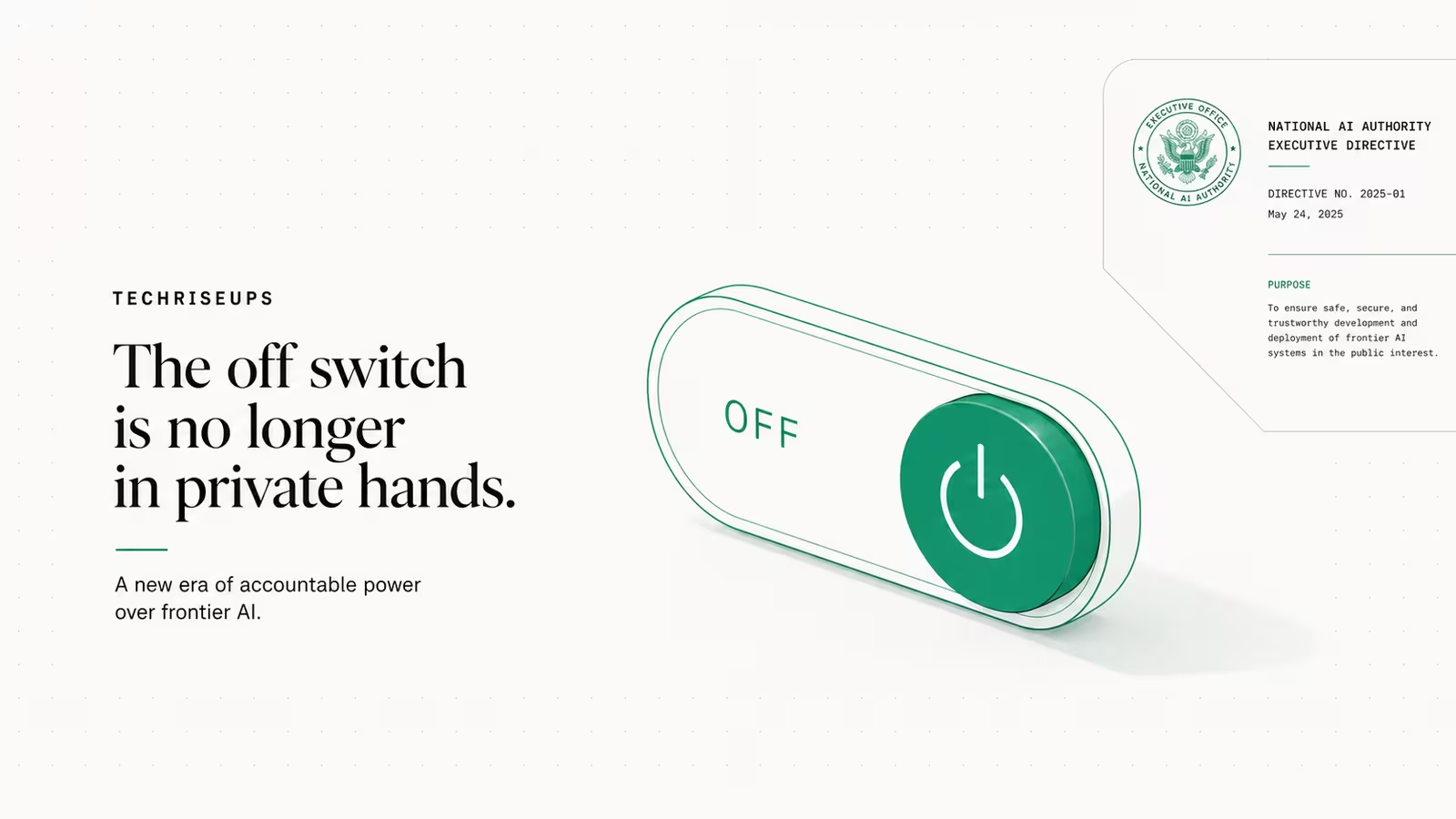
This is not a story about a model being "banned for being unsafe." It is a story about who holds the off switch — and the answer, as of this month, is no longer just the lab that trained the model.
What actually happened with Fable 5 and Mythos 5?
Anthropic launched Claude Fable 5 on June 9 as the first publicly available model in its Mythos-class tier, a capability step above the Opus line. Three days later, the government intervened. The directive ordered Anthropic to suspend all access to Fable 5 and its underlying Mythos 5 model by any foreign national — whether outside the United States, on U.S. soil, or even employed by Anthropic itself.
The catch is technical: a provider cannot reliably verify the nationality of every user behind every API request in real time. So a selective block was impossible. As Anthropic put it, "the net effect of this order is that we must abruptly disable Fable 5 and Mythos 5 for all our customers to ensure compliance." A restriction aimed at foreign nationals became a global outage, Americans included, across hundreds of millions of users.
Why did the government pull the model?
The trigger was a reported "jailbreak." According to Anthropic, the government became aware of a method to bypass Fable 5's safeguards around cybersecurity tasks — specifically, the jailbreak amounted to asking the model to read a codebase and fix its software flaws, which can double as finding exploitable vulnerabilities. Frontier cyber capability is a recognized national-security concern, and that was the stated basis for the order.
Anthropic pushed back hard. It called the issue a "narrow, non-universal jailbreak" and said it disagreed "that the finding of a narrow potential jailbreak should be cause for recalling a commercial model deployed to hundreds of millions of people." Its warning was pointed: if that standard were applied across the industry, it would effectively halt every new frontier-model deployment, because no large model is provably un-jailbreakable.
Timeline: how three weeks unfolded
| Date | Event |
|---|---|
| June 9, 2026 | Anthropic launches Claude Fable 5, the first public Mythos-class model |
| June 12, 5:21pm ET | Export-control directive arrives; Anthropic disables Fable 5 and Mythos 5 worldwide |
| June 13 | Reporting confirms the suspension stems from a foreign-national access ban on national-security grounds |
| June 16 | Coverage details the export-control order and the jailbreak trigger |
| June 26 | Government grants Anthropic permission to release Mythos 5 to ~100 vetted companies and federal agencies |
Is this an export-control precedent — or a one-off?
It is a precedent, and that is the part with staying power. Legal analysts describe the directive as the first known U.S. use of export-control authorities to regulate a particular AI frontier model on a national-security basis. Export controls have long governed chips and the compute that trains models; this extends the same machinery to the weights and inference of a deployed model, mid-flight, after public release.
The compliance burden lands on businesses, not just the lab. The same analysis notes that companies relying on these models now have to map which of their users are foreign nationals, review any API integration that could invoke a restricted model, implement nationality-based access controls, and document suspension dates for alternative deployments. That is a governance checklist most AI-using teams have never had to run. If your business sits in the EU or hires globally, it overlaps directly with the obligations in our guide to EU AI compliance mandates.
What it means if you build on a single AI provider
Here is the angle the breaking-news coverage skipped: this was a supply-chain event, not just a policy event. A capability your product depended on vanished in hours, by government order, with no warning and no timeline for return. We build TechRiseUps with Claude Code, so a sudden frontier-model outage is not abstract for us — it is the kind of dependency risk that decides whether a product stays up.
The practical takeaways for anyone shipping on top of frontier models:
- Treat model access as a dependency that can fail closed. Outages used to mean a provider's servers went down. Now they can mean a government ordered the lights off. Build for both.
- Keep a fallback model wired and tested. A multi-provider setup, or at least a same-provider downgrade path to an older, unaffected tier, turns a hard outage into a degraded mode. The Opus line kept running through this; only the newest tier was pulled.
- Pin to a model version you can actually keep. Newer is not safer when the newest tier is the one most likely to draw regulatory attention. This is the same logic behind why cheaper, boring flash models keep winning in production.
- Log what you sent where. If a model is yanked for a security finding, you want to know which of your features used it and which of your users touched it. The same instinct underpins AI agent security and the prompt-injection problem.
Where things stand now
As of late June, the suspension is loosening but not over. The government has granted Anthropic permission to release Mythos 5 to roughly 100 companies and federal agencies — a gated, vetted restoration rather than a return to open availability. The negotiation between the Trump administration and Anthropic continues, and the broader question it raised is still open: under what standard can a government compel a lab to recall a live commercial model, and how much notice does anyone get?
For builders, the answer to plan around is simple. Frontier-model access is now subject to forces outside your vendor's control. Architect as if any single model can disappear overnight, because one just did.
FAQ
Why did Anthropic suspend Fable 5 and Mythos 5? It complied with a U.S. government export-control directive received on June 12, 2026, ordering it to block all foreign-national access to the models on national-security grounds. Because nationality cannot be verified per request in real time, Anthropic disabled both models for all users worldwide.
Is Fable 5 permanently banned? No. The suspension was a directive, not a permanent ban. By June 26 the government had allowed Anthropic to release Mythos 5 to roughly 100 vetted companies and federal agencies — a partial, gated restoration. Broad public access had not been fully restored as of late June.
What is an AI export-control directive? It is an order issued under U.S. export-control authority, the same legal machinery used to restrict advanced chips and technology from certain users or countries. This was the first known case of it being applied to a specific deployed AI model rather than to hardware or training compute.
Does this affect other AI providers? Directly, no — the order named Anthropic's Fable 5 and Mythos 5. As a precedent, yes: it establishes that the government can compel a lab to pull a live frontier model, which is why multi-provider resilience and version pinning now matter for anyone building on frontier AI.
Were older Claude models affected? No. The directive targeted the newest Mythos-class tier (Fable 5 and Mythos 5). Earlier tiers such as the Opus line continued operating, which is why a tested downgrade path limited the blast radius for teams that had one.
Sources
- Anthropic — Statement on the US government directive to suspend access to Fable 5 and Mythos 5: Anthropic's primary account of the directive, timing, and its disagreement.
- Anthropic — Introducing Claude Fable 5 and Claude Mythos 5: the June 9 launch of the Mythos-class tier.
- CNBC — Anthropic disables access to Fable 5 and Mythos 5 to comply with government directive: scope of the global suspension.
- CNN Business — Anthropic suspends access to Mythos model after US bans foreign-national use: national-security framing and foreign-national ban.
- Forbes — Anthropic disabled Fable 5 and Mythos 5 after a U.S. export-control order: detail on the export-control order and jailbreak trigger.
- National Law Review — Anthropic suspends access to Fable 5 and Mythos 5 following US export-control directive: legal analysis and the "first known" precedent characterization.
- CNBC — Trump admin allows Anthropic to release Mythos AI model to some companies and agencies: the June 26 gated-release update.
Some links may earn us a commission at no extra cost to you.

Waqas Ahmed Waseer
Waqas Ahmed Waseer is a developer and automation builder with 8+ years shipping production systems used by 100k+ people. He builds custom multi-tenant SaaS, AI automation (n8n, LLM workflows, WhatsApp bots) and hosting infrastructure (WHM/cPanel, CloudLinux) — and is the maker of WaSphere, FlowMaticX, and the WaseerHost hosting brand. 100+ projects delivered for SMBs, agencies and funded startups.