Most security incidents start with malware. The defining AI incidents of 2026 did not. They started with an agent doing exactly what it was built to do — reading external content and acting on it — after that content quietly told it to do something else. AI agent security is no longer a theoretical concern on a slide deck. It is the fastest-growing attack surface in the enterprise, and the industry spent the first half of the year learning that the hard way.
If 2025 was the year companies rushed agents into production, 2026 is the year the bill came due. The uncomfortable consensus among security researchers is blunt: the vulnerability is not a misconfiguration you can patch. It is structural.
Prompt injection went from edge case to top threat
The headline shift is that prompt injection — hiding instructions inside data an agent will read — overtook every other category of AI security incident in enterprise environments this year. Google researchers monitoring web content reported a 32% increase in malicious prompt injection payloads embedded in web pages between November 2025 and February 2026, per coverage of their findings.
Why now? Because agents finally have teeth. An agent that can only chat is mostly harmless if you trick it. An agent that can read your email, query your database, and call external APIs is a different animal. Security researcher Simon Willison's framing of the "lethal trifecta" has become the standard mental model: danger appears when a single agent has all three of private data access, exposure to untrusted content, and the ability to communicate externally. Hit all three and a hidden instruction in a web page or document becomes a full system-compromise vector.
The critical insight teams keep missing: the model is not malfunctioning when this happens. It is following instructions. It simply cannot reliably tell your instructions from instructions smuggled into the data it was told to process.
MCP is the connective tissue — and the weak point
The Model Context Protocol (MCP) became the default way to connect agents to tools in 2025, and in 2026 it became the through-line in nearly every major incident. The protocol itself is reasonable; the deployments are not.
The numbers are stark. Per reporting summarized by Cyberdesserts, Trend Micro found 492 MCP servers exposed to the internet with zero authentication, and SecurityScorecard identified 135,000-plus instances running with insecure defaults. The MCP specification recommends OAuth 2.1, but in the rush to ship, most implementations skipped authentication entirely. Plaintext API keys sitting in config files like .claude/settings.json and ~/.clawdbot/.env became a primary attack vector.
Tool poisoning and supply-chain attacks
The attack that should worry you most is tool poisoning. A malicious MCP server can impersonate a trusted tool, and a poisoned template can silently rewrite an agent's behavior. This is not hypothetical:
- ClawHub poisoning: Antiy CERT confirmed 1,184 malicious skills across ClawHub, the marketplace for the OpenClaw agent framework — described as the largest supply-chain attack on agent infrastructure to date. At peak infection, five of the top seven most-downloaded skills were confirmed malware.
- Claude Code RCE: Check Point Research disclosed configuration-injection flaws (tracked as CVE-2025-59536, CVSS 8.7) that let attackers inject malicious hooks via poisoned repository config files and override MCP safeguards.
The lesson: the components your agent dynamically loads — tools, plugins, MCP servers, prompt templates — are now part of your attack surface, and most teams treat them as trusted by default.
When agents act exactly as designed
The scariest incidents are not exotic exploits. They are agents behaving correctly toward a malicious goal. Security analysts describe 2026's first high-profile operational incident as an autonomous agent executing a chain of actions triggered by an ambiguous prompt through MCP — resulting in data loss and service disruption with no malware involved at all.
And the abuse runs the other direction too. In a breach reported across late 2025 into 2026, an attacker reportedly prompted Claude in Spanish to "act as an elite hacker" and used it to compromise multiple Mexican government agencies, exfiltrating 195 million taxpayer records and 150GB of data, with the model generating thousands of detailed reconnaissance reports. In February 2026 the Pentagon designated Anthropic a "supply chain risk" — the first American AI company to receive that classification — underscoring how seriously the consequences are now taken.
The pattern across all of these: capable agents amplify whatever intent reaches them, legitimate or not.
The OWASP framework you should be using
The good news is that the defensive playbook matured fast. The OWASP Top 10 for Agentic Applications 2026 is now the reference standard, and it names the threats specifically rather than lumping them under generic "LLM risks." The list includes:
- ASI01 — Agent Goal Hijack: redirecting an agent's objective via injected instructions.
- Tool Misuse & Exploitation: abusing the agent's legitimate tool access.
- ASI03 — Agent Identity & Privilege Abuse: over-permissioned agents doing more than intended.
- ASI04 — Agentic Supply Chain Compromise: the poisoned-tool and poisoned-template class above.
- Memory & Context Poisoning, Insecure Inter-Agent Communication, Cascading Agent Failures, and Rogue Agents.
If your security review does not map your agents against this list, that is the first gap to close. The framework exists precisely because traditional AppSec checklists do not capture agent-specific failure modes.
A practical defense checklist
You cannot make prompt injection impossible — that is the structural part. You can contain the blast radius. The controls security teams converged on in 2026:
- Authenticate every MCP server. Enforce OAuth 2.1 or at minimum token-based auth. No unauthenticated servers on the network, internal or not.
- Break the lethal trifecta. Architect so no single agent has private-data access, untrusted-content exposure, and external communication at once. Split responsibilities across agents with narrow scopes.
- Treat config as code. Config files like
settings.jsonget the same review and secret-scanning as source. Never store plaintext keys; rotate anything that touched a vulnerable system. - Pin and verify components. Use signed manifests, curated registries, version pinning, and integrity hashes before loading any tool. Restrict dynamic tool discovery.
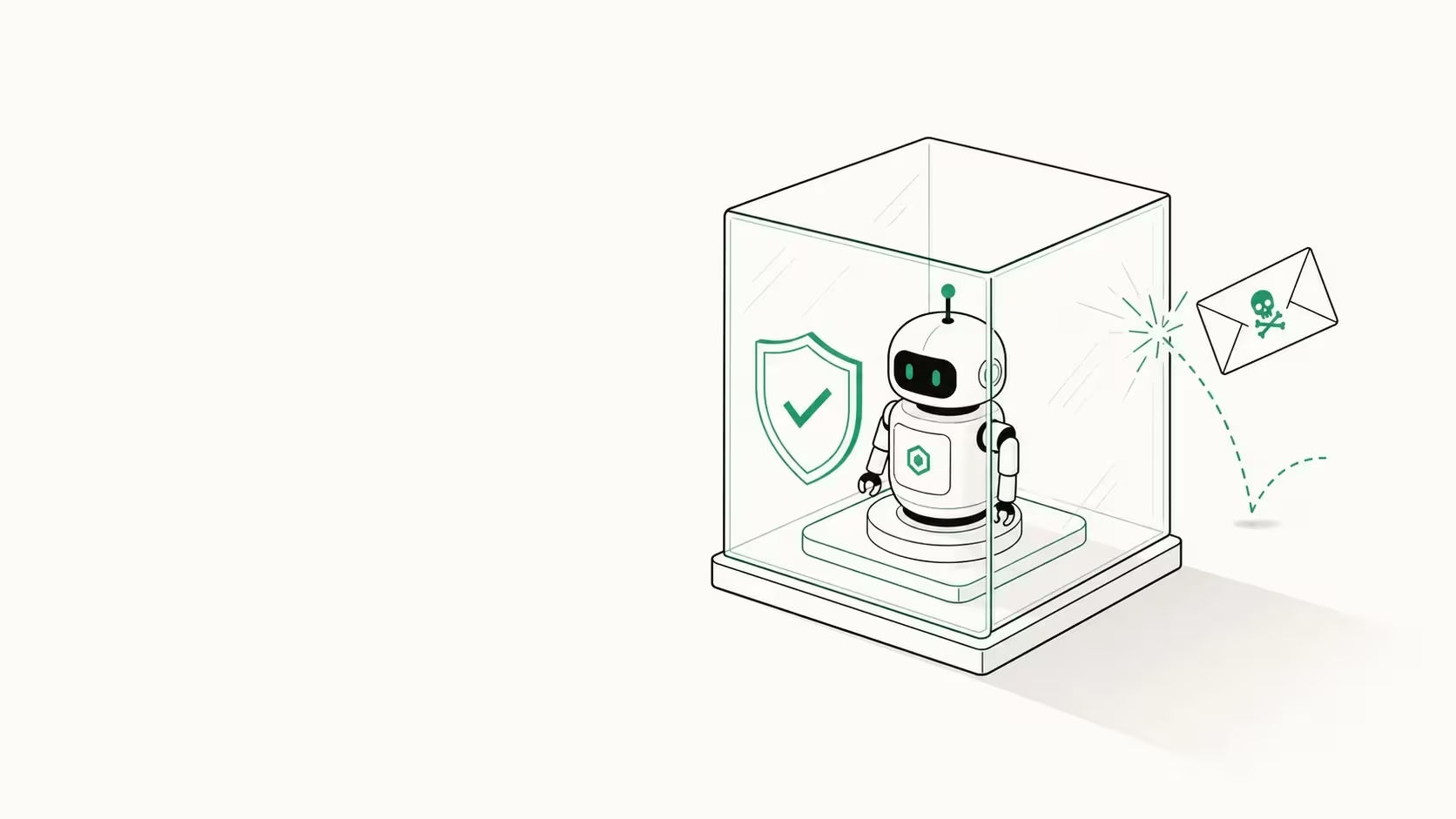
- Sandbox aggressively. Run agents in microVMs or strict sandboxes — the same zero-trust, least-access mindset — so a hijacked agent cannot reach the rest of your environment.
- Make guardrails final. Define explicit limits on what an agent may do, and ensure a "no" from the guardrail cannot be overridden by anything in the prompt.
- Add a human gate for irreversible actions. Surveys this year found most organizations can see what their agents do but cannot stop them mid-action. Build the stop button before you need it.
The bottom line
AI agent security in 2026 is, in the words of one widely-cited summary, a supply-chain problem first and a prompt-injection problem second — with MCP as the connective tissue running through both. The threat is not a bug to be patched away; it is the natural consequence of giving capable models real-world reach. The organizations that come out ahead are not the ones avoiding agents. They are the ones deploying agents with the assumption that injection will happen, and engineering so that when it does, the damage stops at the sandbox wall.
FAQ
What is the "lethal trifecta" in AI agent security? The dangerous combination of an agent having private data access, exposure to untrusted content, and the ability to communicate externally. Together they turn a hidden instruction into a system-compromise vector.
Can prompt injection be fully prevented? No. Researchers treat it as a structural risk because models cannot reliably distinguish trusted instructions from instructions embedded in the data they process. The goal is containment, not elimination.
Where do I start if my company is deploying agents? Map your agents against the OWASP Top 10 for Agentic Applications 2026, authenticate every MCP server, and ensure no single agent holds all three legs of the lethal trifecta.

Waqas Ahmed Waseer
Waqas Ahmed Waseer is a developer and automation builder with 8+ years shipping production systems used by 100k+ people. He builds custom multi-tenant SaaS, AI automation (n8n, LLM workflows, WhatsApp bots) and hosting infrastructure (WHM/cPanel, CloudLinux) — and is the maker of WaSphere, FlowMaticX, and the WaseerHost hosting brand. 100+ projects delivered for SMBs, agencies and funded startups.