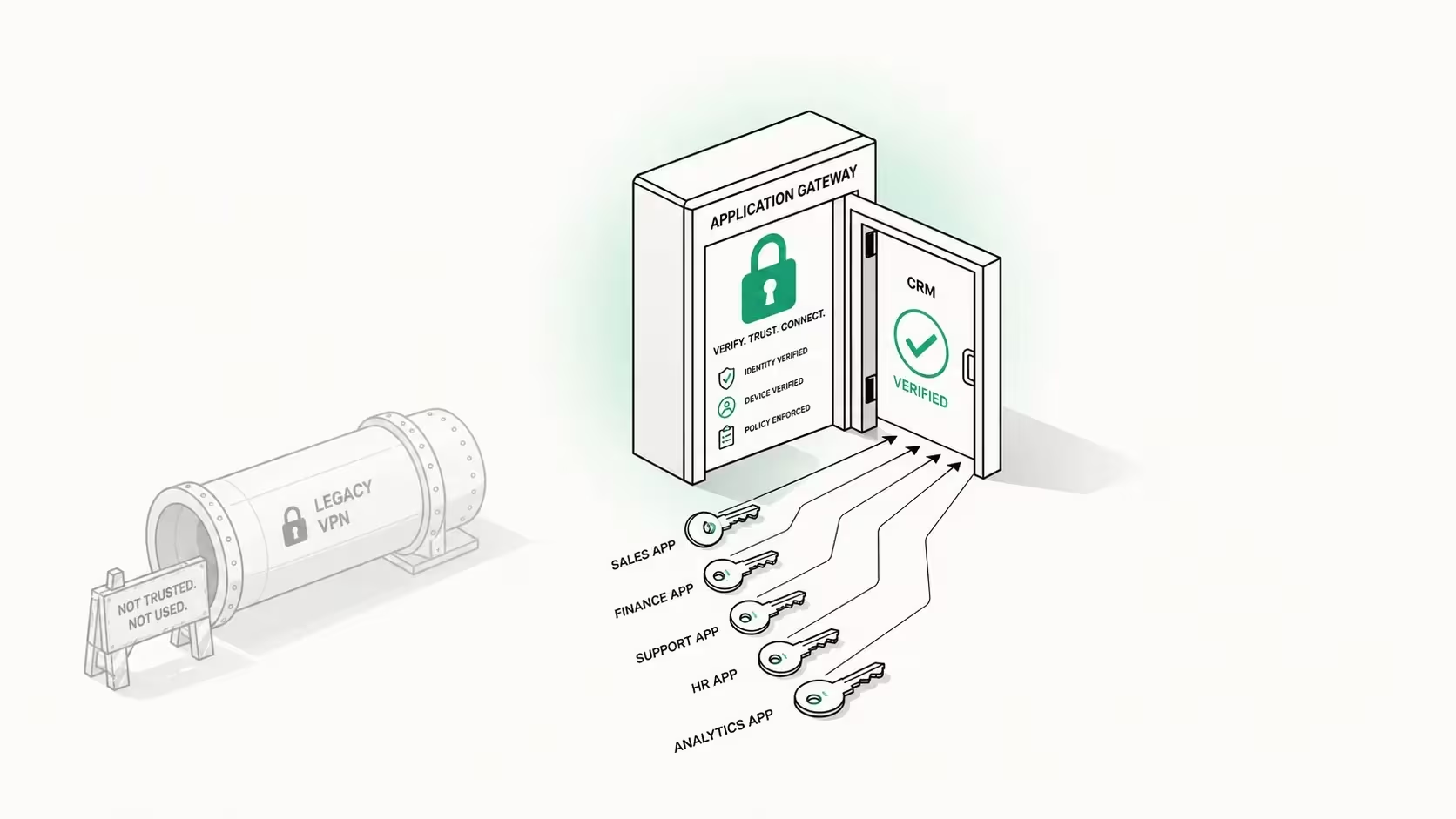
The corporate VPN had a good run. For two decades it answered a simple question — "how do remote employees reach internal apps?" — with a simple answer: drop them onto the network and trust them. In 2026 that answer is the problem. Once a VPN authenticates you, it typically hands you broad access to the network, and that flat trust is exactly what ransomware crews exploit after stealing a single set of credentials.
That is why zero trust has moved from buzzword to budget line. Zero Trust Network Access (ZTNA) flips the model: instead of putting users on the network, it brokers access to one specific application at a time, re-checking identity and device posture on every connection. This guide covers why the shift is happening now, what the leading ZTNA tools actually cost, and how to migrate without breaking your remote workforce.
Why 2026 is the tipping point
The market data tells the story. Industry estimates put the global ZTNA market at roughly $2.2 billion in 2025, growing toward an estimated $25 billion by 2035 at around a 27% annual rate, with surveys suggesting roughly 68% of enterprises are adopting ZTNA to replace or complement VPNs.
The drivers are practical, not theoretical:
- The network perimeter dissolved. Apps live across multi-cloud and SaaS, not in one data center, so "inside the VPN" stopped meaning "near the apps."
- VPN gateways are juicy targets. A public VPN appliance is an internet-facing box with privileged network access — a single exploited CVE can expose the whole LAN.
- Lateral movement is the real cost of a breach. Broad post-authentication access — the same blast-radius problem that makes AI agents so dangerous when hijacked — is what lets one compromised laptop become a company-wide incident.
Vendors have piled in. Zscaler expanded its Private Access platform in January 2026 with browser isolation for legacy app access, and Akamai shipped Edge ZTNA with mutual-TLS enforcement in late 2025 — both aimed at agentless access that simplifies the VPN exit.
What zero trust actually changes
A VPN authenticates once and trusts the session. ZTNA authenticates continuously and trusts nothing by default. In practice that means:
- Per-application access, not network access. A contractor who needs one internal dashboard gets that dashboard — not a route to your databases.
- Device posture checks on every connection. Out-of-date OS or missing disk encryption can block access in real time.
- No inbound ports to attack. Most ZTNA tools use outbound-only connectors, so there is no public VPN gateway to scan and exploit.
- Per-request logging. You get an audit trail of who reached which app, which a flat VPN tunnel rarely provides.
The real cost: ZTNA pricing in 2026
The good news for smaller teams is that the entry price for zero trust has collapsed. Here is current public pricing for three of the most popular VPN-replacement tools. Verify the latest figures on each vendor's pricing page before you commit — these change.
Cloudflare Zero Trust
Per comparison sources tracking Cloudflare's Zero Trust plans, there is a free tier for up to 50 users and pay-as-you-go pricing around $7 per user per month (annual) covering core ZTNA plus secure web gateway, with custom enterprise contracts above that. The 50-user free tier makes Cloudflare unusually generous for startups and small teams piloting a VPN replacement.
Tailscale
Per Tailscale's pricing page, the lineup is:
- Personal: $0, free forever, up to 6 users, unlimited devices, non-commercial use.
- Standard: $8 per user per month, unlimited users, with SCIM provisioning, ACL groups, and MDM integrations.
- Premium: $18 per user per month, adding just-in-time access, advanced SSH, network flow logs, and priority support.
- Enterprise: custom pricing with SLAs and professional services.
Tailscale's appeal is that it is built on WireGuard and behaves like a mesh — it is often the lowest-friction path for engineering teams already comfortable with command-line tooling.
Twingate
Per Twingate's pricing and current comparison data, the tiers are:
- Starter: free, up to 5 users.
- Teams: around $5 per user per month.
- Business: around $10 per user per month (annual), with monthly billing higher.
- Enterprise: custom.
Cost-tracking sources note that negotiated pricing for 25–100 user deployments often lands in the $7–$9 per-user range with annual commitments.
Reading the numbers
For a small team, the practical comparison is roughly Cloudflare at ~$7, Tailscale Standard at $8, and Twingate Teams at ~$5 per user per month — close enough that fit and operational style matter more than the dollar figure. A legacy enterprise VPN with appliance maintenance, licensing, and bandwidth often costs more once you account for the hardware and the security team's time keeping gateways patched.
A practical migration plan
You do not rip out a VPN on a Friday. The teams that succeed run zero trust and VPN in parallel, then shrink the VPN to nothing.
1. Inventory your applications
List every internal app reachable via VPN and tag each by sensitivity and protocol (HTTP, RDP, SSH, database). Web apps are the easiest first wins for agentless ZTNA.
2. Start with one app and one group
Pick a single internal web app and a friendly pilot group. Put it behind your chosen ZTNA tool with identity and device-posture policies. Keep the VPN path live as a fallback.
3. Define identity-and-device policies, not network rules
Write access in terms of who and what device, not IP ranges. Require SSO, MFA, and a posture check (encryption on, OS current) for sensitive apps.
4. Migrate by application, retire by attrition
Move apps in waves, newest and most-used first. Each time an app is fully behind ZTNA, remove it from the VPN. The VPN's footprint shrinks until the gateway can be decommissioned.
5. Turn on logging and review access
Use per-request logs to spot over-broad access and tighten policies. This visibility is itself a reason to make the move.
The takeaway
The shift to zero trust is not a rebrand of the VPN — it is a different trust model that grants access to one app at a time, verifies device health on every connection, and removes the internet-facing gateway that attackers love. With Cloudflare offering a 50-user free tier, Tailscale starting at $8 per user, and Twingate's Teams plan near $5, the cost barrier that once protected the legacy VPN is gone. Start with one app, run both systems side by side, and let the VPN shrink until it is no longer worth maintaining. In 2026, the safest network is the one users never actually join.
FAQ
Is ZTNA just a fancier VPN? No. A VPN places you on the network and trusts the session; ZTNA brokers access to individual applications and re-verifies identity and device posture on each connection, with no broad network access granted.
Do I have to replace my VPN all at once? No — the recommended approach is to run ZTNA alongside the VPN, migrate applications in waves, and decommission the VPN gateway only once nothing depends on it.
Which ZTNA tool is cheapest for a small team?
For very small teams, Cloudflare's free tier (up to 50 users) and Twingate's free Starter (up to 5 users) cost nothing to pilot; on paid plans, Twingate Teams ($5), Cloudflare ($7), and Tailscale Standard ($8) per user per month are all in the same range. Confirm current pricing on each vendor's page.

Waqas Ahmed Waseer
Waqas Ahmed Waseer is a developer and automation builder with 8+ years shipping production systems used by 100k+ people. He builds custom multi-tenant SaaS, AI automation (n8n, LLM workflows, WhatsApp bots) and hosting infrastructure (WHM/cPanel, CloudLinux) — and is the maker of WaSphere, FlowMaticX, and the WaseerHost hosting brand. 100+ projects delivered for SMBs, agencies and funded startups.