RL environments are the AI industry's hottest new infrastructure category, and in 2026 venture capital has poured hundreds of millions into the startups building them. An RL environment is a simulated workplace where an AI agent can practice a real task, like booking a flight, closing a support ticket, or refactoring a large codebase, and earn a reward signal for getting it right. As frontier labs exhaust the easy text left to pretrain on, these AI agent training environments have become the bottleneck, and a tight cluster of 2026 funding rounds shows investors betting that the next leg of agent progress happens here rather than in bigger base models.
The money is real and recent. In the space of a few weeks, Prime Intellect closed a $130 million Series A, Bespoke Labs raised $40 million, and Patronus AI added a $50 million round, all to build the gyms where agents train and get tested. Here is what an RL environment actually is, who is building them, and why more than one veteran investor is quietly asking whether this is a bubble.
What is an RL environment, and why do AI agents need one?
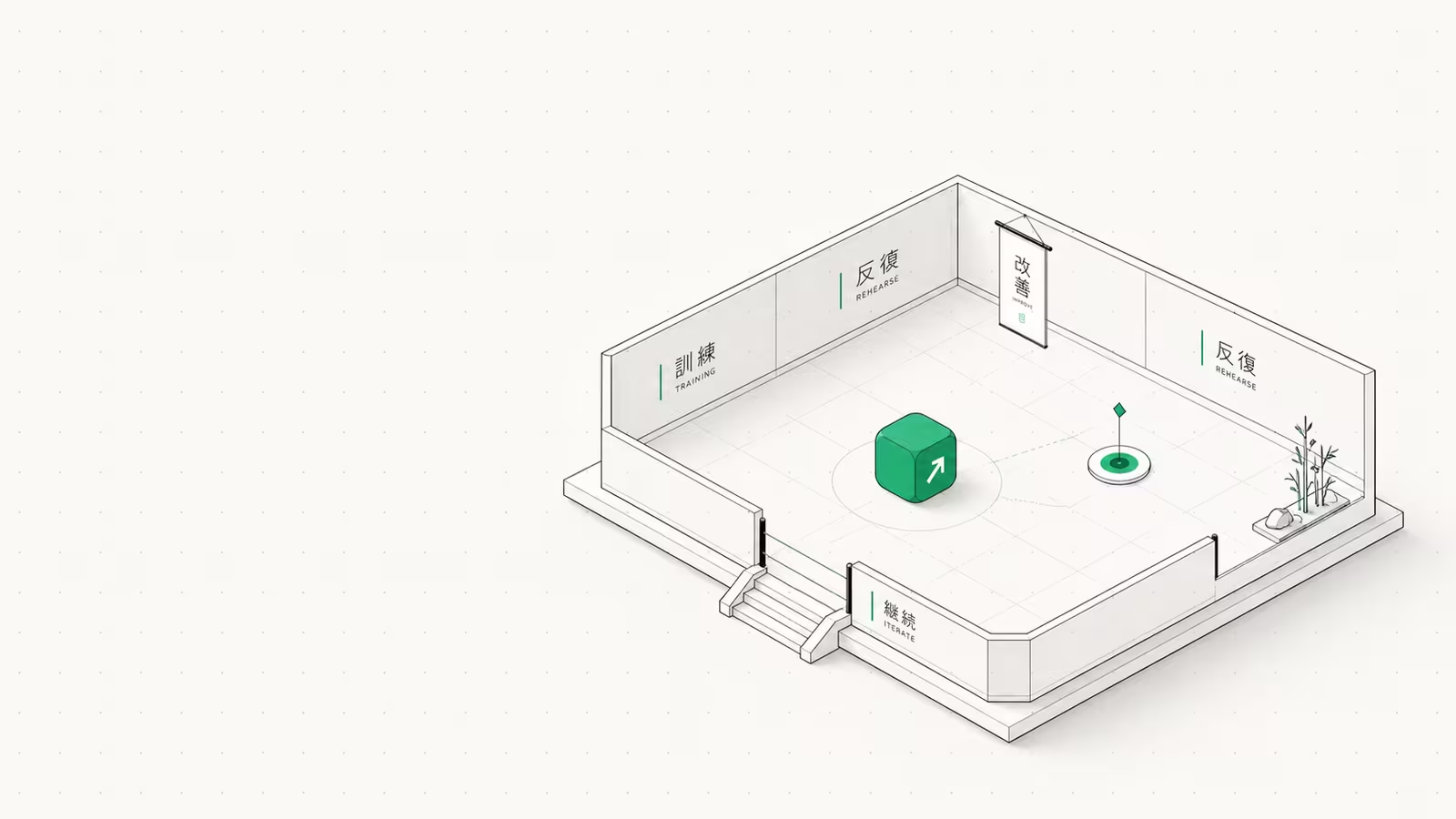
An RL (reinforcement learning) environment is a controlled, interactive simulation where an AI agent attempts a multi-step task, receives a reward when it succeeds and a penalty when it fails, and slowly learns the behavior that wins. One founder described it to TechCrunch as "creating a very boring video game." Simulate a Chrome browser, then reward the agent every time it correctly buys the right item on Amazon. The point is that agents cannot safely learn long, messy workflows in production, where a mistake means a real refund, a deleted file, or an angry customer. A good environment lets an agent fail thousands of times for free. This is a sharp break from the static text-and-image datasets that trained the last generation of models: an environment is not a pile of examples but a live world with rules, tools, and a scorekeeper. That interactivity is exactly what makes them hard to build and expensive to buy.
The 2026 funding wave, by the numbers
The category went from niche to crowded in a single year. The rounds below are all from 2026, and they cluster in a matter of weeks:
| Company | 2026 funding | What it builds | Notable |
|---|---|---|---|
| Prime Intellect | $130M Series A (Jul 8, led by Radical Ventures) | Open RL stack + "Environments Hub" | 6,000 customers, $100M+ ARR |
| Patronus AI | $50M Series B (Jun 25, led by Greenfield Partners) | "Digital world" environments to stress-test agents | $70M raised total; revenue up ~15x in a year |
| Bespoke Labs | $40M Series A (Jul 6, led by Wing VC) | A fake company (codebase, tickets, Slack threads) for agents to rehearse in | Mountain View, founded 2024 |
| Mercor | $10B valuation | Domain-specific environments (coding, health, law) | Data-labeling giant moving into environments |
| Surge | Bootstrapped, $1.2B revenue | New dedicated RL-environments division | Profitable, no outside capital |
| Mechanize | Stealth, ex-Epoch AI team | A small number of very high-fidelity environments | Reportedly offering $500K engineer salaries |
Prime Intellect is the clearest signal of scale: its Series A was led by Radical Ventures with Nvidia Ventures and Intel Capital participating, and the company says it already serves 6,000 customers at more than $100 million in annualized revenue. Patronus AI, founded by two ex-Meta researchers, builds "digital world models," replicas of real websites and internal systems where agents are stress-tested after training. Bespoke Labs goes further, constructing an entire fake company so an agent can rehearse tasks that stretch across days.
Why environments became AI's bottleneck
The shift traces back to a plateau. Pretraining scraped most of the useful public text years ago, and the gains now come from reinforcement learning on real tasks, which requires interactive environments rather than more documents. The old data-labeling giants saw it first. Scale AI lost momentum after Meta's roughly $14 billion investment and the departure of its CEO, while Surge quietly passed $1.2 billion in revenue and spun up a dedicated RL-environments division. Mercor, valued around $10 billion, is now pitching environments for coding, healthcare, and law.
The demand side is even larger than the startups. According to reporting from The Information cited by TechCrunch, leaders at Anthropic discussed spending more than $1 billion on RL environments over a single year. When the buyers are frontier labs with that kind of budget, a supplier market appears fast, which is precisely what 2026 is showing. It fits the broader pattern we covered in the AI agent economy, where the most valuable startups increasingly sell picks and shovels to other AI systems rather than to end users.
Who's building the AI agent training environments
The field splits into three camps. The open-infrastructure players, led by Prime Intellect, want to be the "Hugging Face for RL environments," a hub where thousands of community environments live alongside hosted training and compute. The elite boutiques, exemplified by Mechanize (founded by ex-Epoch AI researchers and reportedly working with Anthropic), build a handful of very high-fidelity environments and pay engineers up to $500,000 to do it. And the data-giants-turned-environment-vendors, Surge, Scale, and Mercor, are repackaging their labeling workforces and infrastructure into simulation and evaluation products. Patronus AI sits slightly apart, focused on the evaluation half: stress-testing and grading agents inside simulated worlds rather than only training them. Most buyers will end up using more than one, because a coding environment and a customer-support environment share almost no engineering.
Is the RL environments boom a bubble?
This is the section the how-to guides skip. The bull case is obvious: agents are the product every enterprise wants, and they cannot ship reliably without somewhere to practice. But there are three real risks. First, commoditization: independent reviewers note there is not yet one clean, buyable RL-environment product, and most deals are bespoke services dressed as platforms, which do not command software multiples. Second, in-housing: the biggest buyers, the frontier labs, have the talent to build environments themselves, exactly as they eventually pulled data work in-house and hollowed out parts of the labeling market. Third, concentration: a huge share of today's revenue traces back to a few labs, so a single change in Anthropic's or OpenAI's training strategy could reset the category overnight. The data-labeling boom-and-cool that hit Scale AI is a recent, uncomfortable precedent. None of this means the winners won't be large; it means the gap between the two or three durable platforms and the dozens of environment shops is likely to be brutal.
What it means for founders and investors
For founders, the lesson mirrors past infrastructure waves and the funding math we broke down in why 88% of AI dollars go to American startups: the defensible position is a real platform with recurring, self-serve revenue and a moat in a specific domain, not a consultancy that hand-builds one environment per client. For investors chasing the record 2026 megadeals, the question to ask any RL-environment pitch is simple: what stops the customer, or the customer's model provider, from building this in-house next quarter? The companies with a clean answer are the ones worth the gold-rush prices.
Frequently asked questions
What is an RL environment in AI? An RL environment is a simulated, interactive setting where an AI agent attempts a task, gets a reward for success or a penalty for failure, and learns the winning behavior through repetition. It replaces static training datasets with a live world that has tools, rules, and a scoring function, letting agents safely practice long, multi-step workflows.
Which startups build AI agent training environments? The most-funded names in 2026 are Prime Intellect, Bespoke Labs, Patronus AI, and Mechanize, alongside data companies moving into the space such as Surge, Scale AI, and Mercor. They range from open community hubs to elite boutiques building a few high-fidelity environments.
Why are RL environments so expensive? Because each one is effectively custom software: engineers must simulate real tools, systems, and reward logic, and high-fidelity environments can take months to build. Mechanize reportedly offered engineers $500,000 salaries for the work, and frontier labs like Anthropic have discussed spending over $1 billion a year on environments.
Are RL environments the same as evaluations? They overlap but are not identical. Training environments teach an agent a behavior through reinforcement learning, while evaluation environments stress-test and grade an already-trained agent. Companies like Patronus AI focus on the evaluation side, though the same simulated worlds are often used for both.
Sources
- TechCrunch — Silicon Valley bets big on 'environments' to train AI agents: defines RL environments, names Mechanize/Prime Intellect/Surge/Scale, and reports Anthropic's ~$1B environment spend.
- PYMNTS — Prime Intellect Raises $130 Million to Help Companies Train AI Agents: $130M Series A led by Radical Ventures, 6,000 customers, $100M+ ARR.
- TechCrunch — Patronus AI lands $50M to build 'digital worlds' that stress-test AI agents: $50M Series B, $70M total, founders and product detail.
- BusinessWire — Bespoke Labs Announces $40M to Build the Environments That Train Reliable Agents: $40M Series A led by Wing VC, July 6, 2026.
- RL List — RL Environment Vendors: 2026 Directory: independent directory noting the space has no single clean, buyable product yet.
Some links may earn us a commission at no extra cost to you.

Waqas Ahmed Waseer
Waqas Ahmed Waseer is a developer and automation builder with 8+ years shipping production systems used by 100k+ people. He builds custom multi-tenant SaaS, AI automation (n8n, LLM workflows, WhatsApp bots) and hosting infrastructure (WHM/cPanel, CloudLinux) — and is the maker of WaSphere, FlowMaticX, and the WaseerHost hosting brand. 100+ projects delivered for SMBs, agencies and funded startups.