The most-funded AI agent startups 2026 has produced aren't building agents at all. They're building the world those agents will live in: payment credentials, identity, memory, phone numbers, and even liability insurance sold to software instead of people. Y Combinator's Spring 2026 batch is the most agent-heavy cohort it has ever run, and the dominant bet is not a smarter chatbot but the "picks and shovels" underneath one. The thesis of the year, repeated across pitch decks and term sheets, is blunt: the agent is the customer.
We build TechRiseUps with Claude Code, and this very research run reaches our SEO data through an MCP server, so we watch the agent-tooling layer as users of it, not from the outside. What follows is who is building what, who is funding it, and what it means if you are starting a company right now.
What is the "AI agent economy"?
The agent economy is the emerging market of infrastructure and services whose paying customer is an autonomous AI agent rather than a human. When an agent has to buy a domain, reserve compute, prove who it is to a bank, remember a task across sessions, or make a phone call, something has to sell it those capabilities in a machine-readable way. That "something" is a fast-growing category of startups. The IMF's 2026 note on agentic payments frames the shift plainly: agents are moving from suggesting actions to executing them, which forces a new layer of financial and identity rails purpose-built for non-human actors. The tell that this is real, not a slide-deck buzzword, is that money is flowing into the boring middle of the stack, not the flashy application on top.
Why startups are selling to agents, not humans
Selling to agents is attractive for the same reason selling shovels beat digging for gold. Application-layer agents are crowded, easy to clone, and exposed to every foundation-model price cut. The infrastructure beneath them is stickier: once a company's agents run on your memory store or authenticate through your identity layer, ripping you out means re-plumbing everything. It is a classic durable-value position. YC's Spring 2026 cohort leans hard into this, with roughly 61% of the batch building B2B tooling rather than consumer apps. Founders describe the strategy as "building the world agents will live in," and investors are rewarding it because an agent that transacts thousands of times a day is a higher-frequency customer than any human user. The catch is that agents are unforgiving buyers: they need deterministic APIs, clear pricing, and airtight auth, or they simply route around you.
The agent supply chain: who is building what
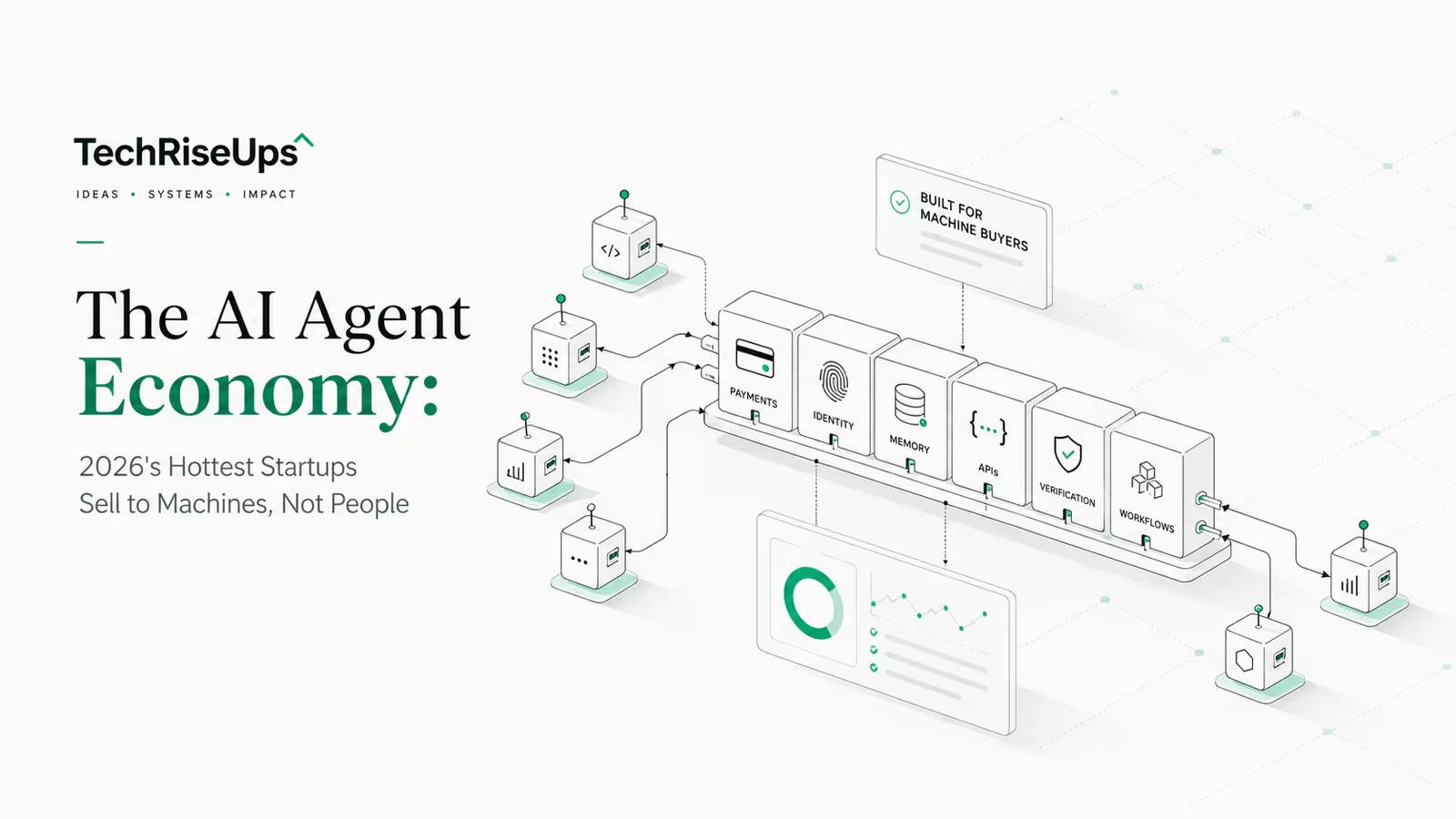
The clearest way to read the batch is by layer. Each slice of the stack now has multiple funded startups treating the agent as an account holder, an authenticated identity, or a liability to be insured. The table below maps the emerging supply chain to representative companies from YC's Spring 2026 directory.
| Layer | What it sells to agents | Representative startups |
|---|---|---|
| Payments & identity | Scoped credentials, agent wallets, verified identity | Allowance, Uno Wallet, Nekuda, Skyfire |
| Memory & context | Shared, persistent memory across an agent fleet | Memory Store, Wato |
| Sandboxes & runtime | Isolated execution, cheaper inference, DB sandboxes | Ardent, ReasonBlocks, StableBrowse |
| Communication | Phone numbers, voice, human-expert handoff | AgentPhone, primitive, Humwork |
| Risk & trust | Liability insurance, anti-fraud behavioral data | Klaimee, Incandor |
| Observability | Monitoring and debugging autonomous systems | Sazabi |
No single company owns the stack, which is exactly why so many seed rounds are getting funded at once. Each layer is a land grab.
Payments and identity: where the money is going first
The payments-and-identity layer is pulling the most capital because it is the hardest to fake and the closest to revenue. An agent that cannot pay is a demo; an agent with a scoped, revocable payment credential is a worker. According to a breakdown of the agentic-commerce landscape by Rye, three companies in this layer have raised nearly $50 million combined. Basis Theory, which runs a PCI-compliant vault and leads the Agentic Commerce Consortium, took $33 million in a Series B in October 2025, pushing its total to roughly $50 million. Nekuda raised a $5 million seed in May 2025 from Madrona, with Amex Ventures and Visa Ventures joining, to build a "Secure Agent Wallet." Skyfire has pulled together about $9.5 million and uses signed JWTs so a merchant can verify which agent is paying. The pattern is that the incumbents of human payments (Visa, Amex, Mastercard) are showing up as investors, not just spectators, because they do not want to miss the rails for machine-speed commerce.
Inside YC's Spring 2026 batch
The Spring 2026 batch is where the "agent as customer" thesis stops being abstract. Alongside the infrastructure plays sit application companies posting numbers that explain the frenzy: Emergent, which builds autonomous coding agents that generate, test, and deploy applications from plain-language intent, is reported to have reached roughly $50 million in ARR within about seven months, one of the fastest ramps in the cohort. The market backdrop is just as heated. A single day of the July 2026 Tech Startups funding roundup shows where the money is landing: Norm AI raised a $120 million Series C at a $1.2 billion valuation to automate contracts and compliance for enterprises, and Taktile pulled in $110 million for an "AI operating system" that runs loan underwriting and claims for banks and insurers. Capital is concentrating where AI meets real operations and real money, and the agent-infrastructure layer sits directly in that path. For a fuller picture of where 2026's AI dollars are landing, see our breakdown of why 88% of AI funding goes to American startups.
What this means if you are a founder
If you are starting a company in this wave, three things follow from the data. First, pick a layer and own its interface: agents reward a clean, deterministic API far more than a clever UI, so the moat is integration depth, not design. Second, build for auth and audit from day one, because an agent that spends money is a compliance surface, and insurers like Klaimee exist precisely because unbounded agent actions are a real liability. Third, watch concentration risk: the same forces pushing megadeals into a handful of names can starve everyone else, a dynamic we covered in 2026's record megadeals and harder seed rounds. The agent economy is early enough that a small team can still claim a layer, but late enough that "an agent, but for X" is no longer a differentiated pitch. The durable question is what your software sells to the millions of agents that will soon be doing the buying. YC's shift here echoes its earlier W26 batch, which tilted toward defense, robotics, and vertical AI — the through-line is AI as infrastructure, not feature.
FAQ
What is an AI agent startup? In 2026 the term increasingly means a company that sells infrastructure to AI agents rather than one that builds a consumer-facing agent. These startups provide the payments, identity, memory, execution sandboxes, and monitoring that autonomous agents need to act reliably, treating the agent itself as the account holder and customer.
Why are investors funding "agent infrastructure" instead of agents? Application-layer agents are easy to replicate and exposed to foundation-model price cuts, while the infrastructure beneath them is sticky and hard to rip out. Once a company's agents run on your memory or auth layer, switching costs are high, which is the durable, "picks and shovels" position investors prefer in a gold rush.
Which layer of the agent economy is raising the most money? The payments-and-identity layer is attracting the most early capital. Companies like Basis Theory, Nekuda, and Skyfire have raised close to $50 million combined, and traditional payment networks are appearing on cap tables because an agent that can transact autonomously is the closest layer to real revenue.
Is the "agent as customer" trend hype or real? The signal that it is real is where the money goes: into unglamorous infrastructure like credential vaults, agent wallets, and liability insurance, not just demos. Roughly 61% of YC's Spring 2026 batch is B2B tooling for agents, and payment incumbents are investing directly, which is unusual for a purely speculative trend.
Sources
- Y Combinator — AI startups (Spring 2026 directory): the batch companies and one-line descriptions cited above.
- Rye — The agentic commerce landscape: who's building what in 2026: funding figures and layers for Basis Theory, Nekuda, and Skyfire.
- Tech Startups — Venture funding roundup, July 7, 2026: market backdrop, including the Norm AI and Taktile rounds.
- IMF — How Agentic AI Will Reshape Payments (2026): the shift from agents suggesting to executing transactions.
Some links may earn us a commission at no extra cost to you.

Waqas Ahmed Waseer
Waqas Ahmed Waseer is a developer and automation builder with 8+ years shipping production systems used by 100k+ people. He builds custom multi-tenant SaaS, AI automation (n8n, LLM workflows, WhatsApp bots) and hosting infrastructure (WHM/cPanel, CloudLinux) — and is the maker of WaSphere, FlowMaticX, and the WaseerHost hosting brand. 100+ projects delivered for SMBs, agencies and funded startups.