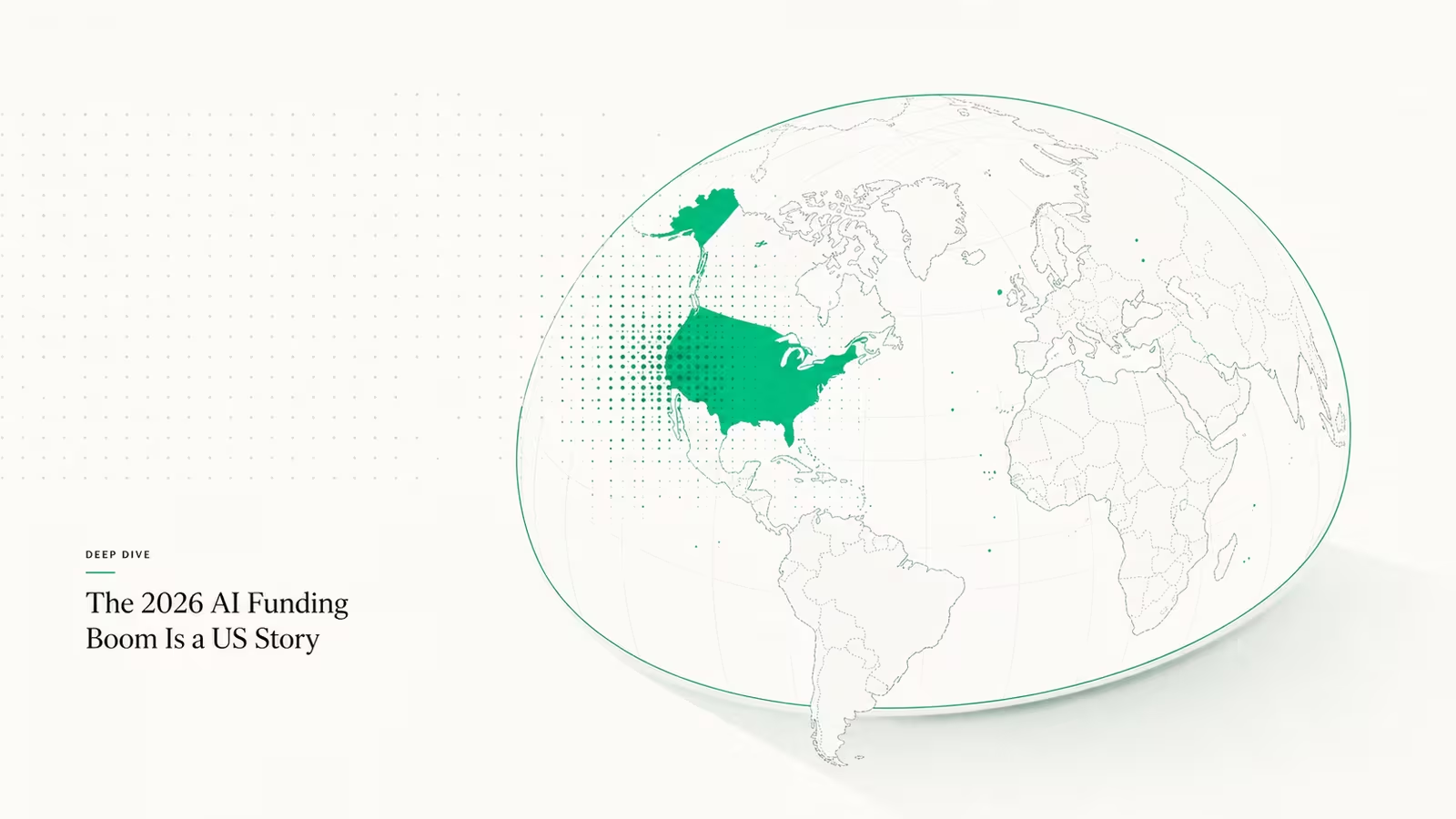
The story of AI startup funding 2026 is not really about how much is being raised — it is about where. Of the roughly $319 billion in AI-related startup capital raised this year, nearly 88% went to U.S.-headquartered companies, and a large share of that landed in just two names: OpenAI and Anthropic. Step back to all venture stages and the picture barely softens — the United States is on track to absorb close to 80% of global seed-through-growth financing this year, up from under half in the pre-AI years. For founders outside the Bay Area, the takeaway is blunt: the money is flowing, but it is flowing to a very specific ZIP code.
This is the story the headline "record year for AI" tends to bury. We build TechRiseUps with Claude Code, and the pattern across mid-2026 rounds is concentration, not breadth. Here is how lopsided it has become, why it is happening, and what it changes for anyone raising outside the U.S.
How lopsided is AI startup funding 2026?
By the numbers, 2026 is the most geographically concentrated venture year in recent memory. The U.S. captured roughly 88% of AI funding and about 80% of all venture dollars, while the rest of the world split the remainder. China is the clear number two, having already raised more than $33 billion year-to-date — enough to top its full-year 2025 total. The U.K. sits near $16.5 billion so far, tracking slightly behind its 2025 pace, and the large European markets (France, Spain, Germany) are flat to modestly up. Everywhere else is roughly steady, not surging.
| Region | 2026 AI/venture funding | Trend vs 2025 |
|---|---|---|
| United States | ~$319B AI (≈88% of global AI) | Sharply up |
| China | $33B+ YTD | Already above full-year 2025 |
| United Kingdom | $16.5B YTD | Slightly behind pace |
| France / Spain / Germany | Flat to moderate | Roughly steady |
| India / Japan / South Korea | No major swing | Flat |
The uncomfortable framing from the data: the U.S. is home to a little over 4% of the global population yet is soaking up the overwhelming majority of the world's AI risk capital.
Why is startup funding concentrating in the U.S.?
The concentration is not an accident, and it is not only about better ideas. Four structural forces stack up in America's favor. First, the capital pools are simply bigger: the largest funds, sovereign co-investors, and crossover investors are U.S.-based or write their biggest checks there. Recent megarounds show sovereign money flowing straight to American AI infrastructure — Together AI closed an $800 million Series C on July 1, 2026 with Aramco Ventures and Vista Equity in the round. Second, the exit pipeline is credible again: Anthropic confidentially filed its draft IPO paperwork on June 1, 2026, with OpenAI preparing its own confidential filing, and a visible route to liquidity pulls late-stage money forward.
Third, the AI stack that is actually being funded — compute, model labs, and infrastructure — is disproportionately built where the chips, data centers, and hyperscaler partnerships already sit. Fourth, talent density compounds the first three; the researchers who command nine-figure rounds cluster in a handful of U.S. metros. None of these are quick to replicate, which is why the gap is widening rather than closing. It is the same dynamic driving valuation inflation in AI seed rounds, one layer up the stack.
The megadeal effect: a few names take most of the money
Concentration is happening between countries and within them. The bulk of 2026 AI dollars did not spread across thousands of startups; it pooled into a short list of capital-intensive leaders, with OpenAI and Anthropic alone accounting for an outsized slice. That leaves the long tail of AI startups competing for a much thinner remainder, which is exactly why seed founders report a harder market even in a record-funding year.
The rounds that are getting done outside the mega-labs tell you where investors still see defensible value — infrastructure, vertical AI, defense, and hard tech rather than generic apps:
| Company | Round | Amount | Sector |
|---|---|---|---|
| Together AI | Series C | $800M | AI infrastructure |
| TwelveLabs | Series B | $100M | Video AI |
| Dominion Dynamics | Series A | $100M | Defense tech |
| Probook | Series A | $40M | AI dispatch/SaaS |
| Oxmiq Labs | Series A | $35M | Chip architecture |
That mix — captured in the July 1 funding roundup — echoes what the latest accelerator cohorts are betting on, too, with defense, robotics, and vertical AI dominating the YC W26 batch.
What it means for founders outside the U.S.
If you are raising outside the United States in 2026, plan for a two-speed market. Domestic capital is available but shallower, and the largest checks will still route through U.S. funds — which increasingly expect a U.S. entity, a U.S. go-to-market, or at least a credible path to a U.S. exit before they lead. The pragmatic playbook is to flip to a Delaware structure early if you are targeting American VCs, anchor a first customer base where the buyers have budget, and treat non-U.S. rounds as capital-efficient runway rather than the trophy raise.
The counter-move is to build where the concentration is not. Sectors and geographies the AI-money spotlight is skipping — GovTech, bootstrapped SaaS, cleantech niches, and markets like India that are growing off a smaller base — have far less competition for both capital and customers. A leaner raise into an ignored niche can beat a bruising fight for a Bay Area seed round. The funding map is lopsided, but that lopsidedness is also a list of underpriced places to build.
FAQ
Is the AI funding boom global? No. In 2026 it is overwhelmingly a U.S. story: roughly 88% of AI-related startup funding went to U.S.-headquartered companies, with China a distant second at $33 billion-plus year-to-date and most other regions flat.
How much AI startup funding goes to the U.S.? About $319 billion in 2026, or close to 88% of global AI startup capital. Across all venture stages, the U.S. is capturing roughly 80% of worldwide seed-through-growth financing.
Which countries are getting AI funding besides the U.S.? China leads the rest of the world with over $33 billion raised year-to-date, followed by the U.K. near $16.5 billion. France, Spain, and Germany are flat to moderately higher, and most of Asia is roughly steady year over year.
Why is so much funding concentrated in a few companies? The AI infrastructure and model-lab layer is capital-intensive and winner-take-most, so a small number of leaders — OpenAI and Anthropic above all — absorb a disproportionate share, leaving the long tail of startups to compete for what is left.
Sources
- Crunchbase News — The AI Startup Funding Boom Is Not A Global Phenomenon: the ~88% U.S. share of AI funding, ~$319B total, ~80% of all venture dollars, and the China/U.K./Europe regional breakdown.
- Tech Startups — Venture Capital & Startup Funding Roundup, July 1, 2026: the Together AI $800M Series C and the wider list of July 1 rounds.
- TechCrunch — Anthropic files to go public: Anthropic's June 1, 2026 confidential draft S-1 filing, with OpenAI's own filing pending.
Some links may earn us a commission at no extra cost to you.

Waqas Ahmed Waseer
Waqas Ahmed Waseer is a developer and automation builder with 8+ years shipping production systems used by 100k+ people. He builds custom multi-tenant SaaS, AI automation (n8n, LLM workflows, WhatsApp bots) and hosting infrastructure (WHM/cPanel, CloudLinux) — and is the maker of WaSphere, FlowMaticX, and the WaseerHost hosting brand. 100+ projects delivered for SMBs, agencies and funded startups.