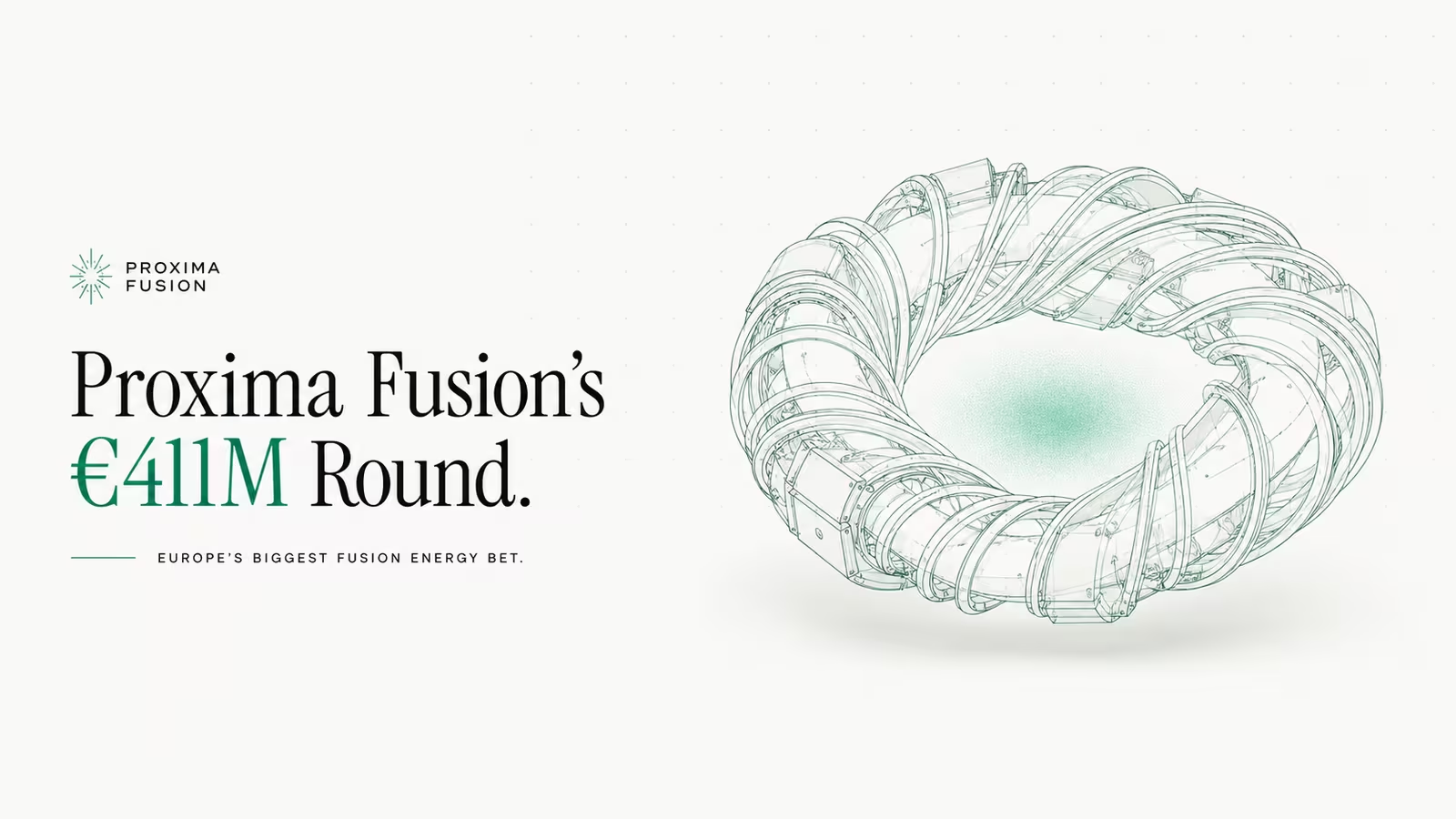
Proxima Fusion, a Munich stellarator startup spun out of the Max Planck Institute for Plasma Physics, raised €411 million ($468 million) on July 7, 2026 at a €2.4 billion valuation, the largest Proxima Fusion funding round to date. It is the largest private fusion investment ever recorded in Europe, and it is the first time Google has backed a European fusion company. For a sector where the US has raised almost all the money, that combination, a European champion and a hyperscaler writing the check, is the real story.
The round was led by XTX Ventures and East X Ventures, with German energy giant RWE and Google joining as strategic investors, alongside KfW Capital, SPRIND, and Burda Principal Investments. A long list of returning backers (Plural, UVC Partners, Balderton, Cherry Ventures, DST Global Partners, Lightspeed, and the EIC Fund among them) followed on. It caps a fast climb: Proxima closed a €130M Series A in June 2025, extended it to €200M, and has now roughly tripled its war chest inside a year.
What Proxima Fusion actually raised, and from whom
The headline number is €411 million, but the more important figures are the strategics behind it. RWE is one of Europe's largest utilities, and it signed a partnership with Proxima months before this round to build the first stellarator plant on the site of a decommissioned nuclear fission station in Gundremmingen, Bavaria. Google's participation matters for a different reason: hyperscalers are the biggest new buyers of firm, carbon-free power, and Google has already signed fusion offtake deals in the US. A European utility that will host the plant and a US cloud giant that will buy the electricity are, between them, a demand signal, not just capital.
Proxima says the money funds three things: completing its Stellarator Model Coil, scaling production of high-temperature superconducting (HTS) cable and magnets, and building out the engineering and manufacturing systems a real power plant needs. That is a notably hardware-heavy use of funds. This is not a round to keep the lights on while the physics gets figured out; it is a round to start building the machines.
Why the stellarator design is the differentiator
Most of the best-funded fusion companies chase the tokamak — a doughnut-shaped magnetic bottle that heats plasma in pulses. Proxima builds a stellarator instead: a more geometrically complex, twisted magnetic cage that, in theory, holds plasma in a stable steady state rather than in pulses. Stability is the whole pitch. A stellarator that runs continuously sidesteps some of the disruption problems that plague pulsed tokamaks, at the cost of far harder engineering and precision magnets.
Proxima's approach, which it calls QI-HTS, builds directly on the Wendelstein 7-X experiment at the Max Planck Institute, the world's largest stellarator and the machine that showed the concept can work at scale. The bet is that decades of publicly funded German plasma science can be commercialized faster than a from-scratch design. Proxima is targeting a net-energy demonstrator called Alpha in the early 2030s, followed by Stellaris, which it pitches as the first commercial stellarator power plant, later in the decade. Those timelines are aggressive, and fusion has a long history of slipping them; treat the dates as ambition, not schedule.
How Proxima Fusion funding stacks up against the leaders
Even after this round, Proxima is a mid-sized player by capital — the fusion race is still dominated by a handful of very well-funded US firms. But it is now, clearly, Europe's front-runner. Figures below are approximate cumulative private funding as of mid-2026, drawn from public reporting.
| Company | Region | Approx. total raised | Approach | Latest milestone |
|---|---|---|---|---|
| Commonwealth Fusion Systems | US | ~$6.8B | Tokamak (SPARC/ARC) | ~$3.85B round, May 2026 |
| TAE Technologies | US | ~$1.8B | Field-reversed config | Pre-merger total |
| Helion Energy | US | ~$1.5B | Magneto-inertial | $465M at $15.5B valuation |
| Proxima Fusion | EU (Germany) | ~$0.7B | Stellarator (QI-HTS) | €411M at €2.4B valuation |
The gap to Commonwealth Fusion is an order of magnitude, and that matters, because fusion is capital-intensive to the point where funding depth is itself a competitive moat. But Proxima has something the US leaders don't: it is the obvious vehicle for European strategic-autonomy money in energy, the same logic now flooding the continent's defense tech sector. Wanting a homegrown fusion champion is, for European governments and utilities, a policy goal as much as an investment thesis.
What the deal signals for deep tech in 2026
Three things stand out. First, capital is rotating toward hard, physical, long-horizon bets — fusion, energy, and infrastructure — at the same time it keeps pouring into AI, and increasingly the two are linked: AI's power demand is part of what makes firm clean electricity investable. Second, hyperscalers are behaving like anchor customers for energy, not just financial investors, which changes how a fusion startup can underwrite a plant. Third, Europe finally has a deep-tech story big enough to draw US strategic capital rather than lose its best startups to it.
None of this means fusion is solved. No company has yet built a plant that puts more energy onto the grid than it consumes, and the engineering risk between a demonstrator and a commercial reactor is enormous. But a €411M round led by serious investors, with a utility to host the plant and a cloud giant to buy the output, is the most credible European fusion setup to date. For founders, the wider lesson tracks the broader 2026 funding market: the money is real, but it is concentrating in a few narratives (AI, defense, and now energy) that can claim hard strategic relevance.
FAQ
How much has Proxima Fusion raised in total? After the €411M ($468M) round announced on July 7, 2026, Proxima's cumulative private funding is roughly €600–700M, following its €130M Series A in June 2025 (later extended to €200M). That makes it Europe's best-funded fusion company, though still well behind US leaders like Commonwealth Fusion Systems.
Can I invest in Proxima Fusion? Not directly — Proxima is a privately held startup, and this round was raised from venture funds and strategic investors such as Google and RWE. There is no public stock. Retail exposure to fusion is generally limited to funds or larger listed companies with fusion stakes.
What is a stellarator, and how is it different from a tokamak? Both use magnetic fields to confine hot plasma, but a tokamak is a symmetric doughnut that typically runs in pulses, while a stellarator uses a more complex twisted shape designed to hold plasma in a stable, continuous state. Stellarators are harder to engineer but may avoid some of the disruptions that affect tokamaks.
Why did Google invest in a fusion startup? Google is one of the largest corporate buyers of clean electricity and needs firm, carbon-free power for its data centers. Backing fusion companies, and Proxima is its first European fusion bet, positions it as an early customer and partner for a potential future power source, not only as a financial investor.
Sources
- Proxima Fusion — €411M announcement: official round details, investors, and use of funds.
- CNBC — Google backs Proxima Fusion: confirms Google's first European fusion investment and the $468M figure.
- EU-Startups — largest European fusion round on record: context on the record and €2.4B valuation.
- TechCrunch — €130M Series A (June 2025): Proxima's prior funding and stellarator approach.
- TechCrunch — every fusion startup that has raised over $100M: the private-fusion funding landscape.
- Canary Media — Commonwealth Fusion Series B2: CFS funding totals for comparison.
- GeekWire — Helion $465M at $15.5B valuation: Helion funding for comparison.
Some links may earn us a commission at no extra cost to you.

Waqas Ahmed Waseer
Waqas Ahmed Waseer is a developer and automation builder with 8+ years shipping production systems used by 100k+ people. He builds custom multi-tenant SaaS, AI automation (n8n, LLM workflows, WhatsApp bots) and hosting infrastructure (WHM/cPanel, CloudLinux) — and is the maker of WaSphere, FlowMaticX, and the WaseerHost hosting brand. 100+ projects delivered for SMBs, agencies and funded startups.