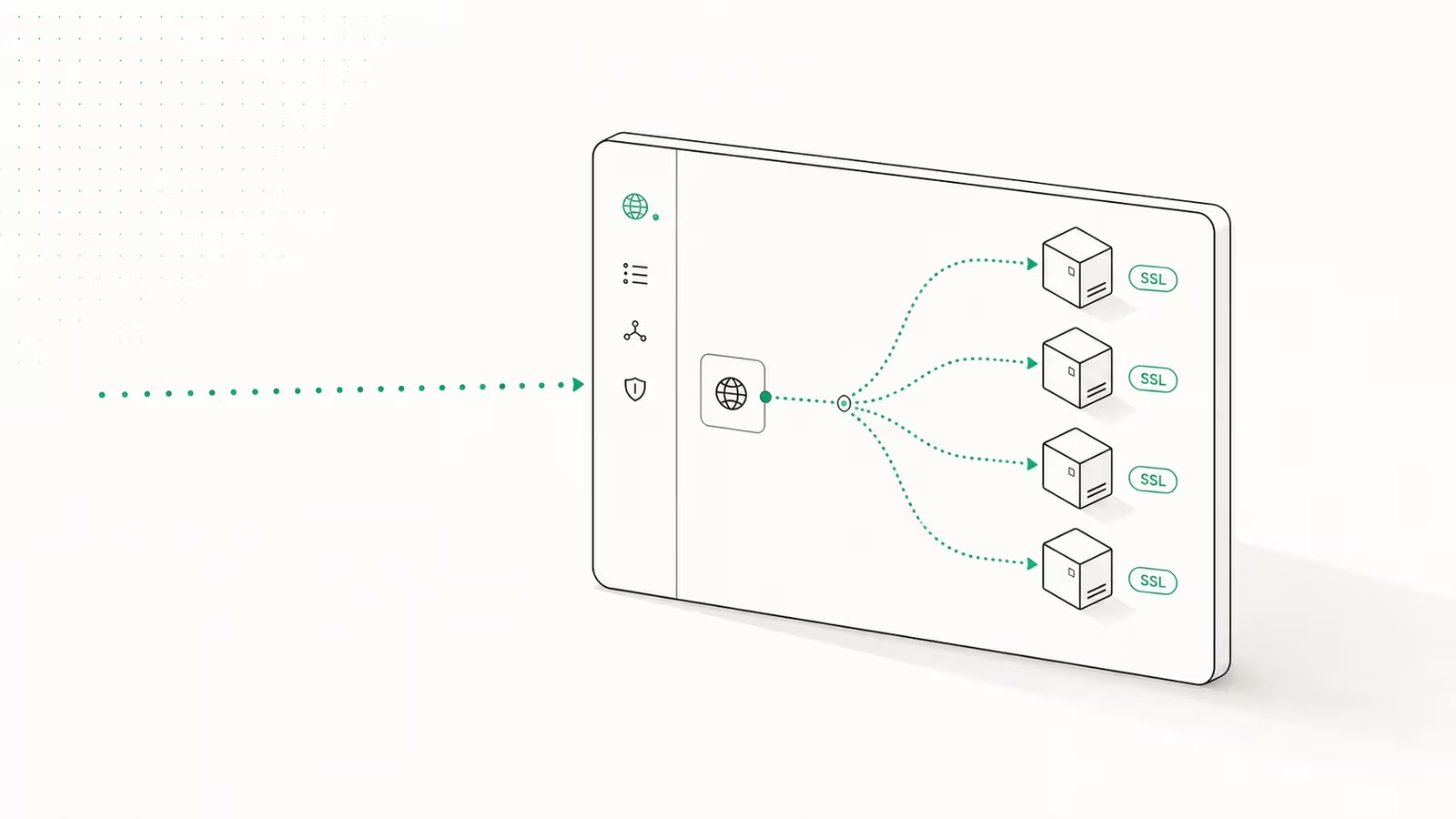
If Nextcloud feels heavy, slow, or like more PHP and database tuning than you signed up for, the good Nextcloud alternatives in 2026 give you more escape routes than ever. The short answer: pick OpenCloud or ownCloud Infinite Scale if you want a modern, lightweight Nextcloud replacement, Seafile if raw sync speed for big files matters most, and Syncthing if you want pure peer-to-peer with no server at all. The rest of this guide ranks seven self-hosted options by what they actually do well — and, unlike most lists, by what each one really costs to run per month.
Most lists stop at "8GB RAM recommended" and never tell you the bill. That number is the whole decision for a self-hoster, so every option below is mapped to a real VPS tier and a dated price.
Disclosure: WaseerHost is our own hosting service, and some outbound links may be affiliate or partner links. It doesn't change which tools made this list or how they're ranked.
Why look for a Nextcloud alternative in 2026?
Nextcloud is still the most feature-complete self-hosted cloud — it replaces Google Workspace or Microsoft 365 with files, calendar, contacts, an office suite, and chat. But that breadth is also the complaint. It runs on a PHP + database stack that wants tuning, the app ecosystem can break on upgrades, and on a small VPS it can feel sluggish under a few concurrent users. People leave for three reasons: they want something lighter (just files and sync, not a full office), something faster for large files, or something with a cleaner operational model than PHP. The good news is that the 2026 landscape splits neatly along exactly those lines, so the right pick depends on which of the three you care about.
The 7 best Nextcloud alternatives, compared
| Tool | Type | Min RAM | Self-host cost/mo* | License | Best for |
|---|---|---|---|---|---|
| OpenCloud | Files + collaboration (Go) | ~2–4 GB | ~€4.49 (Hetzner CX22) | Open source | A modern, simpler Nextcloud replacement |
| ownCloud Infinite Scale | High-performance file sync (Go) | ~2–4 GB | ~€4.49 (CX22) | Open source / Apache | Speed and scale without PHP |
| Seafile | File sync, large-file performance | ~8 GB | ~€6.80 (CX32) | Community (free) / Pro | Teams moving big files fast |
| Syncthing | Peer-to-peer sync, no server | ~1 GB | €0–4.49 | Open source (MPL) | Privacy and device-to-device sync |
| Pydio Cells | Enterprise document mgmt | ~8–16 GB | ~€6.80+ (CX32) | Community / Enterprise | Compliance and access control |
| File Browser | Minimal web file manager | <1 GB | ~€4 (smallest VPS) | Open source (Apache) | A dead-simple personal file server |
| Cozy Cloud | Personal all-in-one cloud | ~2 GB | ~€4.49 (CX22) | Open source / hosted | One private cloud for your own data |
*Software is free/open-source; the cost is the Linux VPS it runs on. Prices reflect Hetzner Cloud's official rates following its 2026 price adjustment (CX22: 2 vCPU/4 GB; CX32: 4 vCPU/8 GB), with current figures cross-checked against VPS for Devs' June 2026 breakdown (CX22 ≈ €4.49, CX32 ≈ €6.80). Verify the live price before you buy.
What is OpenCloud, and why is everyone talking about it?
OpenCloud is the 2026 story in this space. It's an open-source file and collaboration platform from Berlin's Heinlein Group, built as a fork of ownCloud's Infinite Scale codebase and written in Go instead of PHP. That single decision removes the two things people dislike most about Nextcloud: there's no separate database to manage, and the app ships as a single binary or container that stores data directly on the file system. It targets "digitally sovereign collaboration" — GDPR-compliant, with encryption, 2FA, ransomware protection, and an integrated office suite — which makes it a natural fit for European teams and public-sector users. For a small team that wants Nextcloud's "private Google Drive" idea without the operational weight, OpenCloud is the most interesting new option, and it runs comfortably on a 4 GB VPS for around €4.49/month.
ownCloud Infinite Scale: the high-performance original
ownCloud is Nextcloud's predecessor — Nextcloud was forked from it in 2016 — and in 2026 it answered back with Infinite Scale (OCIS), a full rewrite in Go. Like OpenCloud (which descends from it), OCIS drops PHP entirely, runs as a single binary, and needs no database tuning, which gives it very low resource usage and strong horizontal scaling. The trade-off is focus: OCIS deliberately sheds some of the "office in a box" collaboration features to concentrate on fast, reliable file sync. If your priority is moving a lot of data quickly with enterprise auth (LDAP, SAML, Active Directory) and you don't need Nextcloud's full app catalog, OCIS is the technically superior engine. It fits on the same ~€4.49/month CX22 tier as OpenCloud for small deployments.
Seafile: when sync speed is the whole point
Seafile is the performance pick. It stores files in an internal block format and uses delta sync, transferring only the changed parts of a file, which is why it's consistently described as 2–3x faster than Nextcloud on large files. The Community Edition is free and open-source; a paid Pro tier adds full-text search and finer admin controls. The cost is appetite for RAM — Seafile is happiest with around 8 GB, so plan on a CX32-class VPS at roughly €6.80/month, ideally on NVMe storage. It's the right call for a team that lives in large design files, video, or datasets and treats raw sync throughput as non-negotiable. It's less of a Google Workspace replacement and more of a very good Dropbox you own.
Syncthing: no server, no monthly bill
Syncthing is the outlier because there's no central server at all. It's completely decentralized, syncing folders directly between your devices over end-to-end TLS, so your files never touch a third party unless you add one. That makes it the privacy maximalist's choice and, often, the free one: if you sync between machines you already own, your monthly cost is €0. Add a cheap ~€4.49 VPS only if you want an always-on node so devices can sync when they aren't online together. The catch is that Syncthing is sync, not a cloud — there's no web UI for browsing files, no sharing links, no office suite. Pair it with a lightweight web manager if you need browser access. For keeping a laptop, desktop, and phone in lockstep without trusting anyone, nothing is simpler.
The lighter options: File Browser, Pydio Cells, and Cozy Cloud
Three more cover the edges. File Browser is a single Go binary with no database that gives you a clean web UI over a folder — perfect when you want to browse, upload, and share from a tiny VPS and nothing more; it runs on the smallest instance available for around €4/month. Pydio Cells goes the opposite direction: it's built for regulated teams that need role-based access control, audit logging, and workflow automation, which is why it wants 8 GB (16 GB in production) and lands at €6.80/month and up. Cozy Cloud is a personal cloud that bundles files, notes, and a password manager into one private space for an individual rather than a team. Choose File Browser for simplicity, Pydio for compliance, and Cozy for a self-owned personal cloud.
Self-host or pay for managed hosting?
Here's the honest trade most lists skip: the software is free, but your time isn't. Self-hosting any of these means you own updates, backups, TLS certificates, and the 2 a.m. page when the disk fills up. On a quiet personal setup that's a non-issue; for a business whose files cannot disappear, it's a real operational job. The decision comes down to one question — do you have someone who treats the server as their responsibility? If yes, a €4.49–6.80/month VPS is unbeatable value. If not, a managed instance (our own WaseerHost offers managed open-source hosting, and several OpenCloud and Nextcloud partners do the same) costs more but moves backups, patching, and uptime off your plate. Self-host to save money and keep control; pay for managed to buy back time and a support number. If you want to see what running your own box actually involves first, our guide to self-hosting Supabase on a VPS walks through the same backup-and-TLS reality these tools share.
Which Nextcloud alternative should you pick?
- Want a modern, lighter Nextcloud? → OpenCloud or ownCloud Infinite Scale. Go-based, no database, ~€4.49/month.
- Move large files fast? → Seafile, on an 8 GB VPS (~€6.80/month).
- Pure privacy, maybe free? → Syncthing, peer-to-peer, €0 if you skip the VPS.
- Dead-simple file server? → File Browser, smallest box you can rent.
- Compliance and access control? → Pydio Cells.
- A personal cloud for one? → Cozy Cloud.
None of these is "better than Nextcloud" outright — they're better at one thing each. Nextcloud is still the best all-in-one if you genuinely use the calendar, office, and chat. The moment you only want files done well, one of these will be lighter, faster, or cheaper to run.
Frequently asked questions
Is there a free Nextcloud alternative?
Yes — most here are free and open-source. OpenCloud, ownCloud Infinite Scale, Syncthing, File Browser, and Seafile's Community Edition all cost nothing for the software. Your only spend is the VPS to run them, from about €4.49/month, and Syncthing can be genuinely free if you sync between devices you already own.
What is the lightest Nextcloud alternative?
File Browser is the lightest with a web UI — a single Go binary, no database, runs on under 1 GB of RAM. Syncthing is even lighter on resources but has no web file browser. For a full Nextcloud-style experience that's still light, OpenCloud and ownCloud Infinite Scale are the leaders because they replaced PHP with Go.
Is OpenCloud better than Nextcloud?
For pure file sync and operational simplicity, often yes — OpenCloud's Go architecture needs no database and uses fewer resources. For features, no: Nextcloud still has the larger ecosystem with office, calendar, contacts, and chat. Pick OpenCloud if you want a clean, fast file cloud; keep Nextcloud if you use its full app suite.
How much does it cost to self-host a Nextcloud alternative?
Expect €4.49–6.80/month for the VPS in 2026, based on Hetzner's official Cloud pricing (June 2026 figures here). Lightweight options (OpenCloud, File Browser, Syncthing) fit a 4 GB CX22 at ~€4.49; heavier ones (Seafile, Pydio Cells) want an 8 GB CX32 at ~€6.80. The software itself is free; rising RAM prices are the main reason that VPS bill is creeping up — we covered why VPS prices climbed in 2026.
Can I migrate my data from Nextcloud?
Yes, though effort varies. Because OpenCloud and ownCloud Infinite Scale share lineage with ownCloud, they're the most natural migration targets. Seafile and Pydio import standard file trees but won't carry over Nextcloud-specific app data (like Deck boards or Talk history). Always export and verify a backup before switching, and run the old and new instances in parallel until you've confirmed everything synced.
Sources
- SSD Nodes — 6 Best Nextcloud Alternatives for Self-Hosted Cloud — alternative lineup, Seafile delta-sync speed, RAM guidance
- Sliplane — 5 Awesome Nextcloud Alternatives — Syncthing decentralization, ownCloud maturity, Cozy Cloud
- Contabo — Nextcloud vs ownCloud vs Filecloud (2026) — ownCloud Infinite Scale Go rewrite, dropping PHP
- OpenCloud — official site — Heinlein Group, open source, GDPR, feature set
- Hetzner Cloud — official pricing — CX22/CX32 plan specs and live prices
- Hetzner — Statement on 2026 price adjustment — the 2026 price change
- VPS for Devs — Hetzner CX22 Pricing 2026 — June 2026 CX22/CX32 price breakdown
Some links may earn us a commission at no extra cost to you.

Waqas Ahmed Waseer
Waqas Ahmed Waseer is a developer and automation builder with 8+ years shipping production systems used by 100k+ people. He builds custom multi-tenant SaaS, AI automation (n8n, LLM workflows, WhatsApp bots) and hosting infrastructure (WHM/cPanel, CloudLinux) — and is the maker of WaSphere, FlowMaticX, and the WaseerHost hosting brand. 100+ projects delivered for SMBs, agencies and funded startups.