Prediction market startups went from a regulatory curiosity to one of 2026's hottest venture categories in about eighteen months. Kalshi raised a $1 billion Series F at a $22 billion valuation in May, doubling its price in five months, while rival Polymarket landed a $2 billion strategic investment from the owner of the New York Stock Exchange. Then, on July 24, the CFTC told both platforms to stop rubber-stamping new betting markets — the first real friction in an otherwise vertical run. If you want the short version: the money and the users are real, but the regulatory ceiling just became visible.
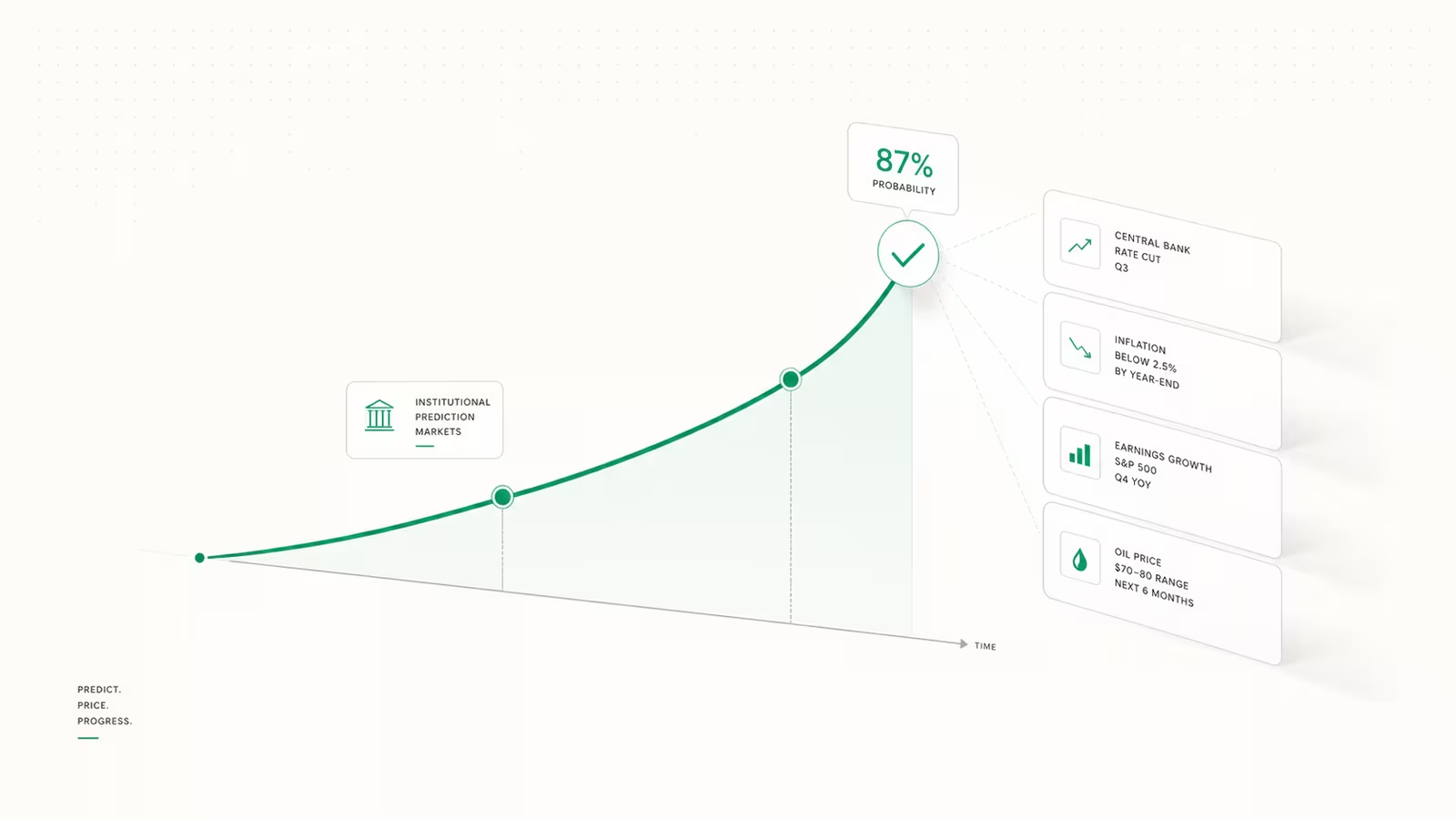
A prediction market lets people trade contracts that pay out based on a real-world outcome — an election, a Fed rate decision, a World Cup result. The price of a "yes" contract, between 0 and 100 cents, reads as the market's implied probability of the event. That simple mechanic is what turned a niche idea into a category that venture investors now treat like an exchange business rather than a gambling app.
Why prediction markets suddenly matter in 2026
The category's breakout traces to the 2024 U.S. election, when Kalshi and Polymarket's odds were quoted alongside traditional pollsters and, in several races, called outcomes earlier. That credibility pulled in mainstream users, and 2026 turned attention into volume. Kalshi now hosts roughly 90% of U.S. prediction market activity and reports annualized revenue above $1.5 billion, with institutional trading up 800% over six months. That mix — retail scale plus hedge funds and prop firms treating event contracts as a real asset class — is why the funding stopped looking like hype and started looking like an exchange land grab. Venture money in 2026 has clustered around a few narratives with hard commercial proof, and prediction markets sit alongside AI and defense as one of them, a pattern also visible in the year's record startup megadeals.
Kalshi vs Polymarket: the two giants
Two companies dominate, and they took opposite routes to get there. Kalshi is CFTC-regulated, U.S.-facing, and built like a compliant derivatives exchange; Polymarket is crypto-native, historically offshore for U.S. users, and now backed by Wall Street infrastructure. The table below sizes them up on the numbers reported through mid-2026.
| Platform | Latest valuation | Key backers | Regulatory posture | Notable 2026 signal |
|---|---|---|---|---|
| Kalshi | $22B (Series F, May 2026); reportedly raising at ~$40B | Coatue, Sequoia, a16z, Paradigm | CFTC-regulated exchange | >$27B World Cup volume; ~90% U.S. share |
| Polymarket | ~$9B (Oct 2025 ICE deal); seeking ~$15B | Intercontinental Exchange (up to $2B), Founders Fund | Crypto-native; U.S. re-entry via QCEX | ICE to distribute its event data globally |
Kalshi's Series F was led by Coatue with Sequoia, Andreessen Horowitz and Paradigm participating, and reporting in June said it was already back in the market targeting a roughly $40 billion valuation that could close in the third quarter. Polymarket's headline event was different in kind: Intercontinental Exchange, the NYSE's parent, committed up to $2 billion at roughly a $9 billion valuation and agreed to distribute Polymarket's event-driven data to its own market-data customers. That deal is the clearest sign the category is being priced as financial infrastructure, not entertainment.
What's driving the surge
The single biggest accelerant this year was sports. The 2026 World Cup turned prediction markets into a live, always-on venue: Kalshi alone processed more than $27 billion in World Cup trading volume across 33,000 distinct event contracts. Sports event contracts do what elections can't — they refill the market with new questions every single day, which is why sportsbook-adjacent startups and even established betting operators are now circling the space. On the institutional side, the appeal is data as much as trading: a liquid market that continuously prices the probability of real events is a sentiment feed that funds and media can plug into, which is exactly what ICE bought access to. Prediction markets are, in effect, becoming the outcome layer that a lot of other products want to consume — a dynamic that rhymes with the broader shift toward startups whose customers are systems and institutions rather than individual consumers.
The CFTC crackdown: the ceiling comes into view
On July 24, 2026, the CFTC's Division of Market Oversight issued an advisory telling Kalshi and Polymarket's U.S. entity to stop using blanket templates to self-certify broad series of event contracts. Under U.S. rules, an exchange can launch most new contracts by "self-certifying" that they comply — a fast, permissionless-feeling process the platforms used to spin up thousands of markets at once. The regulator's message: each contract type needs its own documented settlement logic, not one boilerplate filing covering a whole category. Closely related contracts can still be certified as a class or submitted for slower pre-clearance, but the days of one template minting 33,000 markets are over.
This lands on top of a wider fight. The CFTC has separately proposed rules that could bar sports contracts tied to officiating calls or player injuries, and congressional Democrats urged the agency in April to rein in what they call unregulated sports betting. State gaming regulators, meanwhile, argue that sports event contracts are gambling by another name and belong under their authority, not the CFTC's. For a founder, the takeaway is that the category's growth ceiling is now a regulatory question, not a demand one — and the exact height of that ceiling is being litigated in real time.
What it means for founders and everyone downstream
The honest read for anyone building here in 2026: the top of the market is effectively taken, and the interesting opportunities have moved to the edges. Kalshi and Polymarket own the liquidity, and liquidity is the moat — traders go where the volume is, and volume compounds. New consumer-facing prediction exchanges will struggle to matter unless they own a defensible niche the giants underserve. The more fundable bets sit adjacent: settlement and oracle infrastructure, compliance and market-surveillance tooling built for the CFTC's tighter regime, data products that resell event-probability feeds, and vertical markets in regulated corners the majors avoid. It's a similar shape to other 2026 categories where the platform layer consolidated fast and value migrated to the picks-and-shovels around it. If the exit window keeps reopening the way it has for late-stage tech this year, Kalshi is the obvious IPO candidate in the group — but only if the regulatory questions resolve in a direction it can build on.
FAQ
Are prediction markets legal in the U.S.? Kalshi operates as a CFTC-regulated exchange and is legal at the federal level, though several states dispute whether its sports contracts count as gambling under state law, and litigation is ongoing. Polymarket historically restricted U.S. users and is re-entering the market through a CFTC-registered entity. Legality is settled federally for regulated venues but genuinely contested for sports-related contracts.
What's the difference between Kalshi and Polymarket? Kalshi is U.S.-based, CFTC-regulated, and settles in dollars, which makes it the compliant, institution-friendly option. Polymarket is crypto-native, settles in stablecoins, and grew large offshore before its ICE-backed U.S. push. Kalshi leads on regulated U.S. volume; Polymarket's edge is its crypto ecosystem and its data partnership with the NYSE's parent company.
Why are prediction markets growing so fast in 2026? Three forces stacked up: credibility from the 2024 election, a flood of new users and contracts from the 2026 World Cup, and institutional money treating event contracts as a tradable asset class and a real-time data feed. That combination pushed Kalshi's annualized revenue past $1.5 billion and its valuation to $22 billion in under two years.
Are prediction markets the same as sports betting? Legally, the platforms argue no — they say event contracts are derivatives regulated by the CFTC, not bets regulated by state gaming boards. Practically, a World Cup contract and a sportsbook wager can look nearly identical to a user, which is exactly the tension the CFTC and state regulators are now fighting over.
Sources
- TechCrunch — Kalshi doubles valuation to $22B — Series F amount, valuation, investors, revenue and market-share figures
- CoinDesk — Kalshi targets $40B valuation — new round target and Polymarket's $15B raise
- Fortune — ICE invests $2B in Polymarket — ICE investment size, valuation and data-distribution terms
- Crypto Times — CFTC tells Kalshi, Polymarket to stop blanket filings — July 24 advisory and World Cup volume
- ESPN — CFTC proposes rules limiting sports prediction markets — proposed limits on injury and officiating contracts
- CNBC — Democrats urge CFTC to rein in prediction markets — congressional pressure on sports betting concerns
Some links may earn us a commission at no extra cost to you.

Waqas Ahmed Waseer
Waqas Ahmed Waseer is a developer and automation builder with 8+ years shipping production systems used by 100k+ people. He builds custom multi-tenant SaaS, AI automation (n8n, LLM workflows, WhatsApp bots) and hosting infrastructure (WHM/cPanel, CloudLinux) — and is the maker of WaSphere, FlowMaticX, and the WaseerHost hosting brand. 100+ projects delivered for SMBs, agencies and funded startups.