Three former SpaceX engineers just opened what they are calling America's first autonomous steel factory. On July 22, 2026, a Cincinnati startup named 1872 came out of stealth with a $15 million seed round and a working shop floor where software, not a scheduler with a clipboard, decides what gets welded next. It is a small round by 2026 standards. It is also one of the clearest signals yet that the physical AI wave has reached heavy industry, and that a new class of hard-tech founders wants to rebuild the factory itself rather than sell another dashboard to the people who run one.
What is 1872's autonomous steel factory?
1872 is an AI-native manufacturing startup building an autonomous steel factory in Cincinnati's Camp Washington neighborhood. It was founded by three ex-SpaceX engineers, Dan Summers (CEO), Michael Grant (CTO), and Brian Mongilio (head of operations), and closed a $15 million seed round led by private funds advised by The O.H.I.O. Fund, one of the largest seed deals in the state's history. The name is a reference to 1872, the year Andrew Carnegie built his first steel mill, and the shop sits in the 1903 David Hummel Building Company facility, put up by the same stone-masonry firm that helped build Cincinnati's City Hall and Union Terminal. The pitch is narrow and concrete: take heavy steel fabrication, a business that still runs on quotes, tribal knowledge, and manual welding, and cut lead times from months to weeks by handing most of the coordination to software.
How 1872's "Factory OS" actually works
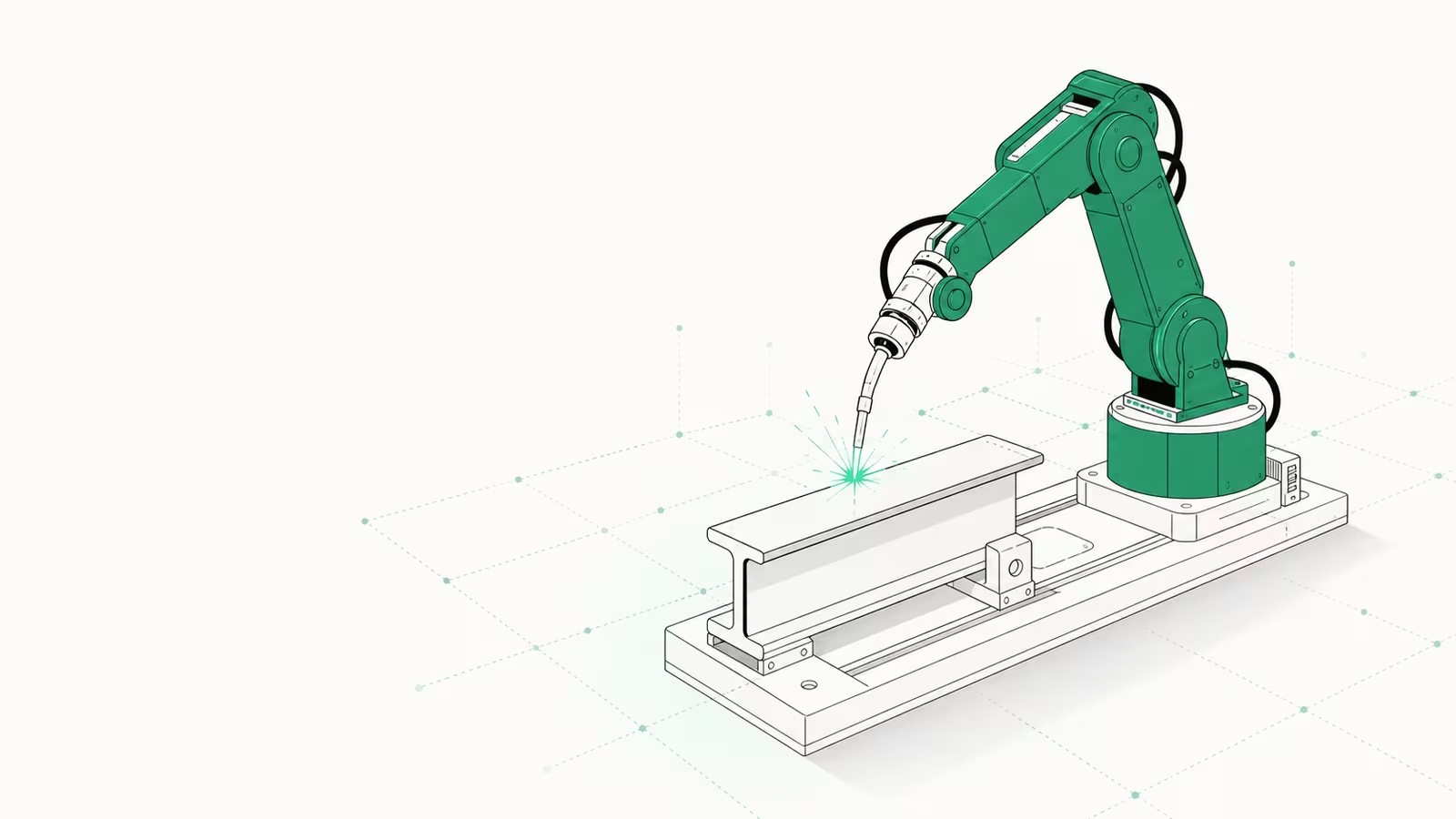
The company's system has two layers. The first is a proprietary platform it calls Factory OS, which handles material procurement, cost estimation, machine scheduling, and shop-floor logistics — the paperwork and planning that normally eats a fabricator's margins. On top of that sit agentic AI systems trained to play specific roles: a purchasing agent that sources steel, a logistics agent that sequences jobs, and welding agents that drive the machines. The physical work runs on welding robots from Columbus-based Path Robotics, using its Obsidian physical AI for adaptive, real-time welding.
That last detail is the technically interesting part. Traditional factory robots are precise but brittle: they repeat a programmed path and choke on the variation that defines custom steel work, where no two beams arrive identical. Adaptive welding lets the robot see the joint in front of it and adjust the weld on the fly, which is what makes a low-volume, high-mix shop automatable at all. 1872 says it is targeting full factory autonomy in 2027; today the honest description is heavily automated with humans still in the loop.
Why steel, and why now?
The choice of steel is not romantic, it is a labor math problem. The American Welding Society projects the U.S. will need roughly 330,000 new welders by 2028, with more than 80,000 openings a year and over a fifth of the current workforce nearing retirement. Meanwhile the fabricated metal products market it serves is worth roughly $350 billion a year in the United States alone. A large, unglamorous, labor-starved industry is exactly the kind of target where automation does not have to be perfect to be valuable — it only has to beat a shortage.
| Traditional steel fabrication | 1872's AI-native model | |
|---|---|---|
| Quoting and planning | Manual estimates, spreadsheets | Factory OS: automated cost + scheduling |
| Welding | Skilled human welders (scarce) | Adaptive robots (Path Robotics / Obsidian) |
| Coordination | Floor supervisors, tribal knowledge | Agentic AI purchasing + logistics |
| Typical lead time | Months | Targeting weeks |
| Main constraint | Welder shortage | Capital and proving full autonomy |
The bigger bet: physical AI meets reindustrialization
1872 is a single seed round, but it sits on top of the loudest infrastructure story of 2026. After three years of language models, investor attention has swung to physical AI — models built for spatial awareness and real-world action — and to the reshoring push it enables. In a Capgemini survey, two-thirds of organizations rated physical AI a high priority for the next three to five years, and 43% said reshoring and reindustrialization were driving that interest. NVIDIA has built an entire narrative around using physical AI to reindustrialize American manufacturing, and the capital chasing hard tech is the same money that fueled European defense tech's record year.
What makes 1872 a useful data point is that it is not a humanoid moonshot. The near-term winners in physical AI are boring form factors — mobile robots and fixed-cell cobots — applied to specific, high-value tasks, not general-purpose androids. 1872 fits that pattern precisely: proven welding hardware, a narrow industrial vertical, and agentic software sitting where the labor shortage is worst. That is a very different bet from a robot that folds laundry, and a more fundable one.
The skeptic's read
The word doing the heavy lifting is "autonomous." Full autonomy is a 2027 goal, not today's reality, and steel fabrication is a capital-heavy, cyclical, thin-margin business where the healthy gross margins of software do not automatically carry over. A SpaceX pedigree signals hard-engineering talent, but rockets and rebar are different problems, and the open question is whether Factory OS becomes a defensible platform or stays a clever integration layer around someone else's welding robots. The counterpoint is that the thesis does not need heroics to work. Put agentic software on top of adaptive welding hardware in a $350 billion industry that is running out of welders, in a policy climate that rewards domestic production, and you do not need full autonomy to win — you need to be meaningfully faster and cheaper than a shop that cannot hire. That is a lower bar, and it is the one worth watching in 2027.
Frequently asked questions
What is 1872 the startup? 1872 is a Cincinnati-based AI-native manufacturing company founded by three former SpaceX engineers. It operates an autonomous steel fabrication factory that combines a software platform (Factory OS), agentic AI agents, and adaptive welding robots to build steel components with minimal manual labor.
How much did 1872 raise and who led the round? The company closed a $15 million seed round led by private funds advised by The O.H.I.O. Fund, described as one of the largest seed rounds in Ohio history. It came alongside the factory's public launch on July 22, 2026.
What is an autonomous steel factory? It is a fabrication shop where software and robots handle most of the workflow — procurement, cost estimation, scheduling, and welding — instead of relying on human estimators, supervisors, and welders for every step. 1872 says it is targeting full autonomy in 2027; for now it runs with humans still overseeing the process.
Why does the welder shortage matter here? Because it is the whole business case. The American Welding Society projects the U.S. will need roughly 330,000 additional welders by 2028, and fabricators already struggle to hire. Automation that can weld reliably does not need to be flawless to be worth paying for when the alternative is jobs no one can staff.
Is this really the first autonomous factory? 1872 describes itself as the first autonomous steel fabrication factory model, a specific claim about heavy steel work rather than manufacturing in general. Automation and robotics are already widespread across industry; what is new is applying agentic AI and adaptive welding to low-volume, high-mix steel fabrication, which has resisted automation because every job is different. Treat "first" as a positioning claim, not an audited fact.
Sources
- Tech Startups — Venture capital & startup funding roundup, July 22, 2026: 1872's $15M seed round, founders, and what the company does.
- Ohio Tech News — 1872 launches autonomous steel factory in Cincinnati: founders, The O.H.I.O. Fund, Factory OS, Path Robotics, and the Camp Washington building.
- The Fabricator — Welding workforce outlook per AWS data: American Welding Society projection of the U.S. welder shortage.
- Capgemini via GlobeNewswire — Two-thirds rate physical AI a high priority: physical AI priority and reshoring survey figures.
- NVIDIA — U.S. manufacturing and robotics leaders drive reindustrialization with physical AI: the broader physical-AI reindustrialization narrative.
Some links may earn us a commission at no extra cost to you.

Waqas Ahmed Waseer
Waqas Ahmed Waseer is a developer and automation builder with 8+ years shipping production systems used by 100k+ people. He builds custom multi-tenant SaaS, AI automation (n8n, LLM workflows, WhatsApp bots) and hosting infrastructure (WHM/cPanel, CloudLinux) — and is the maker of WaSphere, FlowMaticX, and the WaseerHost hosting brand. 100+ projects delivered for SMBs, agencies and funded startups.