Corgi, the AI-native insurance startup built for other startups, has reportedly closed its third funding round in eight weeks — the latest one valuing the company at roughly $4 billion. That is nearly double the $2.6 billion valuation it carried in late May, and it caps a stretch of fundraising so fast that Forbes called the company a "poster child for the insanity" of San Francisco's 2026 AI boom. Here is what the Corgi insurance startup actually does, why investors keep writing bigger checks, and why it is as controversial as it is hot.
What is Corgi, and what does the startup actually do?
Corgi is an AI-native insurance carrier that sells coverage to startups — and increasingly lets startups sell insurance to their own customers. It came out of Y Combinator's Summer 2024 cohort and was founded by Nico Laqua and Emily Yuan, both 26 and both former Basket Entertainment employees named to Forbes' 30 Under 30 in 2024. Instead of routing underwriting and claims to human teams, Corgi deploys AI agents to generate quotes, price policies, and process most claims within 24 hours. It writes general liability, tech errors-and-omissions, employment liability, commercial auto, long-haul trucking, and a novel "AI liability" product covering algorithmic errors and model hallucinations. The company pools industry peers through a Risk Retention Group structure so members can self-insure, and it counts Deel, Artisan, and AI firm Eragon among thousands of startup customers. It has also expanded sideways into data-room software.
Three rounds in eight weeks: the funding timeline
The headline is not just the valuation — it is the pace. Corgi came out of stealth in January 2026 with a $108 million Series A to build out its platform. Then, between early May and late July, it raised three more times, roughly doubling its valuation each round. TCV led the round that minted it a unicorn, and follow-on extensions arrived before the ink on the previous term sheet was dry. Investors and amounts on the most recent extension were not disclosed; TechCrunch and Forbes reported the $4 billion mark through people familiar with the deal.
| Round | Date | Amount | Valuation | Lead |
|---|---|---|---|---|
| Series A (out of stealth) | Jan 2026 | $108M | ~$630M (PitchBook est.) | Undisclosed |
| Series B | Early May 2026 | $160M | $1.3B (unicorn) | TCV |
| Series B1 | Late May 2026 | $106M | $2.6B | Undisclosed |
| Series B extension | July 2026 | Undisclosed | ~$4B | Undisclosed |
That is a three-times increase in valuation in under seven months, and a near-doubling in the eight weeks from early May to late July.
Why do investors keep doubling the valuation?
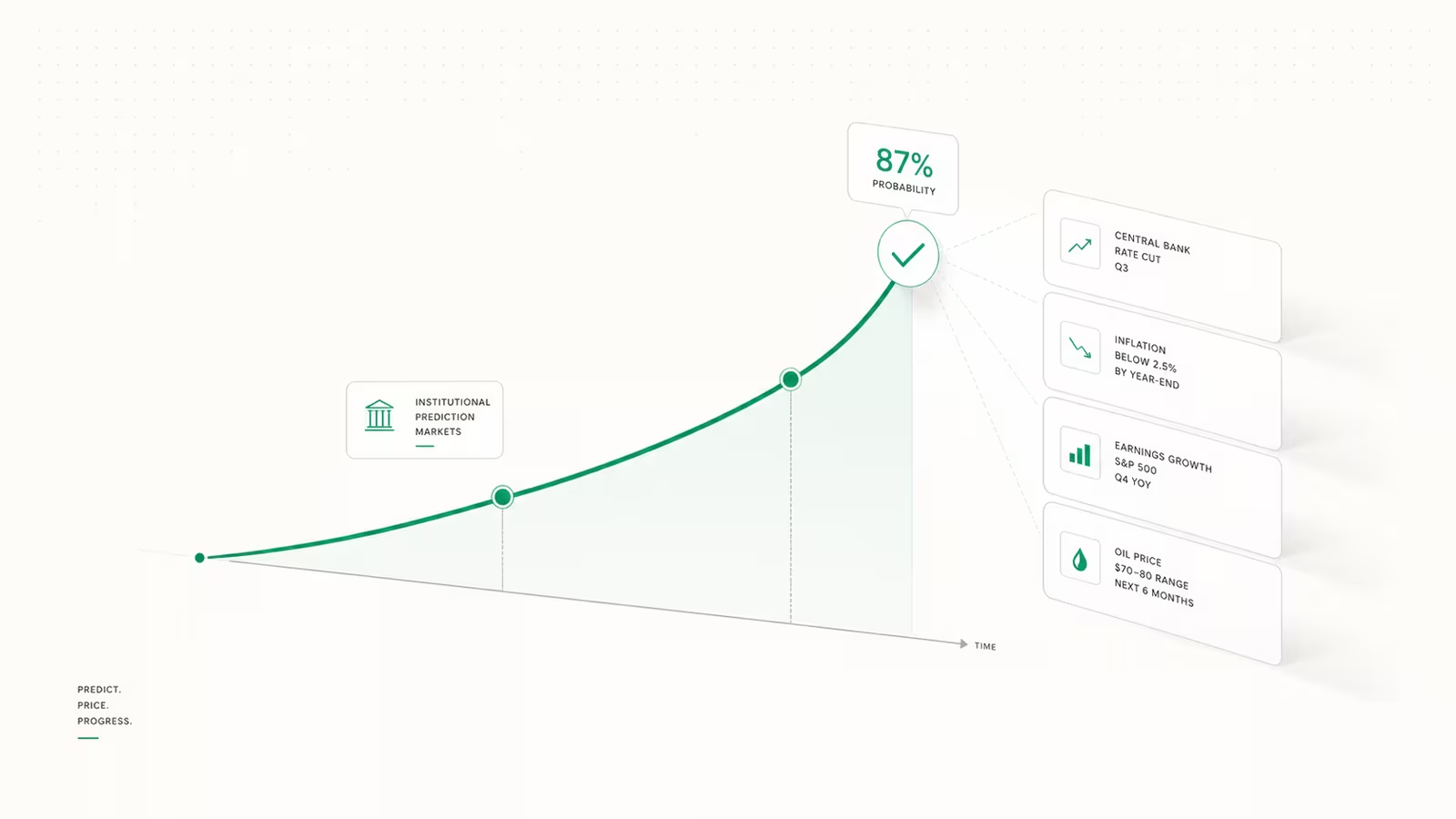
The short answer is revenue growth that looks more like software than insurance. Corgi told investors its annualized revenue run rate was around $45 million and would reach $450 million by year-end — a tenfold jump it attributes to AI cutting the cost of underwriting and claims. Forbes reported the annualized figure at roughly $100 million as of May. Those are company-provided, unaudited projections, so treat the exact numbers with caution, but the trajectory is what venture investors are paying for: a $1.7 trillion U.S. insurance market being attacked by a lean, agent-driven stack. The frantic re-pricing also reflects the wider market. Valuations across AI have compressed the normal fundraising calendar, a pattern we covered in why AI seed-round valuations doubled in 2026 and in the shift toward record megadeals alongside harder early rounds.
The seven-day work week controversy
Corgi is as famous for its culture as its cap table. The company requires employees to work seven days a week, in person, and Laqua has said that if your days off "happen to be Saturday and Sunday every week, then you will not have a place at Corgi." He sleeps on a mattress in a "Founders' Room," showers at a nearby gym, and had a 24-hour Corgi Cafe built into the office because no local coffee shop stayed open late enough. Roughly two-thirds of the first 30 employees reportedly have the Corgi logo tattooed on them. Laqua frames the backlash — which he says has included death threats — as a filter that repels people who would not thrive there. Labor researchers push back on the productivity logic: decades of studies find that beyond a point, more hours reduce output rather than increase it, and chronic sleep loss degrades exactly the judgment an insurance underwriter needs.
Not just the culture: an open-source dispute and litigation
The friction is not limited to work hours. In June 2026, Papermark co-founder Marc Seitz accused Corgi of copying his company's open-source data-room product, language and features "word for word." Laqua denied using any Papermark code but acknowledged his team had "vibe-coded" the feature — mimicking design and functionality without copying source — and said the disputed elements were updated. Corgi then sent Seitz a cease-and-desist demanding he delete his post. The company has also gained a reputation for being litigious and has sued former employees. It is the kind of vibe-coding-to-product speed that has defined other 2026 breakouts, including India's Emergent, which hit a $1.5B valuation — but here it collided with an open-source author in public.
What Corgi signals about startup funding in 2026
Strip away the tattoos and the all-night cafe, and Corgi is a clean test of a thesis the whole market is betting on: that AI agents can gut the cost structure of a regulated, human-heavy industry fast enough to justify software multiples. If the $450 million run-rate projection lands and loss ratios hold, a $4 billion price will look cheap in hindsight. If AI underwriting misprices risk — or a wave of claims exposes thin reserves — a company that raised at ever-higher valuations on projected, unaudited revenue is exactly the kind that unwinds fast. Insurance is not a pure software business; it carries real liabilities on the balance sheet, and regulators, not just markets, get a vote. The bull case and the bear case are both unusually stark. For founders watching, the lesson is less "copy the seven-day week" and more that in 2026, distribution speed and a credible AI cost story can compress years of fundraising into months — with all the fragility that implies.
FAQ
Is Corgi insurance legit? Yes — Corgi is a real, Y Combinator-backed insurance carrier founded in 2024 that writes coverage for thousands of startups, including named customers like Deel and Artisan. It operates through a Risk Retention Group structure and has raised from established venture firms such as TCV. "Legit" as a going concern is separate from whether its valuation or projections prove durable, which remain unproven.
Is Corgi insurance profitable? Corgi has not disclosed profitability, and its own figures are revenue run-rate projections rather than audited profit. It claims a jump from roughly $45 million to a projected $450 million annualized run rate by the end of 2026, and it has acknowledged that its Corgi Cafe operates at a loss. Insurance profitability ultimately depends on loss ratios that take time to show up, so any profit claim today would be premature.
Who owns Corgi insurance? Corgi was co-founded and is led by CEO Nico Laqua alongside co-founder Emily Yuan. As a venture-backed private company, its investors also hold significant stakes; TCV led the round that made it a unicorn, and later Series B extensions brought additional undisclosed backers. Note this is the AI insurtech Corgi, not to be confused with unrelated companies that share the name.
What is the Corgi insurance controversy? There are two threads. The first is its mandatory seven-day, in-person work week, which drew heavy online criticism and, per the founder, death threats. The second is a June 2026 dispute in which Papermark's co-founder accused Corgi of copying its open-source data-room software; Corgi denied using the code, said it had "vibe-coded" the feature, and sent a cease-and-desist. The company has also sued former employees.
Sources
- TechCrunch — Corgi reportedly raised more money at $4B, its third round in eight weeks — the $4B valuation, three-rounds-in-eight-weeks timeline, and $45M→$450M run-rate projection
- Forbes — AI startup Corgi of seven-day-work-week fame raises yet again at $4 billion — valuation history, "poster child" framing, and death-threat backlash
- Forbes — This AI insurance company with an all-night cafe reached unicorn status — founders, AI-native model, RRG structure, culture, and cafe
- TechCrunch — Corgi says it didn't steal an open-source product — the Papermark open-source dispute and Corgi's response
- Reinsurance News — Corgi secures $108m to expand AI-native insurance platform for startups — the January 2026 Series A out of stealth
Some links may earn us a commission at no extra cost to you.

Waqas Ahmed Waseer
Waqas Ahmed Waseer is a developer and automation builder with 8+ years shipping production systems used by 100k+ people. He builds custom multi-tenant SaaS, AI automation (n8n, LLM workflows, WhatsApp bots) and hosting infrastructure (WHM/cPanel, CloudLinux) — and is the maker of WaSphere, FlowMaticX, and the WaseerHost hosting brand. 100+ projects delivered for SMBs, agencies and funded startups.