If you're a startup or a solo developer trying to pick between AWS and Google Cloud in 2026, here's the short version: pick AWS if you want the widest service catalog, the deepest pool of tutorials and hireable talent, and a default that almost nobody gets fired for choosing. Pick GCP if your project leans on data analytics, machine learning, or Kubernetes, or if you just want pricing that's a little kinder without you babysitting a spreadsheet. Neither is "better" in a vacuum. The right answer depends on what you're building and which ecosystem you already live in.
Both run mission-critical production workloads for companies of every size. The marketing pages make them sound wildly different. In practice the gap on raw compute is small, and the real divergence shows up in three places: data egress fees, how each platform handles discounts, and what each one is genuinely great at. Let's get into it.
AWS vs GCP at a glance
| AWS | Google Cloud (GCP) | |
|---|---|---|
| Compute (4 vCPU / 16GB, on-demand) | ~$0.19/hr | ~$0.19/hr |
| Entry VM | t3.micro | e2-micro |
| Object storage (standard, US) | S3 ~$0.023/GB-mo | Cloud Storage ~$0.020–0.023/GB-mo |
| Internet egress (after free tier) | $0.09/GB (first 10TB) | $0.12/GB Premium · $0.085/GB Standard |
| Free egress | 100 GB/mo from regions | 100 GB/mo (Premium) |
| Free tier | $200 credits over 6 mo + always-free serverless | $300 credits for 90 days + always-free e2-micro VM |
| Managed Kubernetes | EKS $0.10/hr per cluster | GKE $0.10/hr per cluster, one free/mo |
| Discount model | Reserved Instances / Savings Plans (commit) | Sustained-use discounts (automatic) + committed-use |
| AI/ML | Bedrock (Claude, Llama, Titan), SageMaker | Vertex AI (Gemini), BigQuery ML |
| Best for | Breadth, hiring, the safe default | Data, ML, Kubernetes, cost-conscious teams |
Numbers are US-region list prices as of June 2026 and move around by region and instance family. Treat them as a starting point, not a quote.
The case for AWS
AWS is the incumbent, and the incumbency is the product. Synergy Research put AWS at roughly 28% of global cloud infrastructure spend in Q1 2026, with Azure around 21% and Google Cloud near 14% (Statista). That lead translates into things you feel every day: when you hit a weird error at 2am, someone on Stack Overflow already hit it in 2019 and wrote up the fix. When you need to hire, the candidate pool that knows AWS dwarfs the GCP pool. When a SaaS vendor publishes a deployment guide, AWS is the first tab.
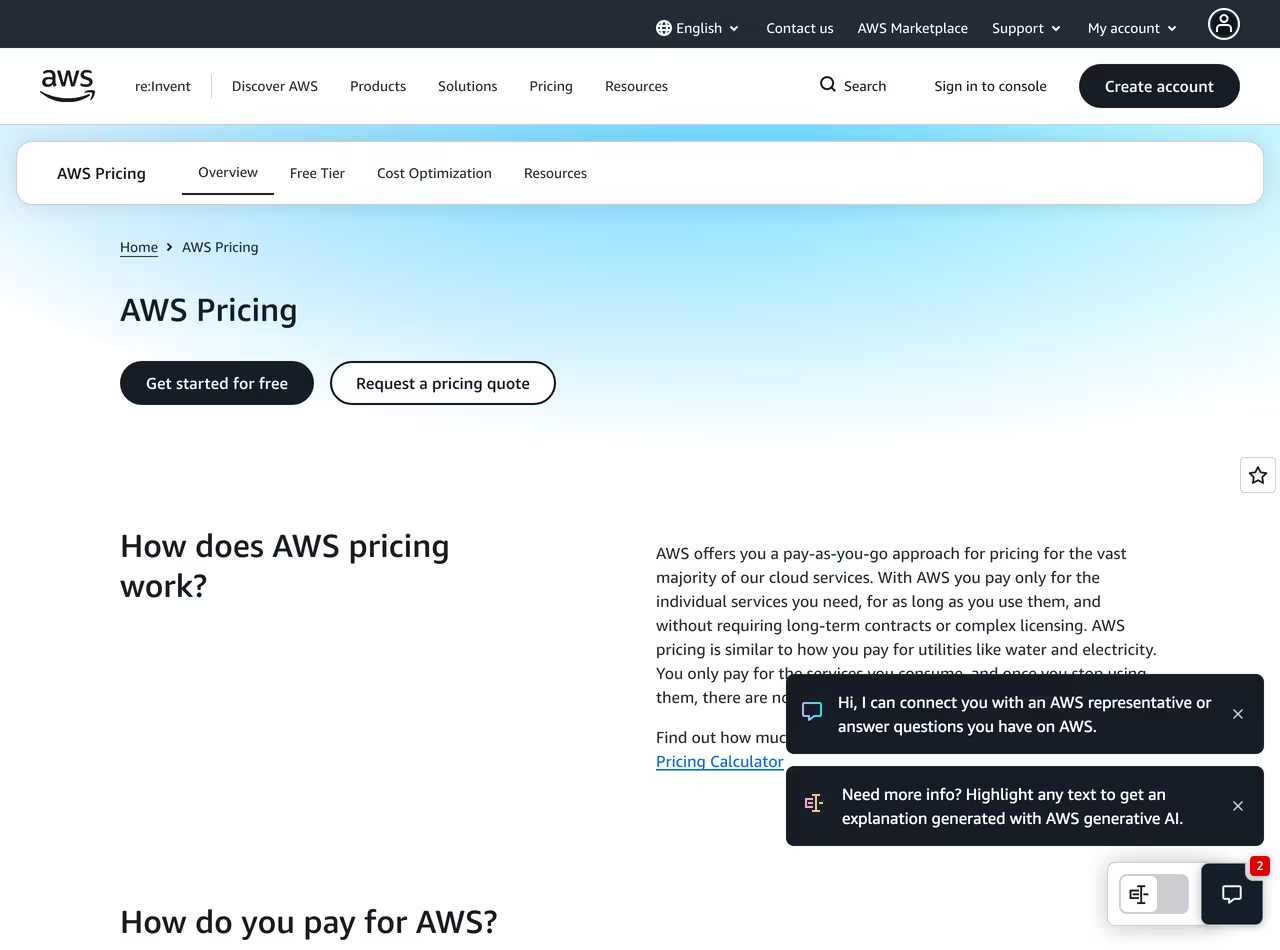
On price, AWS isn't trying to be the cheapest, and it isn't. A general-purpose 4 vCPU / 16GB instance runs about $0.19/hr on-demand, which is basically a tie with GCP. AWS does tend to win on memory-optimized instances, and its entry-level t3.micro lands around $0.0116/hr, or roughly $8.70 a month if you ran it nonstop (CloudZero). Storage on S3 standard sits near $0.023 per GB-month. None of these are shocking either direction.
Where AWS asks more of you is discounts. The savings are real but you have to go get them. Reserved Instances and Savings Plans can knock 40–60% off, but they require you to commit to a term and, in the RI case, think about instance families. If you forget to buy them, you pay full freight. That's the AWS tax on inattention.
The breadth argument is the strongest one. AWS has a service for nearly everything, and the always-free serverless tier is genuinely useful: Lambda plus DynamoDB plus API Gateway can run a real API backend indefinitely at $0, as long as traffic stays moderate. For new accounts created after mid-2025, the old 12-month free EC2 micro instance is gone, replaced by a credit model: $100 up front and up to $100 more for completing activities, $200 total over six months, after which the account closes if you don't upgrade (AWS).
 AWS pricing, June 2026
The case for GCP
Google Cloud is smaller, growing faster, and opinionated in a way that helps certain teams a lot. Per both companies' quarterly earnings, Google Cloud has been growing faster than AWS in percentage terms, so the gap is slowly closing — though AWS still dwarfs GCP in absolute revenue.
The thing GCP does that I wish AWS copied: sustained-use discounts apply automatically. Run a VM steadily through the month and Google quietly drops the price, up to about 30% off, with zero commitment and no spreadsheet. That alone makes GCP 5–10% cheaper for steady, always-on compute without anyone lifting a finger (CloudZero). Committed-use discounts stack on top, reaching roughly 57% for planned usage. The entry-level e2-micro is also a touch cheaper at around $0.008–0.010/hr.
The free tier is more generous on its face. New accounts get $300 in credits valid for 90 days, usable on any service, plus an Always Free e2-micro VM in eligible US regions (us-west1, us-central1, us-east1), 5GB of Cloud Storage, 2 million Cloud Run requests, and 1TB of BigQuery queries every month (GCP Free Tier). For learning or running a small side project, the permanent e2-micro is a nicer deal than AWS's serverless-only always-free path.
Then there's the part GCP is actually known for. BigQuery is a genuinely great serverless data warehouse, and Gemini is wired directly into it so analysts can call a model from SQL and process text columns at terabyte scale without building an ETL pipeline first. Vertex AI's MLOps tooling (Pipelines, Model Registry, Model Monitoring, Feature Store) is more cohesive than what AWS ships, and GKE has been the gold-standard managed Kubernetes since Google invented Kubernetes in the first place.
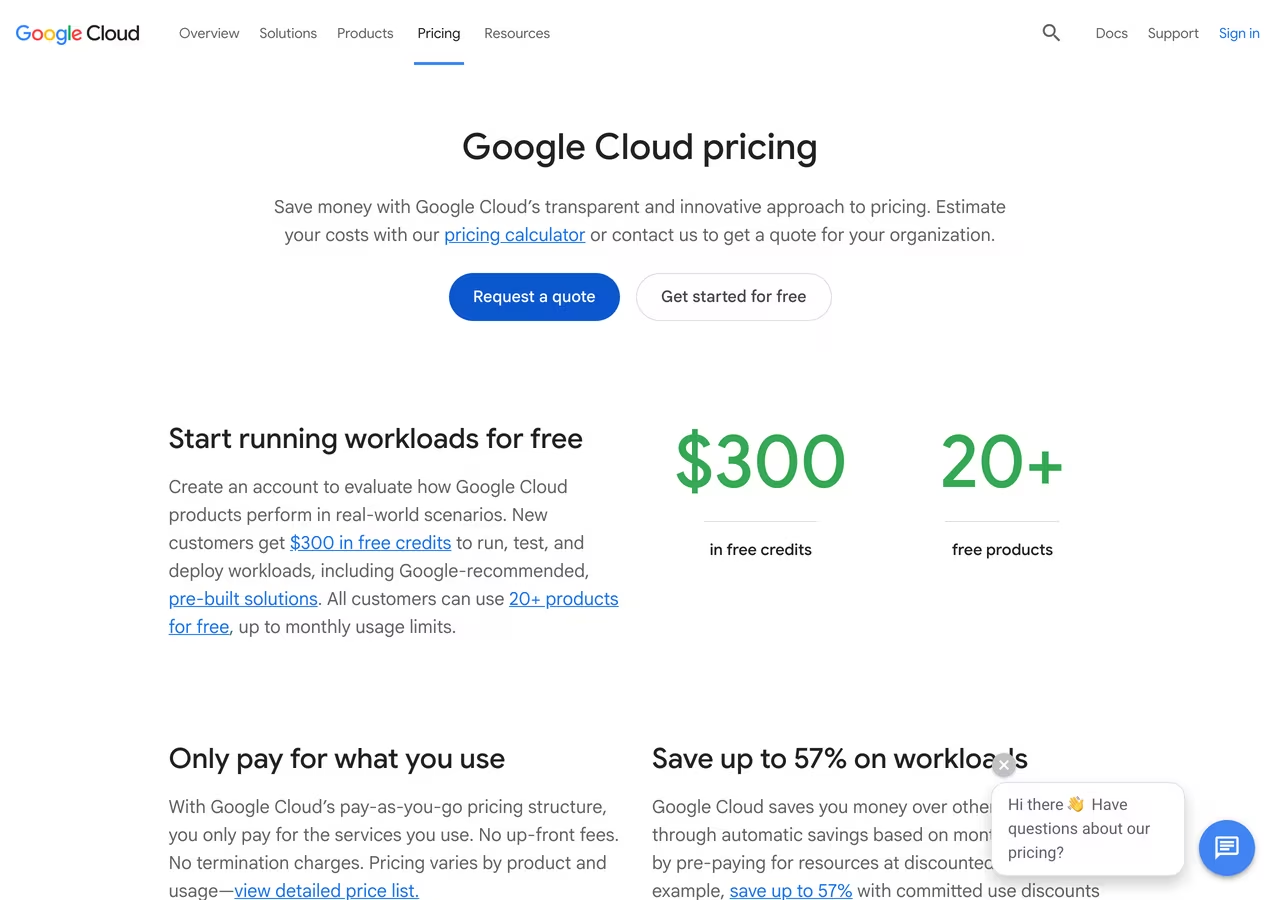 Google Cloud pricing, June 2026
Which to pick, by use case
You're a startup shipping a web app. Go AWS unless you have a reason not to. The talent pool, the docs, the third-party integrations, and the always-free serverless backend make it the path of least resistance. You'll find an answer to every question faster.
You're data- or ML-heavy. GCP, pretty clearly. BigQuery plus Vertex AI plus Gemini-in-SQL is a tighter, more pleasant stack than stitching Redshift, SageMaker, and Bedrock together. If your product is "do something smart with a lot of data," start here.
You're building on Kubernetes. GCP. The control-plane fee is identical at $0.10/hr per cluster on both EKS and GKE, but GKE gives you one cluster free each month via a $74.40 credit, and Autopilot bills per-pod by the second instead of per-node (Sedai). For variable or bursty workloads where node utilization sits below ~60%, Autopilot's bin-packing usually wins on cost and on operational headache.
You're optimizing for cost without a FinOps team. GCP, narrowly. The automatic sustained-use discounts mean you save money by default. On AWS you save money by remembering to buy commitments, and "remembering" is where small teams leak budget.
You're enterprise or you're already deep in one ecosystem. Stay where you are. If your data warehouse, your IAM, and your team's muscle memory all live in AWS, Bedrock and SageMaker are the right default. If you're Google Workspace and BigQuery already, Vertex AI is. Platform choice matters more than model choice in 2026, because the model quality gap between providers is small while the migration cost is not.
The egress trap nobody warns you about
This is the section I wish someone had sat me down for. Egress, the fee for moving data out of the cloud to the internet, is where cloud bills go feral, and both providers play the same game.
AWS gives you 100GB of free egress from regions per month, then charges $0.09/GB for the first 10TB, dropping to $0.085 up to 50TB and $0.07 beyond that (AWS tiers). GCP also gives 100GB free, then charges $0.12/GB on its Premium network tier, which is actually 33% more expensive than S3. The twist: GCP's Standard tier, which routes over the public internet instead of Google's backbone, runs about $0.085/GB and undercuts AWS, if your app tolerates slightly less optimized routing (Spendark).
Why this bites: a data-heavy app serving 10TB of traffic a month pays roughly $900 on AWS and over $1,100 on GCP Premium, and that's a line item most people never modeled. Inter-zone and cross-region transfer add more on top. The good news is that same-region, service-to-service traffic on internal IPs is free on both platforms, so a tidy architecture keeps most of this off your bill. The lesson: cheap compute means nothing if you're hemorrhaging on egress, and if you serve a lot of bytes to end users, put a CDN (CloudFront or Cloud CDN) in front of your origin before the bill teaches you the hard way.
FAQ
Is GCP cheaper than AWS?
For steady, always-on compute, usually yes, by about 5–10%, because GCP's sustained-use discounts apply automatically with no commitment. On raw on-demand list prices the two are nearly identical (~$0.19/hr for a 4 vCPU / 16GB box). But GCP's Premium-tier egress is more expensive than AWS at $0.12/GB vs $0.09/GB, so a bandwidth-heavy app can actually cost more on GCP. "Cheaper" depends entirely on your workload shape.
Is AWS better than Google Cloud?
Better at breadth, ecosystem, and hireability, yes. AWS has the largest service catalog, the most documentation, and the deepest talent pool, which makes it the safer default for general-purpose apps. GCP is better at data analytics, machine learning, and Kubernetes. "Better" isn't a property of the platform; it's a match between the platform and your project.
Should I learn AWS or GCP?
Learn AWS first if you're optimizing for job offers, since far more roles list AWS than GCP and the certifications are more widely recognized. Learn GCP first if you're aiming at data engineering, ML, or analytics work, where BigQuery and Vertex AI skills are specifically valued. The core concepts (VMs, object storage, IAM, networking, containers) transfer between them, so the second platform is much faster to pick up than the first.
Is GCP catching up to AWS?
On growth rate, yes; on absolute size, slowly. Google Cloud has been outgrowing AWS in percentage terms (per their earnings reports), and GCP's market share has been creeping up — though it remains a distant third behind AWS and Azure. But AWS still roughly doubles GCP in absolute spend at ~28% share, so "catching up" is real but it's a multi-year story, not a 2026 upset.
Can I use both AWS and GCP together?
Yes, and plenty of teams do, typically running their core app on one while using the other for a specific strength, like keeping compute on AWS but doing analytics in BigQuery. The catch is cross-cloud egress fees and double the operational surface. For a small team, multi-cloud is usually more cost and complexity than it's worth until you have a concrete reason for it.
Bottom line
Default to AWS if you're building a general product and want the safest, best-supported path. Choose GCP if your work centers on data, ML, or Kubernetes, or if you want pricing that's gentle without active management. The compute is a tie. The difference is the ecosystem around it and the fine print on egress, so model your data-transfer costs before you commit to either. Honestly, for most early-stage teams the bigger mistake is over-engineering for scale you don't have yet, on either platform.
Affiliate disclosure: TechRiseUps may earn a commission if you sign up through links on this page. It costs you nothing extra and never affects our recommendations or the numbers above, which come from each provider's public pricing and independent comparisons.
Sources: CloudZero · Spendark · Sedai (Kubernetes pricing) · AWS Free Tier update · Google Cloud Free Tier · Statista cloud market share
Some links may earn us a commission at no extra cost to you.

Waqas Ahmed Waseer
Waqas Ahmed Waseer is a developer and automation builder with 8+ years shipping production systems used by 100k+ people. He builds custom multi-tenant SaaS, AI automation (n8n, LLM workflows, WhatsApp bots) and hosting infrastructure (WHM/cPanel, CloudLinux) — and is the maker of WaSphere, FlowMaticX, and the WaseerHost hosting brand. 100+ projects delivered for SMBs, agencies and funded startups.