The best ElevenLabs alternatives in 2026 fall into two groups: cheaper cloud voices like Cartesia, PlayAI and Murf that undercut ElevenLabs on price, and open-source models such as Chatterbox, Kokoro and XTTS that you self-host for the cost of a server instead of a per-character bill. If you just want a lower invoice with an API that behaves like ElevenLabs, Cartesia is the closest swap. If you want to stop paying per character entirely and own the pipeline, an open-source model on your own GPU is now genuinely good enough. This guide ranks the real contenders by what they cost, including the server bill self-hosting quietly adds that the vendor listicles leave out.
People leave ElevenLabs for a few concrete reasons: the switch to a metered credit model where roughly one credit equals one character, so long-form narration burns through a plan fast; per-seat and per-clone limits on cheaper tiers; and unease about sending scripts through a third-party API. Every option below fixes at least one of those. None fixes all of them, so the right pick depends on the trade-off you can live with.
The best ElevenLabs alternatives in 2026 at a glance
| Tool | Type | Price (2026) | Voice cloning | Self-host | Best for |
|---|---|---|---|---|---|
| Cartesia | Cloud API | Free; Pro $5/mo (~133 min) | Instant + pro | No | Closest cheap API swap for developers |
| PlayAI | Cloud API | Free; Starter $9/mo; Pro $99/mo | Yes | No | Low-cost agents and playnotes |
| Murf AI | Cloud studio | Free (10 min); Creator $29/mo | Enterprise only | No | Non-technical teams and studio editing |
| PlayHT | Cloud API | Pro $39/mo (50k words) | Yes | No | High-volume word-based projects |
| Chatterbox | Open source (MIT) | Free software + GPU | Zero-shot (~5s) | Yes | Quality on your own hardware |
| Kokoro-82M | Open source (Apache) | Free software + CPU/VPS | No | Yes | Cheap, fast narration at scale |
| XTTS v2 | Source-available | Free (non-commercial) | Clone (~6s) | Yes | Personal multilingual cloning |
| Piper | Open source | Free software | No | Yes | Offline and edge devices |
Cloud prices are monthly list rates from each vendor's official pricing page, checked July 2026. "Free software" means no license fee, but you still pay for the compute you run it on.
Cartesia: the closest cheap API swap
Cartesia is the alternative most developers reach for when the goal is simply a lower bill with a familiar API. Its Sonic model targets low-latency, real-time speech, which is exactly the workload ElevenLabs charges the most for. The Free plan gives 20,000 credits a month, about 27 minutes of audio, and the Pro plan is $5/month for 100,000 credits, roughly 133 minutes, with instant voice cloning and a commercial license included. Higher tiers scale to a $49 Startup plan and a $299 Scale plan. For a small product that needs a few hours of speech a month, Cartesia's entry pricing is a fraction of ElevenLabs' equivalent, and the API is close enough that swapping is mostly a matter of changing keys and voice IDs. The trade-off is a smaller voice library and less mature tooling than ElevenLabs' studio.
PlayAI and PlayHT: cheap agents and high-volume words
PlayAI (the voice product from the Play.ht team) is built for conversational agents and "playnotes," and its entry pricing is aggressive. The Free tier includes 30 minutes of speech credits and one instant voice clone; the $9/month Starter adds 50 minutes plus overage at $0.18 per extra minute, and the $99/month Pro plan includes 700 minutes and three professional clones. If your work is measured in words rather than agent minutes, the classic PlayHT plans run $39/month for 50,000 words on the Professional tier and $99/month for unlimited generation on Premium. Between them, the Play family covers both the "cheap real-time agent" and "bulk article-to-audio" cases, and both undercut ElevenLabs at comparable volume. The caveat is that voice quality and consistency are a notch below ElevenLabs' best models, which matters more for polished content than for internal tools.
Murf AI: the studio pick for non-developers
Murf is the alternative to hand a marketing or L&D team that will never touch an API. It is a browser studio with a timeline editor, synced background music and hundreds of stock voices, so the workflow is closer to editing a video than calling an endpoint. Pricing is time-based rather than credit-based: the free tier gives 10 minutes of generation, and the Creator plan is $29/month billed monthly (or $19/month annually) for 24 hours of voice generation a year, with a $99/month Business tier above it. Voice cloning is gated to Enterprise, which is the main limitation. Murf wins on approachability and the editing experience, and loses if you need programmatic generation or your own cloned voice on a budget.
The open-source contenders: stop paying per character
This is the section the vendor blogs skip, because it competes with them. In 2026 open-source text-to-speech is good enough that self-hosting is a real option, not a science project. The models below cost nothing to license; you pay only for the hardware they run on.
- Chatterbox is Resemble AI's MIT-licensed model, roughly 350–500M parameters, that does zero-shot voice cloning from about five seconds of audio and adds an emotion-exaggeration control. It runs on a single consumer GPU with 4–16GB of VRAM. Notably, in Resemble's own blind listening test, 65.3% of listeners preferred Chatterbox-Turbo over ElevenLabs versus 24.5% for ElevenLabs — a vendor-run study, so weight it accordingly, but a striking open-versus-closed result all the same.
- Kokoro-82M is the efficiency champion: an Apache-2.0 model of just 82M parameters that runs faster than real time on a CPU or in 2–3GB of VRAM, shipping 54 fixed voices across eight languages. It cannot clone voices, but for bulk narration on cheap hardware nothing beats its cost-to-quality ratio.
- XTTS v2 still clones convincingly from a ~6-second sample across 17 languages, but its license is non-commercial and its original developer, Coqui, has shut down — so treat it as a strong pick for personal projects only.
- Piper is the choice for offline and edge use: tiny, fast and fully local, at the cost of flatter, more robotic prosody on expressive text.
What does self-hosting a TTS model actually cost?
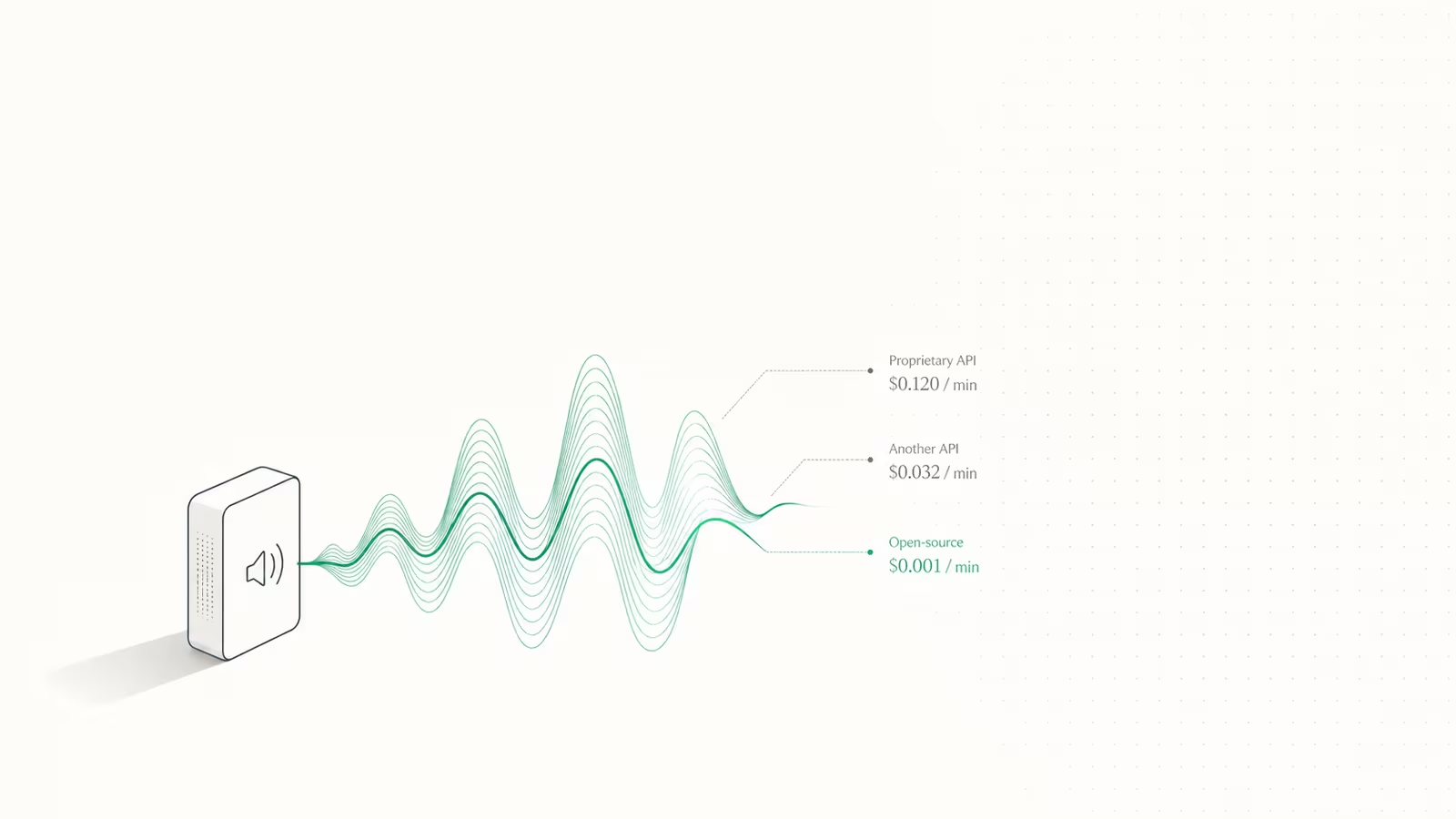
Here is the number the "10 best free alternatives" lists never give you. The software for Chatterbox, Kokoro, XTTS and Piper is free, but running it is not. You are trading a per-character API bill for one flat compute bill plus your own time. Kokoro is the cheap case: it runs on CPU, so a $5–12/month VPS can churn out narration all day, and you can compare providers in the best VPS hosting in 2026, ranked by real price and performance. Chatterbox needs a GPU; renting one by the hour runs from well under a dollar an hour on the providers we break down in the best cloud GPU providers for AI in 2026, ranked by real hourly cost. We run this site's own infrastructure through WaseerHost, our hosting company, so we will be blunt about the real trade-off: the compute is the cheap part. The tax is maintenance — model updates, GPU drivers, keeping the service up, and building the queueing and caching that a hosted API gives you for free. For a team generating tens of hours of audio a month, a self-hosted GPU box crushes ElevenLabs on cash. For someone who needs an hour of speech now and then, a $5 Cartesia plan or Kokoro on a tiny VPS is the smarter buy than babysitting a server.
Which ElevenLabs alternative should you pick?
There is no single winner, only a best fit per situation:
- Cheapest drop-in API: Cartesia at $5/month, or PlayAI if you are building voice agents.
- Non-technical team: Murf, for the studio editor and stock voices, accepting cloning is Enterprise-only.
- Best quality without the per-character bill: Chatterbox self-hosted on a consumer GPU — the closest open model to ElevenLabs' quality.
- Cheapest at scale: Kokoro on a small VPS, if you can live without voice cloning.
- Multilingual personal cloning: XTTS v2, for non-commercial use only.
For most developers leaving ElevenLabs over cost, the honest answer is Cartesia to start and Chatterbox once your volume justifies a GPU. For most non-technical users, it is Murf or PlayAI. Match the tool to the trade-off you can actually live with, not to whichever ranks first on a vendor's own listicle. If you are auditing your whole AI stack for price, we do the same exercise for research tools in the best Perplexity AI alternatives in 2026, ranked by real cost.
Frequently asked questions
What is the best free ElevenLabs alternative? For a cloud tool, Cartesia's free tier (about 27 minutes a month) and PlayAI's free tier (30 minutes) are the most generous with a real commercial-grade API. For truly unlimited free use, self-host Kokoro-82M — the software is free under Apache 2.0 and runs on a cheap CPU server, so your only cost is a few dollars of hosting.
Is there an open-source ElevenLabs alternative? Yes, several. Chatterbox (MIT) and Kokoro (Apache 2.0) are fully open source and free to run commercially; Piper is open source and built for offline devices; XTTS v2 is source-available but non-commercial. All four let you run text-to-speech on your own hardware with no per-character fee and no scripts leaving your servers.
Did an open-source model really beat ElevenLabs? In Resemble AI's own blind listening test, 65.3% of listeners preferred its open-source Chatterbox-Turbo model over ElevenLabs, versus 24.5% who preferred ElevenLabs. It is a vendor-run study, so treat the exact numbers with caution, but it reflects a real shift: open models closed most of the quality gap in 2026.
What is the cheapest ElevenLabs alternative? Among cloud tools, Cartesia's $5/month Pro plan is the cheapest credible API. If you are willing to self-host, Kokoro on a $5–12/month VPS is cheaper still at volume, since the cost is fixed regardless of how much audio you generate — you pay for the server, not per character.
Can I self-host a text-to-speech model, and is it cheaper? Yes, and it usually is for steady volume. Kokoro runs on a small CPU VPS; Chatterbox needs a consumer GPU with 4–16GB of VRAM. Both remove the per-character bill entirely. The catch is maintenance: you own the updates, uptime and the queueing and caching that a hosted API includes by default.
Sources
- ElevenLabs — official pricing: credit-based plans and the ~1 credit per character model.
- Cartesia — official pricing: free tier, $5 Pro plan, credits-to-minutes conversion.
- PlayAI — official pricing: free, Starter and Pro speech-credit plans.
- PlayHT — official pricing: word-based Professional and Premium plans.
- Murf AI — official pricing: time-based Free, Creator and Business plans.
- SiliconFlow — best open-source text-to-speech models in 2026: Chatterbox, Kokoro, XTTS and Piper specs and licenses.
- FindSkill — best open-source TTS 2026: Resemble's vendor-run Chatterbox-vs-ElevenLabs blind-test figures.
Some links may earn us a commission at no extra cost to you.

Waqas Ahmed Waseer
Waqas Ahmed Waseer is a developer and automation builder with 8+ years shipping production systems used by 100k+ people. He builds custom multi-tenant SaaS, AI automation (n8n, LLM workflows, WhatsApp bots) and hosting infrastructure (WHM/cPanel, CloudLinux) — and is the maker of WaSphere, FlowMaticX, and the WaseerHost hosting brand. 100+ projects delivered for SMBs, agencies and funded startups.