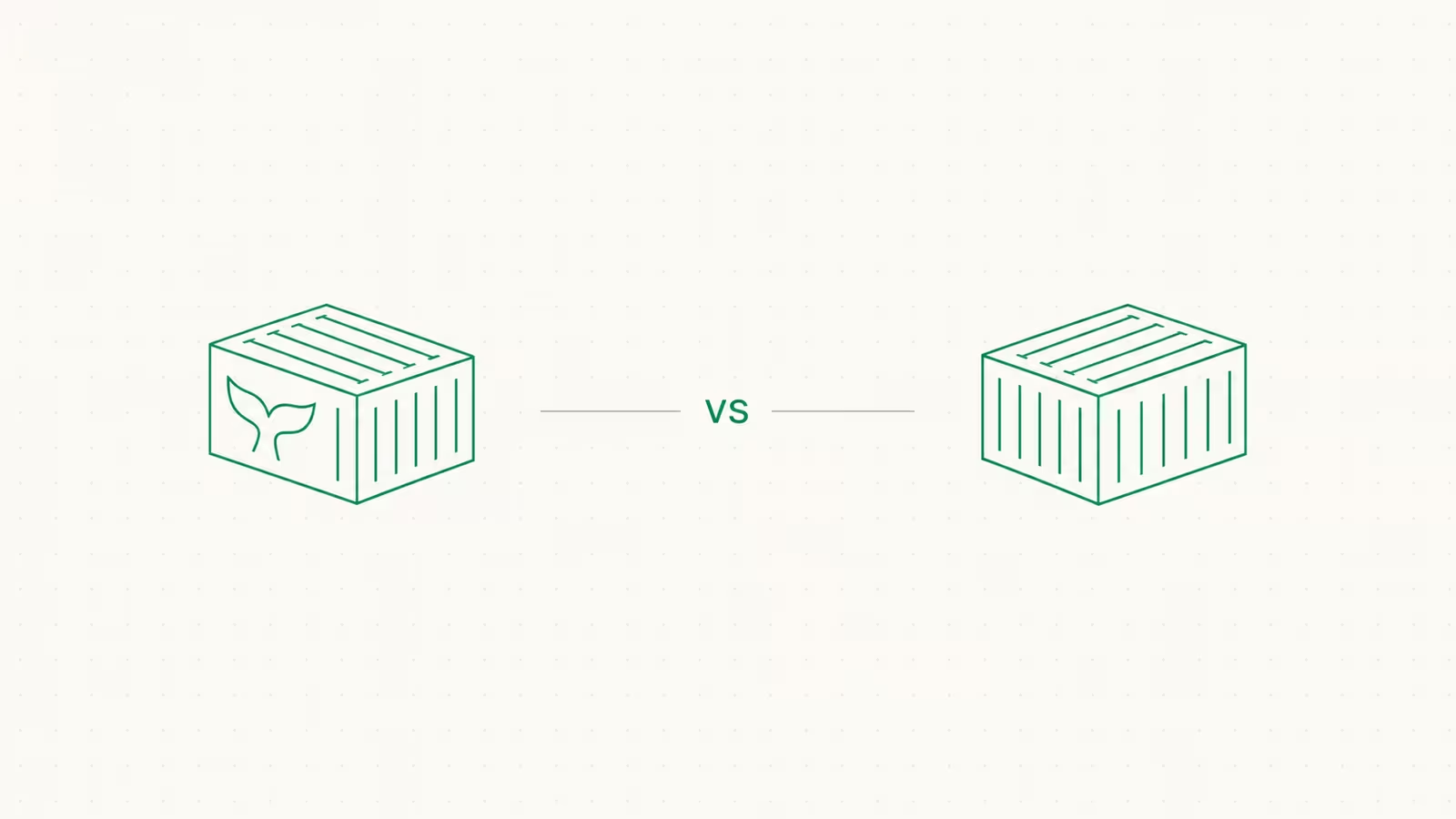
Podman and Docker do the same core job — build, run, and manage OCI containers — but they make opposite bets on architecture, security, and cost. Docker runs a central root daemon and polishes the developer experience; Podman is daemonless, runs rootless by default, and is fully free under the Apache 2.0 license. If you want the shortest possible answer: keep Docker if your team lives in Docker Compose and Docker Desktop and you are under the free-tier size limit; move to Podman if you run Linux servers, care about rootless security, or your company is now big enough that Docker Desktop needs a paid subscription. This guide covers the real differences that matter in 2026, the licensing math, and which one to pick for a single production VPS.
Podman vs Docker: the short answer
Both tools speak the same OCI image format, both use near-identical CLI syntax (alias docker=podman works for most day-to-day commands), and both can run the same containers you already have. The split is architectural. Docker centralizes work through a long-running, root-privileged daemon (dockerd); Podman runs each container as an ordinary user process with no daemon at all. That one design choice cascades into every other difference below — security posture, resource use, how systemd integration works, and what happens when the "engine" crashes.
| Factor | Docker | Podman |
|---|---|---|
| Architecture | Central root daemon (dockerd) | Daemonless, one process per container |
| Rootless mode | Opt-in, some features limited | Default, designed around it |
| License / cost | Engine free; Docker Desktop paid above free tier | Fully free, Apache 2.0 |
| Compose | First-class, mature | podman compose + Quadlets/Kube YAML |
| Best for | Team DX, Compose-heavy workflows, Mac/Windows | Linux servers, security, rootless, Kubernetes |
| Ecosystem | Largest, most tutorials | Growing, strong on Red Hat/Fedora |
What is the real difference between Podman and Docker?
The defining difference is the daemon. Docker routes every command through dockerd, a background service that runs as root and owns all your containers; if it dies, your containers go with it, and anyone in the docker group effectively has root on the host. Podman is daemonless — each container is a direct child of the user who launched it, so there is no always-on privileged process and no single point of failure. Podman also runs rootless by default, mapping container root to an unprivileged host user, while Docker's rootless mode exists but is opt-in and still leaves some features (like certain networking and cgroup setups) partly unsupported. For anyone hardening a server, that default matters: Podman starts from the safer position, and Docker asks you to reach it manually. Podman leans on systemd for lifecycle management (via Quadlets), which fits Linux hosts more naturally than a bespoke daemon.
Which is faster, Podman or Docker?
Honestly, it depends on the workload, and the published benchmarks disagree enough that you should distrust any single "X is faster" headline. Uptrace's 2025 comparison found Docker roughly 10–15% quicker on individual operations like startup, image pulls, and networking, while Podman's daemonless design used markedly less idle memory. Middleware's testing, by contrast, reported Podman outpacing Docker on larger workloads with up to 30% faster startup times. Both can be true: Docker's warm daemon shaves latency off single commands, while Podman avoids the fixed overhead of keeping that daemon resident, which pays off as container counts climb. For the vast majority of self-hosters and small teams, the raw speed gap is not the deciding factor — you will not feel 15% on a docker run you issue a few times a day. Resource footprint on a small box is the more practical concern, and there Podman's no-daemon model has a real edge.
The Docker Desktop licensing question
This is where "free vs free" stops being simple. The Docker engine is open source and free, but Docker Desktop — the GUI plus bundled VM most Mac and Windows developers actually use — requires a paid subscription for larger organizations. Per Docker's own license terms, Docker Desktop is free only for personal use and for "small businesses (fewer than 250 employees AND less than $10 million in annual revenue)." Cross either threshold and every developer using Docker Desktop needs a paid seat: Docker Pro at $9/user/mo, Team at $15/user/mo, and Business at $24/user/mo on annual billing. For a 200-engineer shop that is real money each year. Podman has no equivalent trap — both Podman and Podman Desktop are free under Apache 2.0, with no seat count, revenue clause, or subscription. The 2024 tightening of Docker Desktop's terms is the single biggest reason teams re-evaluated Podman as a serious option rather than a niche one.
Which should you run on a single VPS?
For a solo developer or small team running services on one Linux VPS, the daemon question is less about licensing and more about safety and simplicity. Podman's rootless-by-default model is a genuine advantage on a box exposed to the internet: a container breakout lands on an unprivileged user, not root. It also plays cleanly with systemd, so you can run containers as proper services that survive reboots without a separate daemon to babysit. Docker remains the smoother choice if you rely on Docker Compose stacks, third-party tutorials that assume docker commands, or tools like Watchtower and Portainer that target the Docker socket. At WaseerHost, our own hosting service, we run containerized workloads on our own VPS infrastructure, and the practical reality is that both engines are production-ready on a modern VPS — the deciding factors are your existing tooling and how much you value rootless isolation. If you are setting up a fresh server, our guides on the secure first hour of a new VPS and self-hosting your apps on a VPS apply equally to either engine.
Migrating from Docker to Podman
Migration is easier than most people expect because Podman was built to be Docker-compatible. The CLI is a near drop-in — podman run, podman build, and podman ps all behave like their Docker equivalents, and many teams simply alias docker to podman. Your existing images work unchanged since both use the OCI standard. The friction points are Compose and anything hard-wired to the Docker socket. Podman offers podman compose (which wraps an external Compose provider) plus its own Quadlets and Kubernetes-style YAML for defining multi-container apps, but a complex docker-compose.yml may need testing rather than a blind copy. Socket-dependent tools — some CI runners, Portainer, certain backup scripts — expect the Docker API and may need Podman's compatibility socket enabled or a rethink. Plan the migration around those two areas and the rest tends to just work. Your data-handling routines, like how you back up Docker volumes, carry over with minor path changes.
FAQ
Why use Podman instead of Docker? The main reasons are security and cost. Podman runs rootless and daemonless by default, so there is no always-on root process and a container escape lands on an unprivileged user. It is also fully free under Apache 2.0, with no Docker Desktop–style subscription once your company passes 250 employees or $10 million in revenue. Teams on Linux servers and those aligned with Kubernetes tend to prefer it.
Which is faster, Podman or Docker? It depends on the workload, and benchmarks conflict. Uptrace found Docker about 10–15% faster on individual operations thanks to its warm daemon, while Middleware measured Podman up to 30% faster on larger workloads. In everyday self-hosting the difference is rarely noticeable; Podman's lighter idle footprint matters more on small servers than raw command latency.
What are the disadvantages of Podman?
Podman's ecosystem is smaller, so more tutorials, CI templates, and third-party tools assume Docker. Docker Compose support works through podman compose but a complex stack can need adjustment, and tools built against the Docker socket may require the compatibility socket. On macOS and Windows, Podman runs through a managed VM (Podman Machine) that some developers find less polished than Docker Desktop.
Why are people moving away from Docker? Two triggers: the 2024 tightening of Docker Desktop's paid-subscription terms for larger companies, and a growing preference for rootless, daemonless security on servers. Podman answers both — it is free with no seat licensing and secure by default — which turned it from a niche alternative into a mainstream one. Docker still wins on developer experience and ecosystem breadth.
Sources
- Docker — Docker Desktop license terms — official free-tier thresholds (under 250 employees and $10M revenue)
- Docker — Pricing — current Pro/Team/Business per-seat prices
- Podman — official site — Apache 2.0 license, free and open source
- Uptrace — Podman vs Docker: Performance, Security & Cost — benchmark data on speed and memory
- Middleware — Podman vs Docker: Which Container Runtime Wins in 2026? — architecture and startup-time comparison
Some links may earn us a commission at no extra cost to you.

Waqas Ahmed Waseer
Waqas Ahmed Waseer is a developer and automation builder with 8+ years shipping production systems used by 100k+ people. He builds custom multi-tenant SaaS, AI automation (n8n, LLM workflows, WhatsApp bots) and hosting infrastructure (WHM/cPanel, CloudLinux) — and is the maker of WaSphere, FlowMaticX, and the WaseerHost hosting brand. 100+ projects delivered for SMBs, agencies and funded startups.