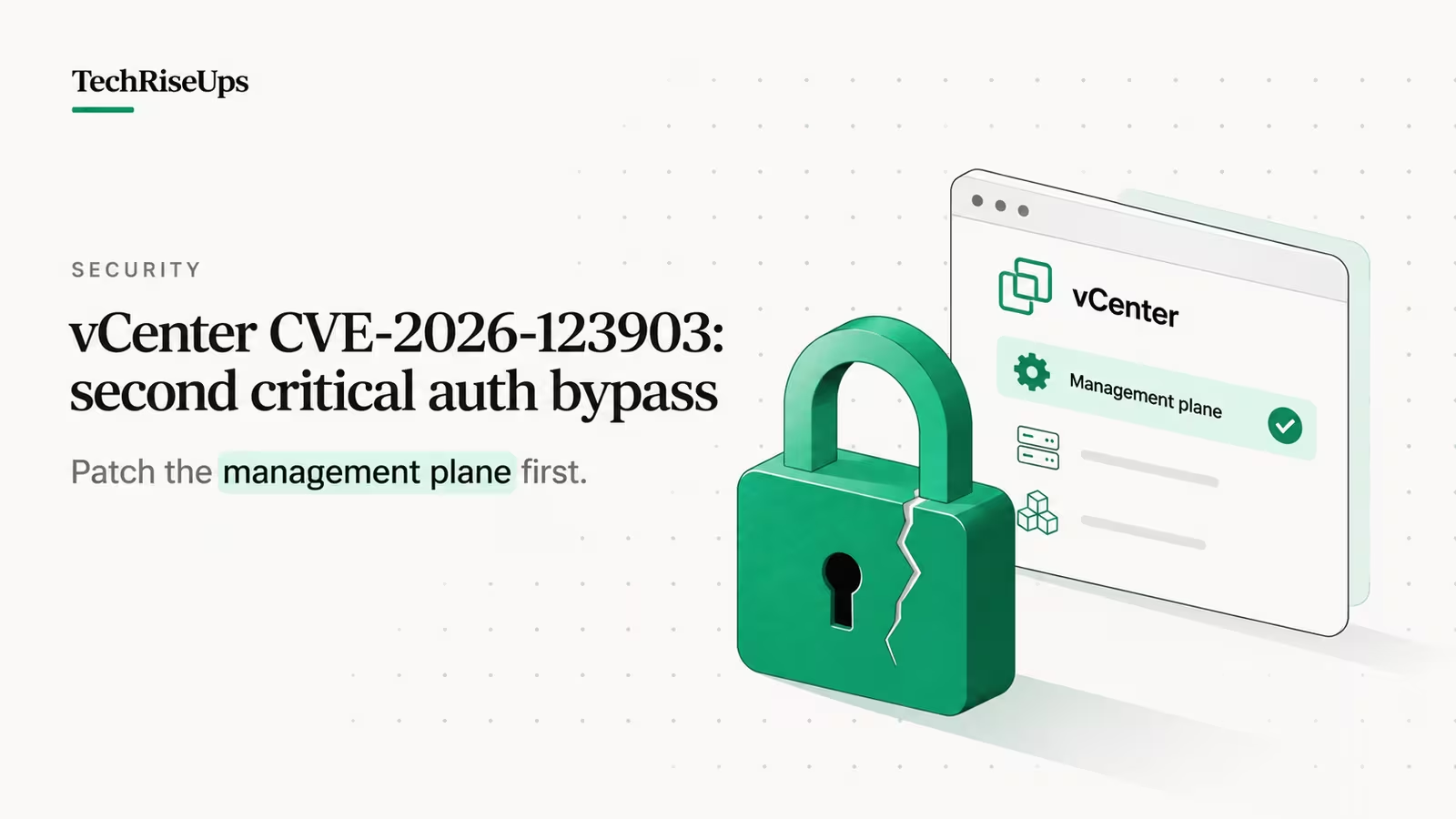
If you patched vCenter last week, you are not done. On November 24, 2026 Broadcom shipped VMSA-2026-0011 to fix CVE-2026-123903, a second critical authentication bypass in the VMware Directory Service, rated CVSS 9.8. It lands five days after Broadcom closed a separate vmdir flaw that a China-nexus espionage group had already exploited as a zero-day. The short version: yes, you need to patch again, and the two fixes are not the same update.
CVE-2026-123903 lets an attacker with only network access to vCenter log in as an administrator without credentials. Broadcom's advisory puts it plainly: "A malicious actor with network access to vCenter may exploit this issue to bypass authentication and gain unauthorized access to the system." The vector is network, the complexity is low, and it needs no privileges and no user interaction, which is why the score sits at the top of the range.
What is CVE-2026-123903?
CVE-2026-123903 is a critical authentication bypass in vmdir, the VMware Directory Service that backs vCenter Single Sign-On. A public proof-of-concept describes the mechanism: a failed LDAP SASL bind, using SRP with a claimed administrator UPN and an invalid proof, plants that identity's access token on the connection. Later plain LDAP operations on the same connection then run as administrator, which lets an attacker create an account and add it to the Administrators group without ever knowing a password. Broadcom scored it CVSS 9.8 (AV:N/AC:L/PR:N/UI:N) and listed no workaround, so patching is the only fix. As of November 25, 2026 there were no confirmed reports of CVE-2026-123903 being exploited in the wild, though PoC code claiming to work appeared the same day the advisory went out.
Why a second patch, five days later?
This is the part day-one coverage glosses over. The earlier flaw, CVE-2026-123890, was also a 9.8 vmdir authentication bypass, and it was already being used in attacks when Broadcom patched it. A suspected China-based group tracked as Armory Castle (formerly UNC5221) exploited it as a zero-day, using a custom tool called BONESAW to extract vCenter's signing key, forge administrator tokens, and create a single sign-on administrator account. Broadcom is explicit that the new bug is separate: "CVE-2026-123903 is a distinct issue and is not related to CVE-2026-123890." So the update you applied last week does not cover this one. Patching CVE-2026-123890 and patching CVE-2026-123903 are two different version bumps, and only the November 24 release closes both.
The vCenter vmdir timeline
The same directory component has now produced three authentication bypasses in five months, which is the real story for anyone running vSphere. Treat vmdir as a recurring risk, not a one-off.
| CVE | Disclosed | CVSS | Status | Notes |
|---|---|---|---|---|
| CVE-2026-59309 | July 2026 | Critical | Patched | First vmdir SSO bypass of the year |
| CVE-2026-123890 | Nov 2026 | 9.8 | Exploited zero-day | Used by Armory Castle with the BONESAW tool; added to CISA KEV |
| CVE-2026-123903 | Nov 24, 2026 | 9.8 | Patched, PoC public | Distinct from 123890; no confirmed in-the-wild use yet |
The pattern matters because an attacker who has studied one vmdir bypass has a head start on the next. The same recurring-component problem drove our coverage of the SharePoint zero-day that forced admins to rotate machine keys, and the Citrix NetScaler bugs exploited for weeks before a patch existed.
Which versions fix it
VMSA-2026-0011 maps the fix across the supported vCenter and VMware Cloud Foundation lines. Check your exact build before you assume you are covered, because the earlier patch for CVE-2026-123890 used different build numbers.
| Product line | Fixed version |
|---|---|
| vCenter 9.1.x | 9.1.2 |
| vCenter 9.0.x | 9.0.2.0300 |
| vCenter 8.0.x | 8.0 U3m |
| VMware Cloud Foundation 5.x | 5.2.5 |
| vCenter 7.0 | Extended support contract required |
The same advisory also fixes two ESX memory-corruption flaws, CVE-2026-123910 and CVE-2026-123911, in the ESX I/O filter service. Both allow code execution for an attacker with network access, so if you run ESX hosts, roll those fixes at the same time rather than treating this as a vCenter-only event.
What to do now
Apply the November 24 update across every vCenter and ESX host, then confirm the build number rather than trusting the patch log, since this is the second fix to the same component in a week. The bug reached Broadcom through coordinated disclosure, with credit to researchers at QiAnXin, ThreatBook, and others, but a public PoC already exists, so the window between "known" and "weaponized" is short.
The operational lesson is older than this CVE. vCenter should never be reachable from the internet. Broadcom's own prerequisite for exploitation is network access to vCenter, so your network segmentation decides your exposure here as much as your patch cadence does. We run our own infrastructure at WaseerHost, and management planes like a hypervisor's control panel sit behind a VPN or a jump host with no public route, so a same-week auth-bypass chain cannot be reached by an unauthenticated attacker scanning the open internet. Patch first, but if your vCenter is exposed, fix that too, because another vmdir flaw will almost certainly follow this one.
FAQ
Do I need to patch vCenter again if I already patched last week? Yes. The update you applied for CVE-2026-123890 does not fix CVE-2026-123903. Broadcom states the two are distinct issues, and only the November 24, 2026 release (VMSA-2026-0011) closes the newer bypass. Confirm your build matches the fixed version for your line.
Is CVE-2026-123903 being exploited in the wild? As of November 25, 2026 there were no confirmed reports of active exploitation of CVE-2026-123903. However, proof-of-concept code claiming to work appeared the day the advisory was published, so treat it as near-term weaponizable and patch without waiting for attack reports.
What is the difference between CVE-2026-123890 and CVE-2026-123903? Both are CVSS 9.8 authentication bypasses in the vmdir directory service, but they are separate flaws with separate fixes. CVE-2026-123890 was exploited as a zero-day by the Armory Castle group; CVE-2026-123903 was found through coordinated disclosure and had no confirmed in-the-wild use at publication.
Which vCenter versions are fixed? vCenter 9.1.2, 9.0.2.0300, and 8.0 U3m, plus VMware Cloud Foundation 5.2.5. vCenter 7.0 users need an extended support contract to receive the fix. The same advisory also patches two ESX code-execution flaws, so update ESX hosts as well.
Sources
- Rapid7, CVE-2026-123903 Critical VMware Directory Service Authentication Bypass Affects vCenter: CVSS 9.8, VMSA-2026-0011, November 24 release, fixed versions.
- The Hacker News, VMware vCenter Hit by Another Critical 9.8-Rated Auth Bypass Flaw: Broadcom quotes, the "distinct issue" statement, Armory Castle and BONESAW, researcher credits.
- iTnews, VMware fixes third vCenter auth bypass days after patching exploited flaw: timeline across CVE-2026-59309, 123890 and 123903, ESX flaws CVE-2026-123910/123911.
- GitHub, dinosn/CVE-2026-123903: technical mechanism of the LDAP SASL bind token-planting bypass, affected and fixed builds.
- CISA, Known Exploited Vulnerabilities Catalog additions, November 2026: federal patch deadlines for actively exploited vulnerabilities.
Some links may earn us a commission at no extra cost to you.

Waqas Ahmed Waseer
Waqas Ahmed Waseer is a developer and automation builder with 8+ years shipping production systems used by 100k+ people. He builds custom multi-tenant SaaS, AI automation (n8n, LLM workflows, WhatsApp bots) and hosting infrastructure (WHM/cPanel, CloudLinux) — and is the maker of WaSphere, FlowMaticX, and the WaseerHost hosting brand. 100+ projects delivered for SMBs, agencies and funded startups.