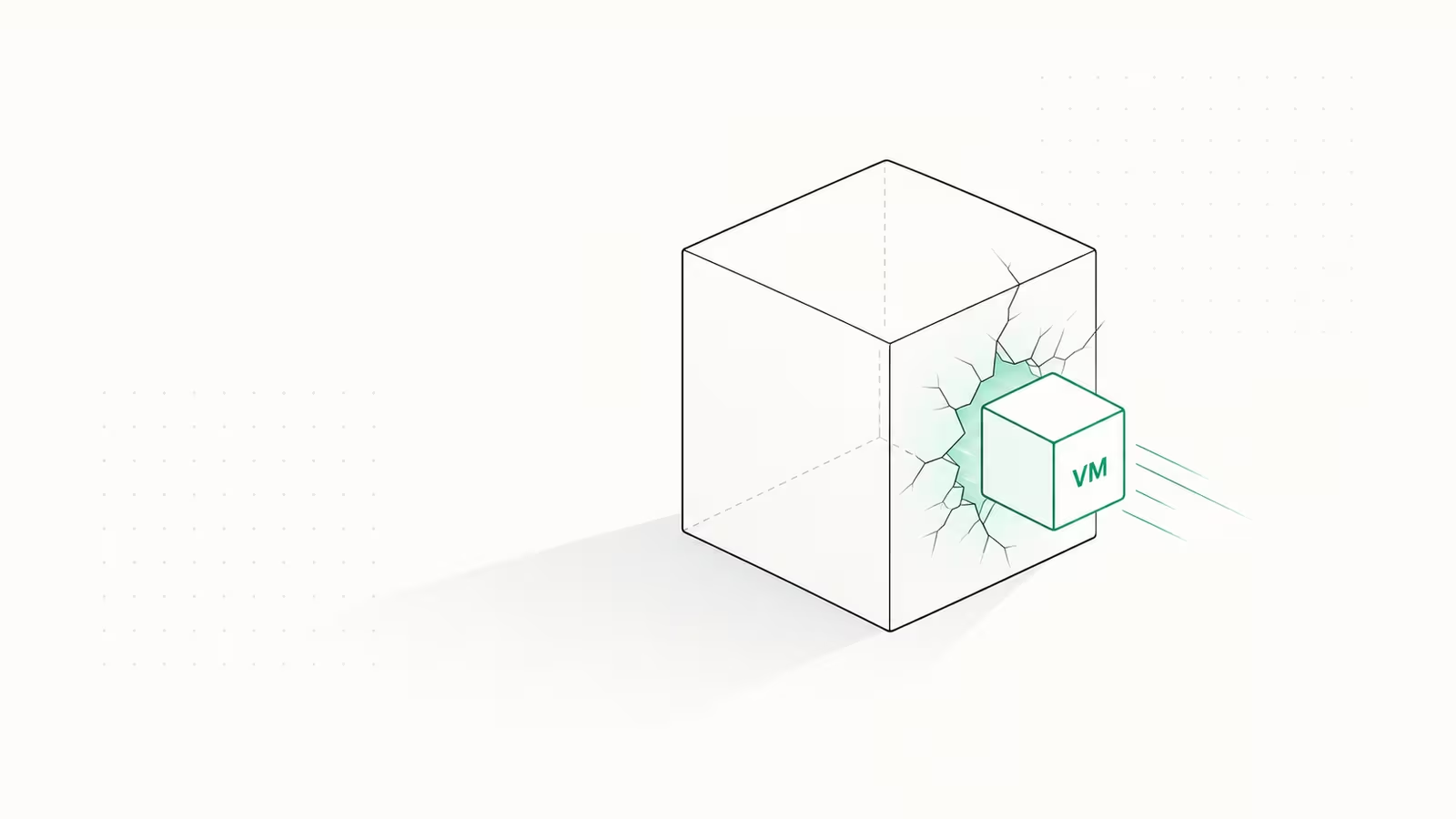
A 16-year-old flaw in the Linux kernel's KVM hypervisor, nicknamed Januscape and tracked as CVE-2026-53359, lets a malicious virtual machine break out of its guest and corrupt the memory of the host it runs on. It is a use-after-free in KVM's shadow memory-management code that affects both Intel and AMD x86 systems, and the fix only landed in stable kernels on July 4, 2026. If you run untrusted guests — a hosting platform, a CI runner, a multi-tenant cloud — this is the class of bug that keeps operators up at night: a full guest-to-host escape from unprivileged code inside the VM. Here is what the flaw is, why it hid for so long, who is actually exposed, and exactly how to close it.
What is Januscape (CVE-2026-53359)?
Januscape is a use-after-free vulnerability in the shadow MMU (memory management unit) of Linux KVM, the kernel's built-in hypervisor. It was found by security researcher Hyunwoo Kim (@v4bel) and submitted as a zero-day to Google's kvmCTF, the controlled reward program that pays up to $250,000 for a working guest-to-host escape. The public proof-of-concept reliably panics the host kernel from inside an unprivileged guest; the researcher says a separate, unreleased exploit turns the same bug into full code execution on the host. It is, to public knowledge, the first single KVM guest-to-host bug triggerable on both Intel and AMD hardware, because the vulnerable code is shared between the two. The National Vulnerability Database published the CVE on July 4, 2026; NVD has not scored it yet, but SUSE rates it 8.8 (CVSSv3.1) and 9.3 (CVSSv4.0) — high, bordering on critical.
How the bug works
The root cause is a page-reuse shortcut in KVM's shadow paging. When KVM builds nested page tables in software, it caches "shadow pages" and reuses them to save work. To find a page to reuse, the function kvm_mmu_get_child_sp() compared only the guest frame number (gfn) — the address a page represents — and ignored the page's role, meaning what kind of tracking structure it actually is. Two different page types can share one address while doing completely different jobs.
A malicious guest exploits that gap. It forces KVM to reuse a shadow page built for a 2 MB mapping (a "direct" page) when the mapping has changed to need a 4 KB page table (a "non-direct" page). The addresses match, so KVM hands back the wrong page. During cleanup, KVM then computes the wrong frame number, fails to remove the reverse-map entry, frees the shadow page anyway, and leaves a stale pointer behind. The next reverse-map operation dereferences that freed memory — a classic use-after-free the guest can steer, as TuxCare's breakdown documents. The upstream fix is almost trivial: kvm_mmu_get_child_sp() now compares the page's full role (role.word) alongside the frame number, so the two page types can never be confused again.
Why nested virtualization is the trigger
Modern CPUs handle guest memory in hardware — Intel calls it EPT, AMD calls it NPT — and that fast path does not touch the buggy code at all. The catch is nested virtualization: running a VM inside a VM. When a guest itself acts as a hypervisor, KVM falls back to the legacy software shadow MMU to manage the inner guest's memory, and that legacy path is exactly where Januscape lives. So even a host that uses hardware paging by default becomes vulnerable the moment it lets guests enable nesting. If your guests never run their own hypervisors, and nested virtualization is switched off, the attack path is closed. That single configuration detail is the difference between exposed and safe for most fleets.
Who is actually at risk
The practical worry is any x86 host that runs untrusted guests with nested virtualization available. In order of concern:
- Multi-tenant cloud and hosting providers running customer-controlled VMs on shared KVM hosts. A single hostile tenant with nesting enabled can, in principle, reach the host and every neighbor on it.
- CI/CD and build infrastructure that spins up throwaway VMs from untrusted pull requests — a common and easily forgotten exposure.
- Any box where untrusted code gets guest-root access and can load its own kernel modules or start a nested hypervisor.
Lower-risk setups: hosts that run only trusted, first-party guests; systems with nested virtualization already disabled; and container-only environments with no /dev/kvm access. We build and run TechRiseUps on our own infrastructure through WaseerHost, and our stance on a bug like this is simple and boring on purpose: patch the host kernel, and leave nested virtualization off anywhere it is not a product requirement. It is the same defense-in-depth logic behind our writeup of the Bad Epoll Linux kernel root flaw — the host kernel is the last wall between tenants, so it gets patched first.
How to fix Januscape
Patch the host kernel. The fix merged to mainline on June 19, 2026 (commit 81ccda30b4e8) and reached the stable trees on July 4, 2026. Update the host — not the guests — to at least the version for your series:
| Kernel series | Fixed version | Released |
|---|---|---|
| 7.1.x | 7.1.3 | Jul 4, 2026 |
| 6.18.x | 6.18.38 | Jul 4, 2026 |
| 6.12.x | 6.12.95 | Jul 4, 2026 |
| 6.6.x | 6.6.144 | Jul 4, 2026 |
| 6.1.x | 6.1.177 | Jul 4, 2026 |
| 5.15.x | 5.15.211 | Jul 4, 2026 |
| 5.10.x | 5.10.260 | Jul 4, 2026 |
If you cannot reboot immediately, the documented mitigation is to remove the attack path by disabling nested virtualization for untrusted guests: set kvm_intel.nested=0 on Intel or kvm_amd.nested=0 on AMD (via a modprobe.d drop-in), unload KVM entirely on hosts that run no VMs, and restrict access to /dev/kvm. Live-patching vendors began shipping rebootless fixes covering both Januscape and its sibling flaw from July 7, 2026, which is the pragmatic route for fleets that cannot take a maintenance window. Note that hosts distributed customer kernels — as many providers do — may lag the upstream dates, so check your specific vendor's advisory rather than assuming coverage.
Why a 16-year-old bug matters
Januscape was introduced in August 2010 (commit 2032a93d66fa, kernel 2.6.36) and sat unnoticed through sixteen years and countless audits. It is also not the only one: a closely related shadow-MMU use-after-free, CVE-2026-46113, was patched in May 2026, and that earlier fix does not block Januscape because the two exploit different mismatches (frame number vs page role). Two guest-to-host escapes in the same legacy code path within two months is the real story. The shadow MMU is old, complex, and increasingly the soft underbelly of virtualization security as hardware paths get hardened. Kim's other 2026 disclosures underline the trend — including ITScape (CVE-2026-46316), the first reported KVM/arm64 guest-to-host escape. The lesson for operators is not panic but posture: assume the hypervisor boundary is fallible, minimize what untrusted guests can reach (nested virt, custom kernels, /dev/kvm), and treat host-kernel patching as the highest-priority maintenance you run. If you are standing up your own boxes, our step-by-step guide to self-hosting apps on a VPS covers the kernel-update hygiene that closes bugs like this before they are weaponized.
Frequently asked questions
What is Januscape (CVE-2026-53359)? It is a use-after-free bug in Linux KVM's shadow MMU that lets a malicious guest VM escape to the host on Intel and AMD x86 systems. The public exploit crashes the host; the researcher claims a private version achieves full host code execution.
Am I affected if I run VMs? Only if your host exposes nested virtualization to untrusted guests. Hosts running trusted, first-party guests, or with nested virtualization disabled, are not on the vulnerable path — the buggy shadow-MMU code only runs when a guest nests another hypervisor.
How do I fix it?
Update the host kernel to a fixed stable release (7.1.3, 6.18.38, 6.12.95, 6.6.144, 6.1.177, 5.15.211, or 5.10.260, from July 4, 2026). If you can't reboot yet, disable nested virtualization (kvm_intel.nested=0 / kvm_amd.nested=0) or use a live-patching service.
Is Januscape being exploited in the wild? There is no confirmed in-the-wild exploitation as of publication. It surfaced through Google's kvmCTF research program, but a working host-panic proof-of-concept is public, so the window for opportunistic attacks is open. Patch on the assumption that it will be weaponized.
Sources
- The Hacker News — 16-Year-Old Linux KVM Flaw Lets Guest VMs Escape to Host: discovery, kvmCTF, CVSS, patched kernel versions, Intel/AMD scope, ITScape.
- TuxCare — Januscape exposes the KVM shadow-paging bug that kept coming back: root-cause walkthrough, CVE-2026-46113 relationship, mitigations, live-patch timeline.
- SecurityWeek — Linux Kernel Vulnerability Allows VM Escape on Intel and AMD Systems: independent confirmation of the guest-to-host escape and affected platforms.
Some links may earn us a commission at no extra cost to you.

Waqas Ahmed Waseer
Waqas Ahmed Waseer is a developer and automation builder with 8+ years shipping production systems used by 100k+ people. He builds custom multi-tenant SaaS, AI automation (n8n, LLM workflows, WhatsApp bots) and hosting infrastructure (WHM/cPanel, CloudLinux) — and is the maker of WaSphere, FlowMaticX, and the WaseerHost hosting brand. 100+ projects delivered for SMBs, agencies and funded startups.