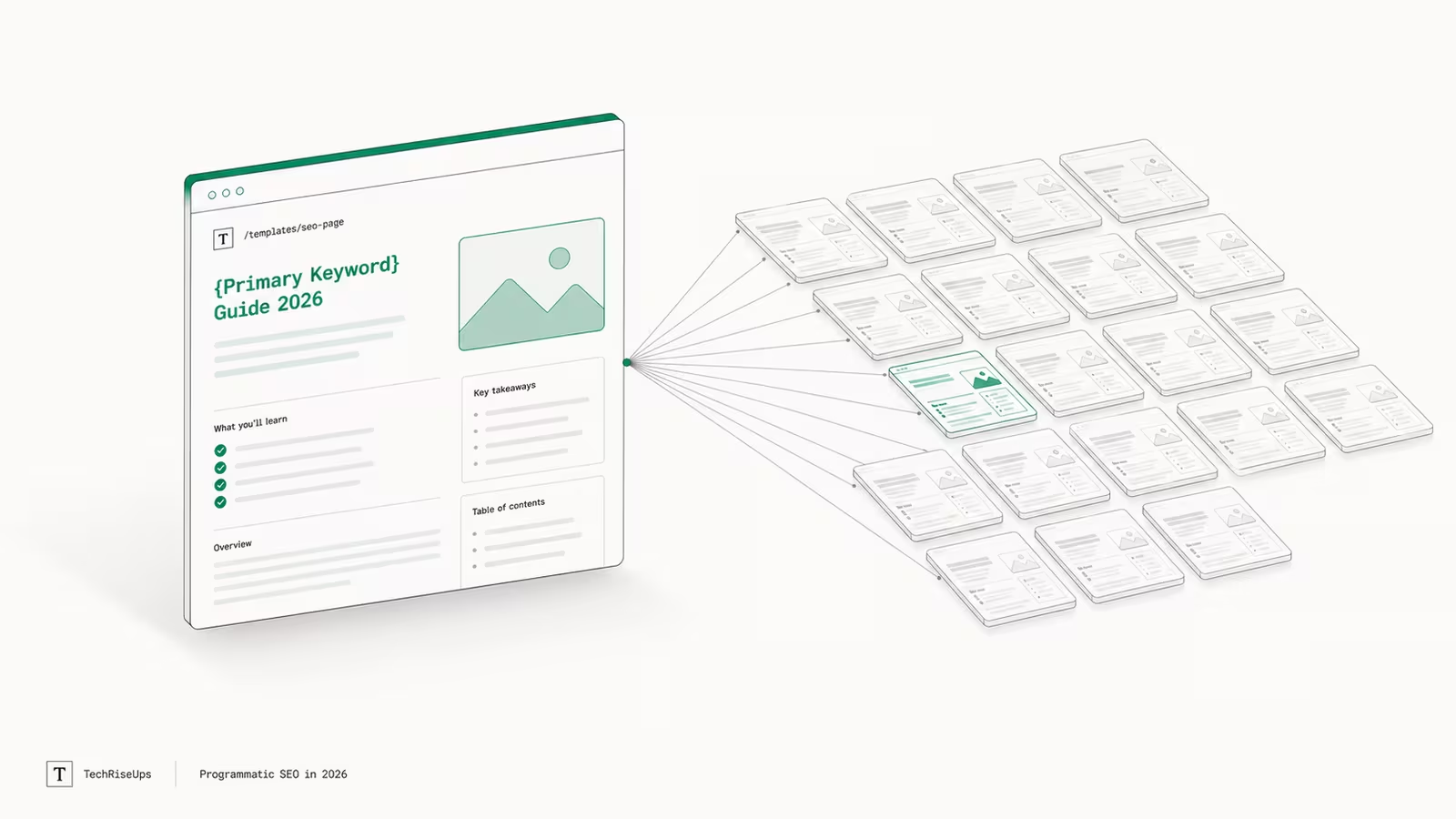
Programmatic SEO is the practice of using a template plus a structured dataset to publish many pages at once, each targeting a different long-tail query. Think of Zapier's "connect X to Y" pages or Wise's currency-conversion pages: one page design, thousands of variations, filled from a database. Done well, it captures search demand no team could write by hand. Done badly in 2026, it is the fastest way to get an entire domain buried by Google's scaled content abuse policy. This guide covers what programmatic SEO is, how to build it, the examples that still work, and where the line now sits between "scaled" and "spam."
We run TechRiseUps on an automated content engine ourselves, built with Claude Code and DataForSEO for keyword and SERP research, with a review gate before anything publishes. So the trade-offs below are the ones we actually work with, not a whiteboard theory.
What is programmatic SEO?
Programmatic SEO (sometimes "pSEO") generates a large set of pages from a single template and a dataset, instead of writing each page individually. The template defines the layout, headings, and copy skeleton; the dataset supplies the unique values (a city, a product, a currency pair, a "tool A vs tool B" combination). A build step merges the two into hundreds or thousands of URLs, each mapped to one specific search query.
The mechanism is the same one behind most large directories, marketplaces, and comparison sites. It only works when two things are true: the underlying keywords follow a repeatable pattern with real search volume ([job] salary in [city], [software] alternatives), and you have a genuinely useful dataset to fill each page. Automation handles the publishing; it does not create the value. That distinction is the whole game, and it is where most programmatic projects quietly fail.
Programmatic SEO vs regular SEO: what's the difference?
Regular (editorial) SEO produces pages one at a time, each hand-written for a specific topic. Programmatic SEO produces pages in bulk from a shared template and a data source. They are not rivals; most healthy sites use both, editorial for depth and authority, programmatic for coverage at scale.
| Editorial SEO | Programmatic SEO | |
|---|---|---|
| Unit of work | One page, hand-written | One template + a dataset row |
| Scales to | Tens of pages | Hundreds to millions |
| Best for | Depth, authority, nuanced topics | Repeatable patterns with data |
| Main risk | Slow, labour-intensive | Thin, duplicative pages |
| Ranking edge | Expertise and originality | Unique data and structure |
The practical rule: reach for programmatic SEO when you can answer the same shape of question hundreds of times with different data. Reach for editorial SEO when each answer needs original judgement. If you're weighing content-optimization tooling for the editorial side, we compared options in our best Surfer SEO alternatives guide.
Programmatic SEO examples that actually work
The sites people cite as pSEO wins all share one trait: proprietary or hard-to-copy data behind each page. Per Ahrefs' teardown, Wise runs roughly 14,888 currency-conversion pages pulling an estimated 4.6M monthly organic visits, Zapier has around 800,000 app-integration pages, and Nomadlist built about 25,000 city pages from its own cost-of-living dataset. Each URL answers a distinct query with live, specific numbers no competitor can trivially replicate.
Contrast that with a template that swaps only a city name into otherwise identical boilerplate. The first group ships a real answer per page; the second ships the same page a thousand times. Google's systems have gotten very good at telling those apart. When you plan a programmatic project, start from the dataset, not the template: if the data isn't unique or genuinely useful per row, the project is a liability before you write a line of code.
How to do programmatic SEO in 2026: a 5-step workflow
The workflow is mechanically simple; the discipline is in the data and the quality bar. These five steps are the core loop.
- Find a keyword pattern that scales. Use a keyword tool to confirm a repeatable modifier has real volume across many variants, not one head term with a long, empty tail. A pattern with 300 variants averaging 40 searches a month beats one with 3,000 dead variants.
- Secure a unique dataset. Source proprietary data, a licensed feed, an API, or first-party data you can legitimately structure. This is the moat and the step most projects skip.
- Design the template around the query. Each page must fully answer its specific query above the fold: the data point, the context, and a clear next step. Write real intro and supporting copy, not just a data dump.
- Build and publish. Merge data into the template via your CMS, a static-site generator, or an import tool. Generate clean, descriptive URLs and unique title tags and meta descriptions per page.
- Manage indexing and monitor. Submit an XML sitemap, watch Search Console for coverage and quality signals, and prune or improve pages that attract impressions but no clicks. Roll out in batches so you can catch a quality problem at 200 pages, not 20,000.
Where programmatic SEO becomes scaled content abuse
This is the part the older guides gloss over, and it is now the most important part. Google's spam policies define scaled content abuse as producing many pages primarily to manipulate rankings rather than help users, and the policy applies regardless of whether the pages are written by humans, AI, or a template. Google's John Mueller has bluntly warned that programmatic SEO is "often just a fancy banner for spam."
Enforcement has sharpened, not softened. Google's March 2026 spam update was the fastest it has ever documented, wrapping in under a day — a sign these rollouts now land quickly and target exactly the bulk, low-value pages a careless programmatic project produces. The pattern that gets penalized is consistent: hundreds of near-duplicate pages, no editorial oversight, thin factual depth, and no first-hand value. The pattern that survives is the opposite: each page answers a distinct query no other page on your site already answers, backed by data worth publishing. If a human wouldn't find a given page useful on its own, it is a penalty risk no matter how it was generated.
Programmatic SEO in the AI-overview era
There's a second pressure on pSEO in 2026 that the classic playbook predates: AI Overviews and answer engines are intercepting the clicks that thin pages used to catch. A page that merely repeats commodity facts now loses twice, once to the ranking filter and once to the AI summary above the results. The programmatic pages that still earn traffic are the ones with data specific enough that an AI Overview, ChatGPT, or Perplexity has to cite the source to answer.
That reframes the quality bar as an opportunity. Structure each page as a self-contained, extractable answer: a clear question-shaped heading, the unique data point stated plainly, and a short comparison or context block an engine can quote. This is the overlap between programmatic SEO and generative engine optimization and answer engine optimization — the same unique-data discipline that satisfies Google's spam bar is what gets a page cited by AI. Build for the citation, and the ranking tends to follow.
Tools you'll actually need
You can run a programmatic project with a spreadsheet and a CMS, or with a full code pipeline. The stack matters less than the data. A typical setup:
- Keyword research: an SEO suite (Ahrefs, Semrush, or a data source like DataForSEO) to validate the pattern and volume.
- Data store: Google Sheets or Airtable for small sets; a real database for anything above a few thousand rows.
- Build/publish: a CMS with a bulk importer, a static-site generator (Next.js, Astro, Hugo), or a spreadsheet-to-site tool.
- Monitoring: Google Search Console for indexing and quality signals, plus rank tracking.
The unglamorous truth is that budget goes into sourcing and cleaning data and into a human review step, not into the automation. That is exactly the ratio Google's 2026 policies reward.
FAQ
What does programmatic SEO mean? It means generating many web pages from one template combined with a structured dataset, so each page targets a different long-tail keyword automatically. The automation handles publishing at scale; the value still comes from the data and copy on each page.
What is the difference between programmatic SEO and SEO? Regular SEO creates pages one at a time, each hand-written for a topic. Programmatic SEO mass-produces pages from a template and a data source. Most sites use both — editorial content for authority and depth, programmatic content for wide coverage of a repeatable query pattern.
What is an example of programmatic SEO? Wise's currency-conversion pages, Zapier's app-integration pages, and Nomadlist's city pages are classic examples. Each publishes thousands of URLs from a template, but every page carries unique, useful data, which is why they rank instead of getting flagged as thin content.
Is SEO dead or evolving in 2026? Evolving. AI Overviews and Google's scaled-content crackdown killed the spray-and-pray model, but pages built on unique data that answer a distinct query still rank and increasingly get cited by AI engines. The bar rose; the opportunity didn't disappear.
Sources
- Google Search Central — Spam policies for Google web search: the official scaled-content-abuse and site-reputation-abuse definitions.
- Google Search Central — Updating our site reputation abuse policy (Nov 2024): the policy update that formalized enforcement.
- Ahrefs — Programmatic SEO, explained for beginners: example sites, page counts and traffic estimates, and the John Mueller "spam" quote.
- Semrush — What is programmatic SEO?: the template-plus-database workflow and pros/cons.
- SEO-Kreativ — Google March 2026 spam update, completed: timing and impact of the fastest-documented spam update.
Some links may earn us a commission at no extra cost to you.

Waqas Ahmed Waseer
Waqas Ahmed Waseer is a developer and automation builder with 8+ years shipping production systems used by 100k+ people. He builds custom multi-tenant SaaS, AI automation (n8n, LLM workflows, WhatsApp bots) and hosting infrastructure (WHM/cPanel, CloudLinux) — and is the maker of WaSphere, FlowMaticX, and the WaseerHost hosting brand. 100+ projects delivered for SMBs, agencies and funded startups.