Ranking #1 used to be the whole game. Win the top blue link, win the click. That bargain is breaking.
Google's AI Overviews now show up on roughly 48% of all searches as of March 2026, up from 34.5% in December 2025, according to SQ Magazine's tracking. And when that AI box appears, the click you fought for often evaporates. Pew Research, running the cleanest controlled study so far across 68,000 queries, found a 46.7% relative drop in clicks when an AI Overview is present. Ahrefs measured a 58% CTR hit on the top result. Seer Interactive, across 2.43 billion impressions, clocked it at 61%.
So here's the uncomfortable truth: you can rank #1 and still lose. The new prize isn't the link. It's the citation.
What GEO actually is
Generative Engine Optimization is the practice of getting your content pulled into and cited by AI answer engines: Google's AI Overviews and AI Mode, ChatGPT, Perplexity, Gemini, Copilot. Not ranked. Cited. Named as the source the model leaned on.
The term comes from a 2023 Princeton paper (Aggarwal et al., later published at KDD 2024) that ran 10,000 queries across 25 domains and tested what makes content show up in generated answers. The findings still hold up, and they're refreshingly specific:
- Adding statistics lifted visibility up to 32%
- Citing your own sources lifted it up to 30%
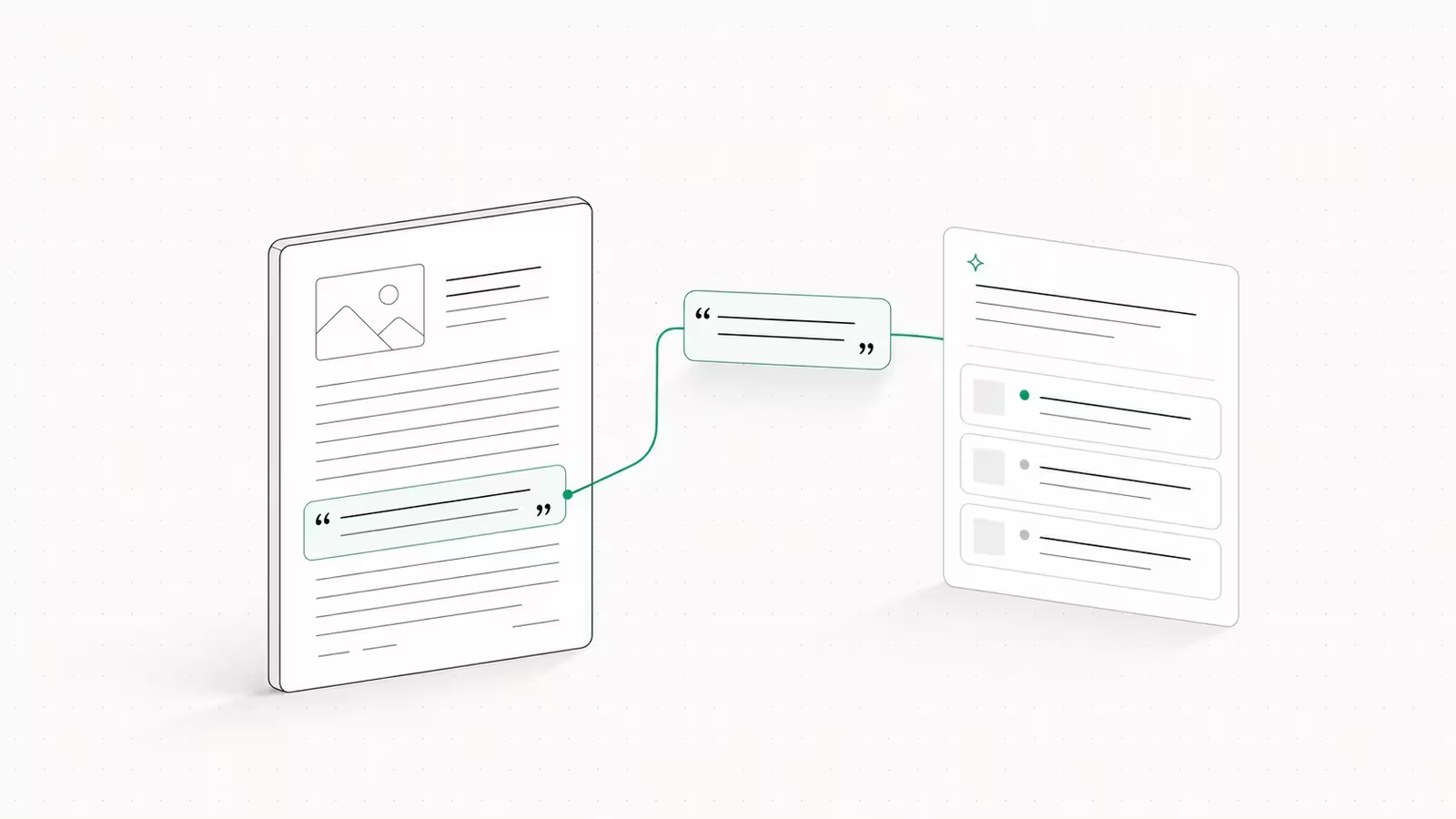
- Adding quotations lifted it up to 41%
- Cleaner, more fluent writing added 28%
Notice what's missing from that list: keyword stuffing, exact-match anchors, link spam. The old levers do almost nothing here.
Why the math is brutal
Google gives you ten blue links. An AI answer gives you two to seven. Analysis of citation data across the major engines shows LLMs typically reference just 2 to 7 domains per response. Ten slots became seven, then four. The funnel didn't shrink. It collapsed.
And the engines barely agree with each other. Only 11% of domains cited by ChatGPT also get cited by Perplexity. Google's own AI Overviews and AI Mode cite the same URL only 13.7% of the time. You're not optimizing for one algorithm anymore. You're optimizing for several that read the same web and reach different conclusions.
The plot twist: Google says GEO is "still SEO"
Here's where the hype meets a wall.
In May 2026, Google published its first official guide to optimizing for generative AI features. The headline message, repeated by John Mueller and covered by Search Engine Journal: "optimizing for generative AI search is optimizing for the search experience, and thus still SEO."
Then Google did something the GEO-tool vendors did not love. It ran a mythbusting section. Per the guide, you do not need:
- An llms.txt file
- Special content chunking
- Any AI-specific schema or markup
- AI-flavored rewrites of your pages
Google's reasoning is simple. Its AI features run on top of the same Search index and the same ranking and quality systems, using retrieval-augmented generation to pull from what's already indexed. If you're not crawlable, indexable, and genuinely useful, no magic file saves you. If you are, no magic file is needed.
So who's right, Google or the GEO industry? Both, partly. Google is right that there's no secret schema. But the GEO crowd is right that the strategic target moved. You're now writing to be extracted and quoted, not just ranked and clicked. Same fundamentals, different finish line.
One caveat on the llms.txt debate: Google says it ignores the file, and there's no evidence ChatGPT or Perplexity reward it either. If you've added one, fine, it costs nothing. Just don't believe it's doing work. It isn't.
What actually gets you cited
Strip away the noise and the same signals keep surfacing across the Princeton research, Search Engine Land's 2026 GEO guide, and the citation studies.
Say something only you can say. AI engines have a hundred lookalike articles to choose from. Give them a reason to pick you: original research, proprietary data, a benchmark, a framework built from real experience, a number nobody else published. Commodity content gets summarized into oblivion. First-hand information gets named.
Front-load the answer. Models extract passages, not whole pages. Put the direct answer in the first two sentences under a heading, then expand. A question as an H2 followed by a tight 40-to-60-word answer is the single most extractable shape on the web right now.
Back claims with stats and cited sources. This is the Princeton finding made practical. Quote experts. Link out to real data. The same moves that make a human trust you make a model quote you.
Keep it fresh and dated. AI engines weigh recency hard. A 2024 guide with no updates loses to a 2026 one on the same topic. Add a visible "Last updated" line and actually update the thing. Don't fake the date; refresh the substance.
Earn mentions off your own site. Reddit, YouTube, industry roundups, and third-party reviews feed these models constantly. Being talked about elsewhere is a citation signal in its own right. Wikipedia, Reddit, LinkedIn, and YouTube punch far above their weight in citation data.
The payoff is real, not theoretical. Brands cited inside an AI Overview earn about 35% more organic clicks than non-cited brands on the same page. The citation is the new click.
The engines don't read the web the same way
Treating ChatGPT, Perplexity, and Google AI Overviews as one target is the most common GEO mistake I see. They source differently, and a page that wins one can be invisible in another.
Perplexity is the most link-hungry of the three. It cites generously, surfaces sources inline, and leans on fresh, well-structured pages. If you publish original data, Perplexity tends to find and name you fastest.
ChatGPT with web search pulls from a narrower set and rewards authority and brand mentions across the wider web. It's the engine where being talked about on Reddit, in reviews, and in roundups pays off most. Its citation set overlaps with Perplexity only about 11% of the time, so winning one tells you little about the other.
Google's AI Overviews and AI Mode sit on top of the Search index, which is why Google insists it's still SEO. But even these two Google products disagree with each other, citing the same URL only 13.7% of the time. Strong classic rankings help, yet they don't guarantee a citation in either box.
The practical move: don't chase one engine. Write the most quotable, best-sourced answer on the open web, then track all three separately. What you optimize stays the same. Where you show up will differ, and that's fine.
Do this now: a one-week GEO checklist
No theory. Pick your ten most important pages and run them through this:
- Add a direct answer in the first 2 sentences under each main heading. 40 to 60 words. No throat-clearing.
- Inject at least one original stat or data point per cornerstone page, with a source link.
- Turn key sections into question-shaped H2s that match how people actually ask.
- Confirm AI crawlers can reach you. Check robots.txt isn't blocking GPTBot, PerplexityBot, or Google-Extended unless you mean to block them.
- Add or fix Article/FAQ schema for clean machine reading. Not for AI specifically, Google says it's not required, but it still helps real Search.
- Stamp a real "Last updated" date and refresh stale numbers.
- Strengthen E-E-A-T: named authors, bios, credentials, citations. Show the experience.
- Track your citations. Tools like Profound, Peec AI, and SE Ranking now monitor how often you show up in ChatGPT, Perplexity, Gemini, and AI Overviews. You can't improve what you don't measure.
The contrarian takeaway
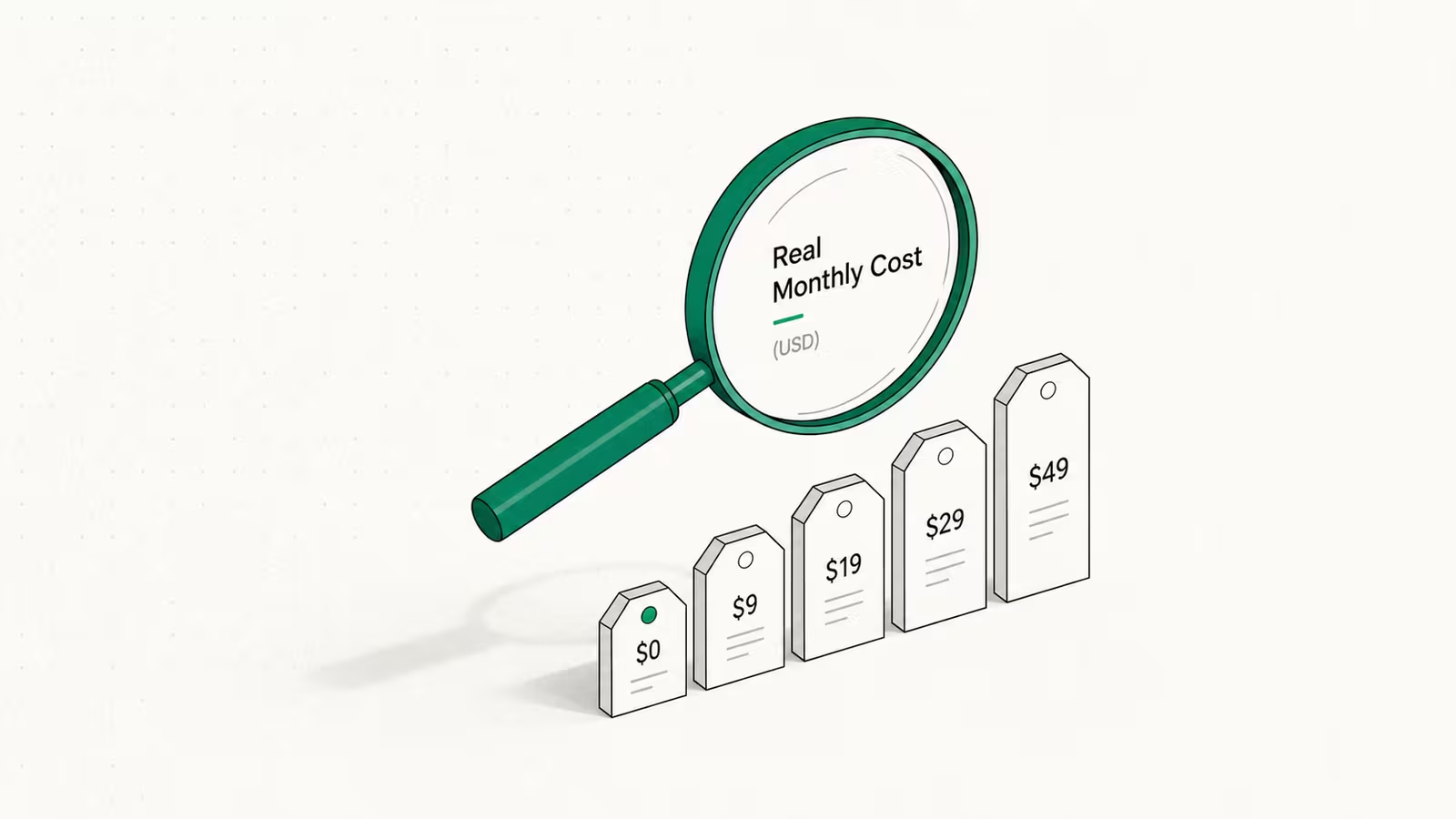
Most GEO advice in 2026 is selling you a new file format or a $200/month dashboard. Skip it. The engines reward what good editors always rewarded: a clear claim, backed by evidence, written by someone who clearly knows the subject, and kept current.
The shift that matters isn't technical. It's strategic. Stop asking "how do I rank?" Start asking "would a model quote this sentence?" If your page is the most quotable answer on the open web, you'll get cited across Google, ChatGPT, and Perplexity without a single trick.
Ranking #1 was a position. Getting cited is a reputation. Build the second one, and the first stops mattering so much.
Some links may earn us a commission at no extra cost to you.

Waqas Ahmed Waseer
Waqas Ahmed Waseer is a developer and automation builder with 8+ years shipping production systems used by 100k+ people. He builds custom multi-tenant SaaS, AI automation (n8n, LLM workflows, WhatsApp bots) and hosting infrastructure (WHM/cPanel, CloudLinux) — and is the maker of WaSphere, FlowMaticX, and the WaseerHost hosting brand. 100+ projects delivered for SMBs, agencies and funded startups.