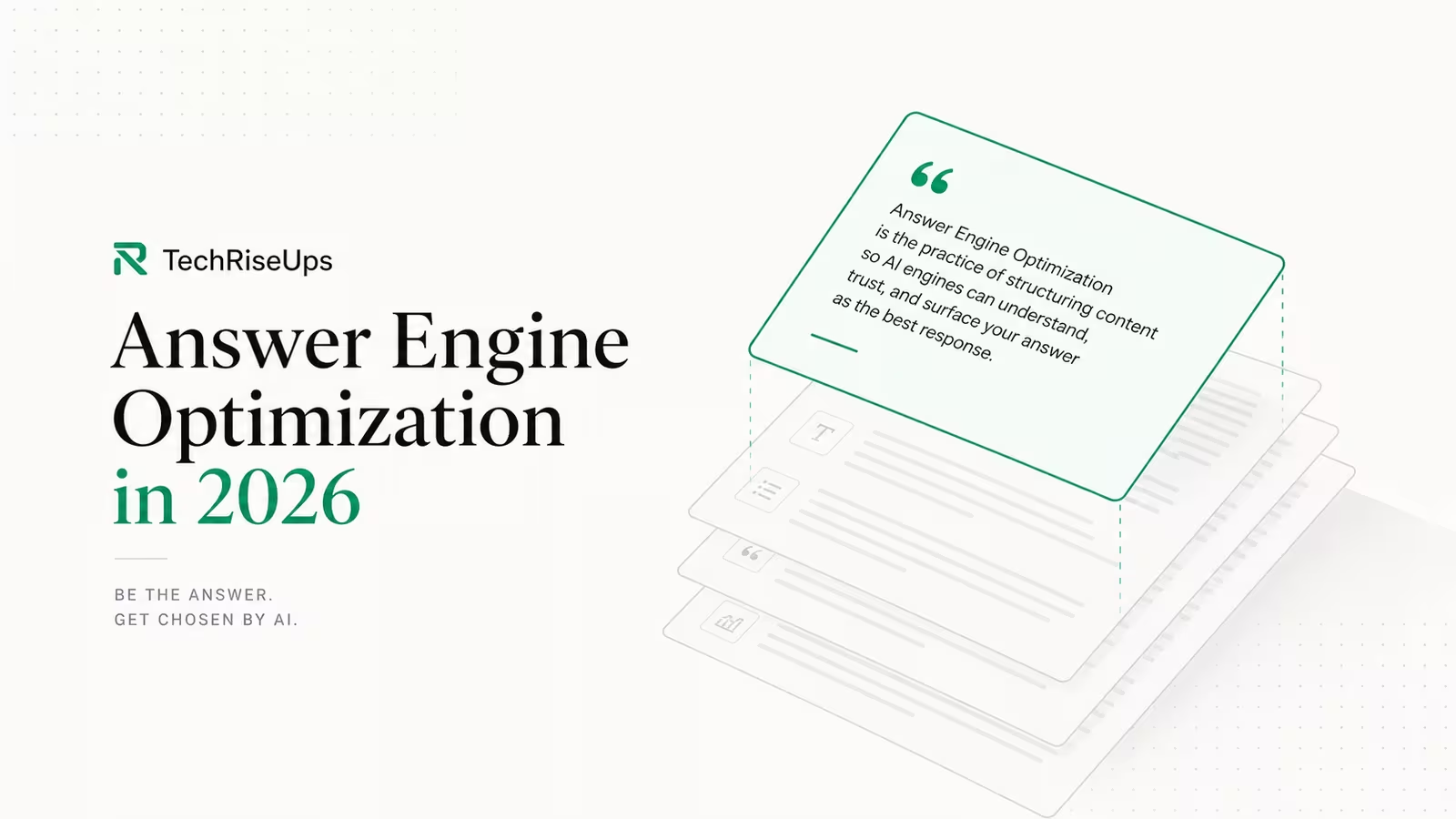
Answer engine optimization (AEO) is the practice of structuring your content so answer engines — Google's AI Overviews, ChatGPT, Perplexity, and voice assistants — can extract it and serve it as the direct answer, ideally with your brand named as the source. It is what you optimize for when the goal stops being a click and becomes being the quoted answer. That shift is not hypothetical: as of 2026, roughly a quarter of organic search traffic is expected to move to AI assistants, and the majority of Google searches already end without a click. Where SEO won you a blue link, AEO wins you the answer itself.
We build the TechRiseUps content pipeline with Claude Code, and every article we publish is written as a set of self-contained, extractable answer blocks for exactly this reason. This is the practical version of what we apply: what AEO actually is, how it differs from SEO and from generative engine optimization, a step-by-step checklist, and the 2026 data on whether it pays off.
What is answer engine optimization?
Answer engine optimization is the discipline of making your content the source an AI answer engine quotes when it responds to a query. An "answer engine" is any system that returns a synthesized answer instead of a list of links: Google's AI Overviews and AI Mode, ChatGPT search, Perplexity, Gemini, and voice assistants. AEO does not try to rank a page at position one so a human clicks it. It tries to get a specific passage of your content lifted into the machine's answer, with attribution, so your brand appears at the moment of decision even in a zero-click result.
In practice that means writing content a model can parse, trust, and reuse without ambiguity: direct answers stated up front, clear question-shaped headings, structured data, and strong authority signals. The core keyword — answer engine optimization — sits alongside classic SEO rather than replacing it, because the engines still pull most of their answers from pages that already rank well.
AEO vs SEO vs GEO: the distinction most guides skip
Most articles treat AEO, SEO, and GEO as synonyms. They are not, and knowing the difference tells you what to actually change.
| Discipline | Goal | Optimizes for | You win when… | Main surfaces |
|---|---|---|---|---|
| SEO | Rank a page, earn the click | Keywords, links, page authority | You hold a top organic position | Google/Bing blue links |
| AEO | Be quoted as the answer | Extractable answers, schema, clarity | An engine lifts your passage into its reply | AI Overviews, Perplexity, voice, featured snippets |
| GEO | Be mentioned across a generated response | Brand presence, citations, corpus coverage | A model name-drops or cites you in synthesis | ChatGPT, Gemini, Claude, long-form AI answers |
The clean way to hold them apart: AEO is about winning one specific answer to one specific question — it is the direct descendant of the featured-snippet game. GEO is about how often models mention and cite your brand across many generated responses, which depends as much on your overall footprint and reputation as on any single page. SEO is still the foundation both stand on — 99% of the URLs that show up in Google's AI Mode already rank in the top 20 organic results. If you want the full picture on the generative side, our guide to generative engine optimization covers it in depth; this piece stays focused on winning the answer.
How to do answer engine optimization: a practical checklist
You can start applying AEO to an existing page today. Work in this order, highest-leverage first:
- Answer the question in the first 40–60 words. Answer engines extract the tightest, clearest passage that resolves the query. Put a complete, standalone answer directly under the heading before any preamble — HubSpot's own guidance is to lead with the core answer in the first 40–60 words. No "in this article we will."
- Use question-shaped headings. Match how people phrase things to an assistant: "What is X?", "How do you do X?", "Is X worth it?" Each heading should be answerable on its own.
- Make every section self-contained. Write each section as one extractable block of roughly 120–170 words that fully answers its heading — state the what, the number, the trade-off, and the context in one place. Engines quote contiguous passages, not scattered fragments.
- Add structured data. FAQ, HowTo, and Article schema tell the machine what your content is. Structured markup is one of the most consistent signals across answer-engine guidance.
- Format for extraction. Short paragraphs, bullet lists, and at least one comparison table. Tables and lists are the formats engines lift most readily.
- Build entity and author signals. Show author names, credentials, and dated timestamps on-page. Answer engines weight trust heavily, so display update dates and named authors and keep facts current.
- Earn mentions off-site. Contribute genuinely useful answers on Reddit, industry publications, and reference sites. Models are trained and grounded on those corpora, so a citation there feeds back into what they say about you.
- Keep the classic SEO fundamentals. Fast, crawlable pages that already rank are the raw material answer engines pull from. AEO is an addition to technical SEO, not a replacement — the same crawlability and indexing hygiene that lets Google read you lets AI crawlers read you, which is also why a well-formed llms.txt file is worth understanding.
Does answer engine optimization actually work?
The early data says the traffic is smaller but far higher quality. Click-through volume from AI answers is lower by design — many results are zero-click — but the visitors who do come through convert unusually well. In one analysis cited by Forbes, traffic from ChatGPT-style experiences converted up to nine times better than traditional search (a June 2025 study). The reason is intent: someone who arrives after an AI has already vetted and recommended you is much closer to a decision than someone scanning ten blue links.
The catch is measurement. AI answers are personalized and vary between users, so third-party "visibility dashboards" are noisy. The pragmatic move is to watch referral and direct traffic from ChatGPT, Perplexity, and Gemini in your analytics, and track how often your brand is cited for the queries you care about, rather than chasing a single rank number.
What are the best answer engine optimization tools?
There is no single winner yet; the category is young and splits by job. For tracking whether AI engines cite you, dedicated AI-visibility trackers (such as Profound and Ahrefs' Brand Radar) monitor mentions across ChatGPT, Perplexity, and AI Overviews. For the content work itself, established SEO suites — Semrush, Ahrefs, Frase, Surfer — have added AEO features on top of their keyword and content tooling. Because AEO leans so heavily on schema and clean structure, a schema generator plus your existing analytics covers most of the fundamentals before you pay for anything specialized. Pick based on the job you actually need: measurement versus content production.
FAQ
How do you do answer engine optimization? Lead every page with a direct 40–60 word answer, use question-shaped headings, add FAQ and Article schema, format with lists and tables so passages are easy to extract, show author and date signals, and keep the underlying page fast and well-ranked. AEO is applied on top of solid SEO, not instead of it.
What is AEO vs SEO? SEO optimizes to rank a page and earn a click; AEO optimizes to be quoted as the answer inside an AI or voice result, where there may be no click at all. SEO measures rankings and traffic; AEO measures citations and mentions. They complement each other — engines mostly pull answers from pages that already rank.
What's the best answer engine optimization tool? It depends on the job. Use an AI-visibility tracker (Profound, Ahrefs Brand Radar) to see whether engines cite you, and a content/SEO suite (Semrush, Frase, Surfer) plus a schema generator to do the optimization. No single tool covers both well yet.
Will SEO be replaced by AI? No. It is changing, not disappearing. Answer engines still source the vast majority of their answers from pages that rank in organic search, so classic SEO remains the foundation. AEO and GEO are new layers on top of it, aimed at winning the answer and the mention rather than only the click.
Sources
- Profound — What is Answer Engine Optimization?: AEO definition, the ~25% traffic shift by 2026, and the finding that 99% of AI Mode URLs already rank in the top 20.
- HubSpot — AEO Guide: best practices, the 40–60 word direct-answer rule, and trust/author signals.
- Forbes — Answer Engine Optimization: What Brands Need To Know: the ~9x conversion advantage of AI-driven traffic (June 2025).
- GoodFirms — AI SEO Statistics 2026: zero-click and AI Overview adoption data for 2026.
Some links may earn us a commission at no extra cost to you.

Waqas Ahmed Waseer
Waqas Ahmed Waseer is a developer and automation builder with 8+ years shipping production systems used by 100k+ people. He builds custom multi-tenant SaaS, AI automation (n8n, LLM workflows, WhatsApp bots) and hosting infrastructure (WHM/cPanel, CloudLinux) — and is the maker of WaSphere, FlowMaticX, and the WaseerHost hosting brand. 100+ projects delivered for SMBs, agencies and funded startups.