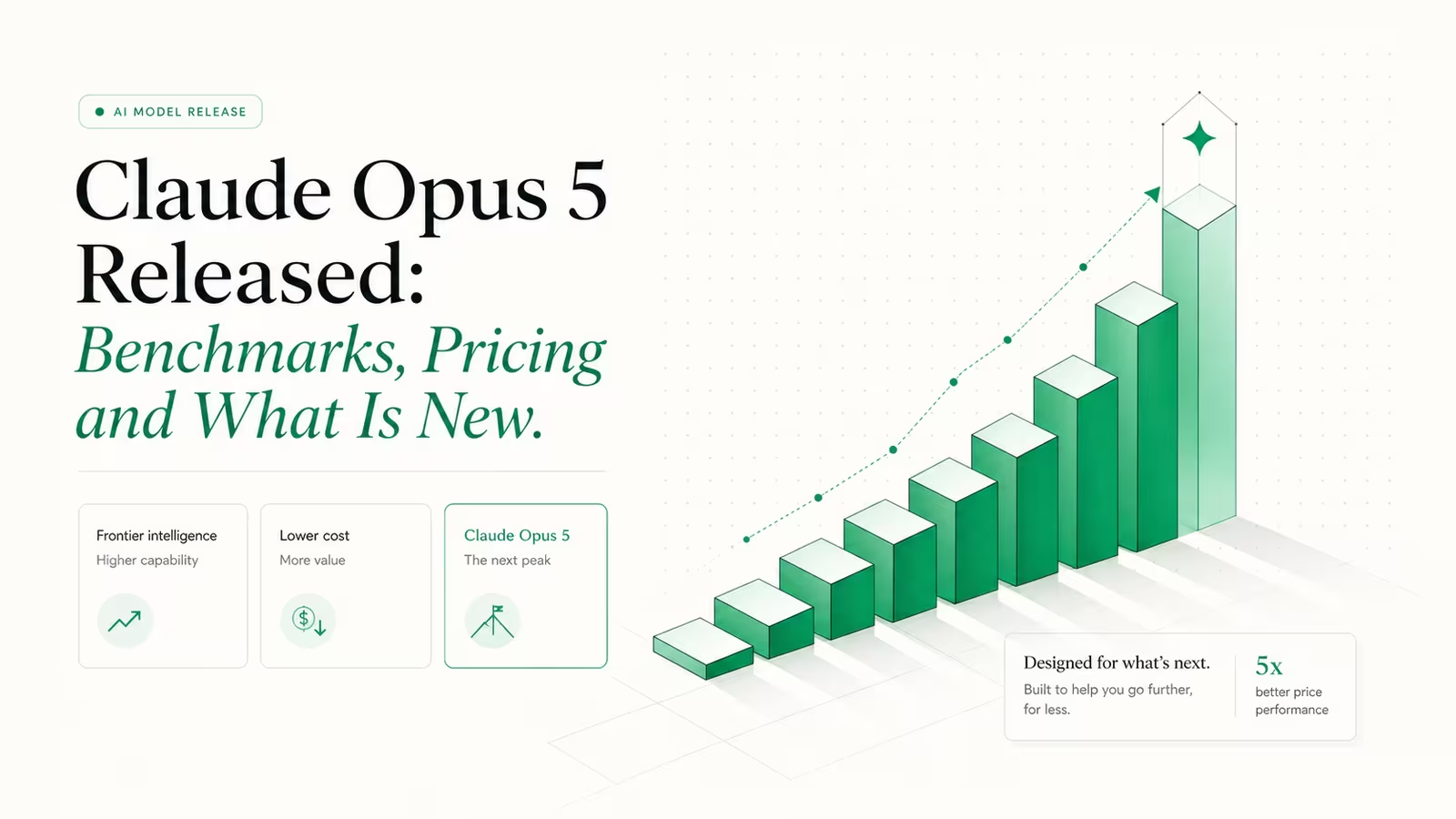
Anthropic released Claude Opus 5 on July 24, 2026, and the headline is simple: it lands close to the intelligence of the company's most capable public model, Claude Fable 5, while costing half as much per task and keeping Opus pricing flat at $5 per million input tokens and $25 per million output tokens. It ships as the new default on Claude Max, the strongest model on Claude Pro, and via the claude-opus-5 API string across Claude Code, Claude Cowork, and the Messages API.
This is a genuine flagship step, not a point release. On agentic coding and computer-use benchmarks Anthropic now calls Opus 5 its state-of-the-art model, and independent write-ups from launch day line up with that framing.
What is Claude Opus 5?
Claude Opus 5 is Anthropic's frontier model for coding, autonomous agents, and complex knowledge work, released July 24, 2026. It keeps a 1 million-token context window as both the default and maximum, with no smaller variant, and supports up to 128,000 tokens of synchronous output on the Messages API. The pitch is efficiency at the top of the range: Anthropic says Opus 5 reaches near-Fable 5 quality at roughly half Fable 5's price, which reframes "use the best model" from an occasional splurge into an everyday default.
The other structural change is a five-level effort control. Instead of one setting, you dial how hard the model works, from lighter passes up through high, xhigh, and max. Higher effort spends more output tokens for better results on hard problems; lower effort keeps latency and cost down for routine work. Anthropic pairs this with a fast mode that runs about 2.5× quicker than the default at roughly twice the cost, so teams can trade money for speed when a task is latency-sensitive.
The benchmarks that matter
Anthropic and launch-day coverage frame Opus 5's wins as agentic rather than raw trivia. The clearest signals:
| Benchmark | Claude Opus 5 | Context |
|---|---|---|
| SWE-bench Verified | ~96.0% (5-trial avg) | real-world software fixes |
| OSWorld 2.0 (computer use) | 70.57% | beats Fable 5's best at ~1/3 the cost |
| ARC-AGI-3 | ~30.2% | ~3× the next-best model |
| Zapier AutomationBench | 26.0% | ~1.5× the next-best model |
| Frontier-Bench v0.1 | 43.3% max effort (44.4% at xhigh) | 74-task Terminal-Bench 2.1 successor |
On Anthropic's aggregate knowledge-work set, Opus 5 scored about 53.4, essentially tied with Fable 5 at 53.5 and comfortably ahead of Opus 4.8 at 46.5 and GPT-5.6 at 47.5. The SWE-bench Verified figure near 96% puts it at the front of the pack for automated code repair. The honest caveat Anthropic states itself: Opus 5 still trails Mythos 5 on cybersecurity-specific tasks, so it is not a clean sweep.
Benchmarks are directional, not gospel. What they signal here is consistent: the biggest jumps are in tasks where the model has to act over many steps, use tools, and check its own work, rather than answer a single question.
What actually changed for builders
Three practical shifts stand out beyond the scores.
It verifies its own work. Anthropic highlights that Opus 5 is markedly better at checking outputs and iterating until a task genuinely passes, instead of stopping at a plausible-looking answer. For agent loops, that reduces the number of babysitting turns a human has to spend catching silent failures.
Two new beta reliability features. Opus 5 introduces automatic fallbacks and the ability to change tools mid-conversation. Automatic fallbacks let an API request degrade gracefully under load rather than hard-fail, and mid-conversation tool changes let a long-running agent swap its toolset without restarting the session. Both target the same pain point: keeping long agentic runs alive.
Cost control is now a dial, not a guess. Between the five effort levels and fast mode, teams can tune spend per task class. Cheap, high-volume calls run at low effort; a gnarly refactor runs at max. That granularity is the quiet enterprise story, and it is why several launch-day analyses framed Opus 5 as much about the bill as the benchmarks.
For anyone already living in an agentic workflow, this matters more than a leaderboard number. In our own headless Claude Code automation, the cost-per-task and self-verification behavior of the underlying model drive how much you can safely run unattended, which is exactly what Opus 5 is tuned to improve.
Pricing and availability
| Attribute | Detail |
|---|---|
| Release date | July 24, 2026 |
| API model ID | claude-opus-5 |
| Input price | $5 / million tokens |
| Output price | $25 / million tokens |
| Context window | 1,000,000 tokens |
| Max output | 128,000 tokens |
| Where | Claude.ai, Claude Code, Claude Cowork, Claude API |
| Plans | Default on Max, strongest on Pro |
The key economic point is that pricing did not rise versus Opus 4.8 despite the capability jump. Anthropic's positioning, "frontier intelligence at half the price" of Fable 5, is a deliberate move to make the top-tier model the one you reach for by default rather than only for hard problems. If you pick models by cost-per-solved-task, see how the math shifts in our best AI model for coding in 2026 breakdown.
Should you switch to Opus 5?
If you run agents, write code, or do multi-step knowledge work, yes, testing it is worth the hour. The combination of near-Fable 5 quality, unchanged Opus pricing, stronger self-verification, and per-task effort control makes it the sensible new default for most production workloads on the Claude platform. The two reasons to hold off: security-heavy pipelines where Mythos 5 still leads, and anything where you have already validated a specific model against a specific eval and changing it introduces regression risk.
FAQ
How good is Opus 5? By Anthropic's numbers it is state-of-the-art on agentic coding and computer-use tasks, roughly 96% on SWE-bench Verified and 70.57% on OSWorld 2.0, and it ties Fable 5 on Anthropic's aggregate knowledge-work set (53.4 vs 53.5). It trails the specialized Mythos 5 on cybersecurity work.
Is Opus 5 available?
Yes. It launched July 24, 2026 on Claude.ai, Claude Code, Claude Cowork, and the Claude API under the model ID claude-opus-5. It is the default model on Claude Max and the strongest option on Claude Pro.
Is Opus 5 better than Fable 5? Not more capable, roughly equal, at about half the cost. Anthropic positions Opus 5 as reaching close to Fable 5's frontier intelligence while being far cheaper per task, which for most workloads makes it the better practical pick. Fable 5 remains the top-end ceiling.
What is special about Claude Opus? Opus is Anthropic's most capable model tier, aimed at coding, agents, and hard reasoning. Opus 5 specifically adds a five-level effort control, a fast mode at 2.5× speed, stronger self-verification, and a 1M-token context, at the same price as the previous Opus generation.
Sources
- Anthropic — Introducing Claude Opus 5 — official announcement, pricing, availability, effort control
- Anthropic — Claude Opus 5 System Card (PDF) — primary safety and capability documentation
- VentureBeat — Anthropic launches Claude Opus 5 — context window, output limit, benchmark comparisons
- MarkTechPost — Meet the New Claude Opus 5 — SWE-bench Verified and agentic benchmark detail
- Codersera — Claude Opus 5 Benchmarks Explained — Frontier-Bench v0.1, ARC-AGI-3, effort-level results
Some links may earn us a commission at no extra cost to you.

Waqas Ahmed Waseer
Waqas Ahmed Waseer is a developer and automation builder with 8+ years shipping production systems used by 100k+ people. He builds custom multi-tenant SaaS, AI automation (n8n, LLM workflows, WhatsApp bots) and hosting infrastructure (WHM/cPanel, CloudLinux) — and is the maker of WaSphere, FlowMaticX, and the WaseerHost hosting brand. 100+ projects delivered for SMBs, agencies and funded startups.